Joe's Barbershop
The Other Black GirlJoe's Barbershop is more than a neighborhood business: it is a recurring meeting place for the Resistance, where secrecy, shared investigation, and disagreements over strategy take shape. Its ordinary identity as a barbershop sits beside its less visible role as a gathering point—sometimes after closing, at hours that make the group’s caution palpable. In Shani Edmonds’s visits, the shop becomes the threshold through which she enters the Resistance and later a setting for its continuing deliberations about Nella Rogers, Hazel-May McCall, and the spreading OBG phenomenon.
Setting and Physical Details
Joe's Barbershop is in Harlem, New York. Shani Edmonds first approaches it late at night on July 10, 2018, after a forty-five-minute cab ride during which she searches online for information about Lynn Johnson and the Resistance without finding answers. The shop is supposed to be closed, and the hour—three in the morning—makes the invitation to come inside feel at once welcoming and unsettling. At the nearby corner of 127th and Frederick Douglass, a car revs its engine in vain as Shani weighs the promise of family against the strangeness of meeting in a closed barbershop in an unfamiliar part of the city.
The entrance marks a boundary between public street and concealed meeting space. A man at the door looks Shani over, then reassures her that those inside are family and invites her in. The welcome does not immediately dispel her unease; she is new to Harlem and has no online information to confirm what she is walking into. The location’s atmosphere is therefore built through a contrast: the language of kinship offers a promise of belonging, while the closed shop, the hour, and the unknown people make entry an act of trust.
The interior is not fully revealed at once. Shani is told that the lights will remain off until they are upstairs, where a flashlight provides a limited beam. Someone guides her by the shoulders through the dark, and she follows despite imagining dangers she cannot see. The dark passage makes the upstairs room feel like a space reached through deliberate concealment, not simply the back room of a business. On a later visit, Shani encounters crowded purple-gray walls covered with photographs of Black activists. Malcolm X appears especially often; the images include familiar historical photographs as well as contemporary pop-art and comic-book treatments. One prominent image places Malcolm X in a pose of reflection, painted in red, white, and blue, beside a postcard-sized rendering of the Obama HOPE poster. The room’s decoration gives the meeting place a visible political history, distinct from the secrecy of its entrance.
A Meeting Place for the Resistance
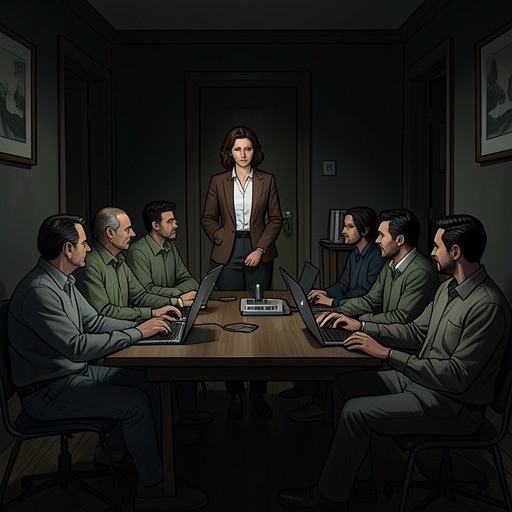
The barbershop is a practical base for the Resistance’s meetings. By September 27, 2018, Shani describes early-morning gatherings there twice a month, where Lynn Johnson reports what contacts monitoring other parts of the country have learned. The recurring schedule makes the shop a point of continuity: information gathered beyond Harlem is brought into the room, discussed, and placed within the group’s understanding of the threat. Joe's Barbershop is not merely where members happen to meet; it is where they assemble a dispersed picture of events.
Lynn Johnson also uses the shop to impress the Resistance’s most important precautions on Shani: avoid digital tracking and disclose nothing to outsiders. After Shani agrees to come to New York, Lynn spends an extended period explaining why she must promise to follow those rules. The restrictions frustrate Shani, who begins to question whether she wants to be involved with a group that is so guarded. The shop’s atmosphere of controlled access and darkness thus has a counterpart in the Resistance’s rules. Secrecy is not just a mood associated with the building; it shapes what members may say and how they communicate beyond it.
Intelligence, Reach, and Stakes
At the meetings, the Resistance’s reports give the shop a national horizon. Lynn Johnson says that when she first learned of OBGs five years earlier, sightings had been contained to a few northeastern cities: New York, Boston, and Philadelphia. By the time of Shani Edmonds’s account, reports place them as far south as Miami, as far north as Portland, and as far west as Los Angeles. The twice-monthly briefings transform a neighborhood location into a listening post for a phenomenon understood to be spreading across the country.
Joe himself contributes testimony drawn from outside the city. After visiting his daughter in California, he describes the change he believes has overtaken her: to him, it is as though part of the person he raised has been replaced by a false surface. He rejects the idea that her experience can be explained simply by Hollywood, pointing instead to the agent who has her auditioning for three slave roles in a single month. Lynn records details of the symptoms she asks him about, including a smile-and-nod, a helpless shrug, and a glassy-eyed stare. In this exchange, the shop is where a private family fear becomes part of the Resistance’s collective record—and where the group connects behavioral change to the racialized pressures facing Black women in the entertainment industry.
Strategy and Internal Tensions
Joe's Barbershop also hosts disagreement about how the Resistance should act. Shani wants the group to make a move concerning Nella Rogers and Hazel-May McCall, rather than remain in the shadows. Lynn Johnson argues for caution: Nella is still at Wagner Books and attended Hazel-May McCall’s event, so the group cannot yet assume she is safe. Lynn invokes earlier harms, including Shani’s experience at a magazine and the loss of her own medical-school opportunity, to explain why proximity to a suspected OBG is dangerous. She insists that the group knows why OBGs can change other Black women and must keep Nella at arm’s length.
For Shani, that caution has a personal cost. She says that being part of the Resistance’s spying has been an experience, but she does not want to keep sharing a room with Hazel-May McCall after what Hazel-May McCall did to her. She questions why she came to New York if the group will not act on the Nella-Hazel situation and considers redirecting her attention toward her own life. The exchange makes the barbershop a site not only of instruction and intelligence but also of friction over what collective responsibility requires. Lynn Johnson’s insistence on distance and Shani’s demand for action emerge from different experiences of risk, and the group’s meeting place holds both positions without resolving them immediately.
The next day, Lynn Johnson asks Shani to return to Joe's Barbershop after work, offering no explanation beyond the need to talk. Shani arrives expecting to be told that her time in the Resistance is over. Instead, she finds a silver-haired woman examining the room’s activist-covered walls; Lynn Johnson enters shortly afterward and recognizes that the two women have not yet met. The scene gives the shop another function: it is where members can be brought into contact, although the precise significance of this meeting is not established in the available account.
Narrative Significance
Joe's Barbershop gathers several scales of the story into one location. The late-night entrance and concealed upstairs room dramatize the Resistance’s guarded methods; the regular meetings connect Harlem to reports from distant cities; and conversations there reveal how broad suspicions become personal disputes over trust and action. Its political imagery makes the room’s commitments legible, while its restricted access keeps the group’s work apart from ordinary public life.
The shop’s importance also lies in the gap between welcome and knowledge. Shani is promised a family before she understands the organization, its history, or its rules. Later, she knows the rules and the reports, yet still questions whether the Resistance’s caution can meet the urgency of what is happening. Joe's Barbershop remains the concrete place where that evolving relationship is tested: a neighborhood business that serves, within the narrative, as a concealed meeting ground for shared evidence, recruitment, and unresolved strategy.