Kendra Rae’s First Hair-Conditioner Formula Trial
The Other Black GirlDiana Gordon’s first hair-conditioner formula trial with Kendra Rae Phillips is the origin point of a project meant to ease Black women’s passage through racism, and the moment that made its promise inseparable from risk. Diana remembers working the creamy formula into Kendra’s divided hair while trusting both Imani’s assurances and her own judgment. The result was far more disturbing than the mild temperamental change she had expected, and the memory returns years later as a warning about the cost of mistaking good intentions for control.
Purpose and Origins
The experiment grew out of Imani’s after-hours project, which she described to Diana as a way to make life a little easier for Black women across the country. Diana understood the aim not as an abandonment of Black pride, but as relief from having to work so hard against racism. That distinction mattered to her: the formula was supposed to help preserve pride, not erase it. Its rationale was practical and protective, even as its method involved intervening in another woman’s behavior through a hair product.
Diana brought the idea to Richard Wagner, who questioned whether a chemical that might not work could possibly fix everything. He was especially doubtful that it would affect a woman as stubborn as Kendra. Diana reassured him that she did not want Kendra to perform a caricature of Blackness; she wanted her to relax and regain her footing. Behind that appeal was a broader ambition Diana associated with Kendra’s advice to play the long game: to rise in publishing and perhaps eventually build an imprint, or even a Black publishing house. Richard’s support would help make the project possible, but Diana’s account also shows how she framed the intervention as temporary and strategic, a way to keep things on track until Black women gained more power.
The First Application
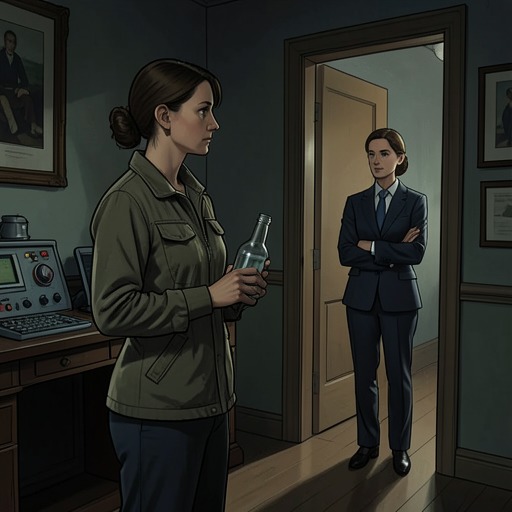
Diana’s memory fixes the treatment in physical detail. Kendra’s thick, dark hair was divided into eight parts, and Diana’s gloved hand worked the cool, creamy formula into it. Imani had promised that the batch would not burn. Diana had already tested a small amount with her pinky, but the precaution did not remove the uncertainty: she still hoped Kendra would not object to the smell, and she paused to ask whether the treatment felt all right.
Kendra trusted Diana to decide what came next, whether braids or curlers, while warning her not to make her look foolish. Diana promised she would not. Then she reached into Kendra’s hair, took a section by the root, and began, silently praying as she applied the formula. The scene’s intimacy is also its imbalance: Kendra gives Diana trust, while Diana and Imani hold the knowledge about the substance and its intended effect. The trial is therefore not simply a technical test. It is a personal act carried out under an assurance that neither woman can yet fully verify.
The Unintended Effect
Diana later recalls seeing Kendra’s face after the application: a sickly brown complexion, flat and glassy eyes, and a dull, monotonous voice. The change was meant to be purely temperamental, Imani had promised, but the visible and vocal result made that expectation feel dangerously inadequate. Diana describes herself and Imani as frighteningly optimistic at the time. They could not know that it would take Imani years to develop a less harsh formula.
The severity of the memory complicates Diana’s language of helping Kendra relax. In the conversation with Richard, she casts the goal as modest and reversible: ease Kendra’s tension, then return to normal. What she recalls instead is a bodily transformation whose effects exceeded that limited description. The discrepancy does not establish that Diana intended to harm Kendra; it does show that intention could not guarantee a controlled outcome. The formula’s promised gentleness and its eventual harshness remain side by side in her account.
Retrospective Meaning
Years later, as Diana prints a spreadsheet listing young Black women deemed in need of fixing, the sound of the machine brings Kendra’s altered face back to her. The memory interrupts the ordinary work of processing another list and links the early experiment to a continuing system of interventions. A later batch of the white, greasy substance, scented with honeysuckle, shows that the formula continued to be developed; Diana remarks that it has come a long way since the first one. Yet improvement does not erase the original trial or the years required to make the mixture less severe.
The episode also clarifies Diana’s dependence on Richard. When difficult assignments make her contemplate leaving, she remembers that he supported her after Kendra disappeared, connected her with a new publisher, and helped secure talk shows, television adaptations, and film deals. Most importantly, he funded the project after Diana persuaded him it could work. That history helps explain why she continues to feel bound to him, but it also gives the trial a wider consequence: a scheme presented as a route toward greater Black influence in publishing is sustained through Richard’s backing and through a product whose earliest effects Diana still finds frightening. The remembered application thus remains both the beginning of a hoped-for intervention and evidence of the danger built into it.