Needles and Pins
The Other Black GirlNeedles and Pins is Colin Franklin’s novel about the opioid crisis, a book whose topical subject and emotionally affecting passages coexist with a damagingly reductive portrayal of Shartricia Daniels. For Nella Rogers, an assistant editor at Wagner Books, the novel’s central significance lies in that contradiction: its treatment of a Black character turns a manuscript discussion into a confrontation over who gets to define representation, and what the publishing house means when it praises diversity.
Premise and First Response
The novel addresses the countrywide opioid epidemic and includes several elements Nella considers effective. She recognizes its bleak account of the crisis, moving dialogue, a family of ten confronting long-buried secrets, and a baby who escapes a precarious situation unharmed. These strengths keep her judgment from being a simple dismissal: she can see that the book’s intentions appear sympathetic even as one of its characters, in her view, fails badly.
Her private reaction is much harsher than the answer she initially gives Vera Parini, Colin’s editor and Nella’s boss. While trying to finish the manuscript, Nella imagines throwing its pages from her apartment window onto Fourth Avenue. Around midnight, she writes a list of everything she dislikes, tears it up, and burns the pieces in a Yankee candle. She records the burned scraps and sends the video to her friend Malaika, who tells her to go to bed. The small ritual captures a criticism Nella cannot yet comfortably put into professional language: her frustration is intense, but she knows the book has merits and that the person asking for her opinion holds power over her work.
When Vera asks what she thinks, Nella calls the book timely, choosing the kind of publishing shorthand that promises attention from outlets such as NPR and Good Morning America. She knows the word can mean that a book adds to a public conversation, but also that it makes the project legible as a commercial opportunity. The gap between that safe response and her unspoken reservations frames the manuscript’s role in the story: its editorial value is never only about the pages, but also about how Wagner will present them and whose judgment it will take seriously.
Shartricia Daniels and the Limits of Representation
Nella’s objection centers on Shartricia Daniels, whom she sees as less a developed person than a bundle of familiar stereotypes. Shartricia is nineteen, pregnant with her fifth child, and uncertain whether the father is a man called LaDarnell or one called DeMontraine because both men leave town. She swears and complains through much of her appearance in the novel, while remaining isolated from her family and from the few friends who are not affected by opioid addiction. Nella’s problem is not that the novel depicts hardship, but that Shartricia’s hardship seems to define her completely, without giving her a credible movement beyond it.
The character’s name adds another pointed detail. In the novel, it is said to come from her mother’s attempt to honor the color of the bright green dress she wore at a club when her water broke. Nella finds this detail both vexing and, despite herself, endearing. That mixed response matters: she is not rejecting every choice Colin makes, but judging how the character’s few distinguishing details function within a portrait she finds otherwise narrow. Shartricia’s voice, too, strikes her as an awkward blend of racial and cultural shorthand rather than an individual way of speaking.
Nella suspects that Colin’s original story may have focused on white characters in a white suburban town, with Shartricia added after someone urged him to include a character of color. She cannot confirm that history, and recognizes it as her inference. Yet the suspicion sharpens her concern that the novel uses Blackness as a visible marker of diversity without granting its Black character complexity. Nella has followed public arguments about representation, including Jesse Watson’s warning that cultural sensitivity can become a checklist rather than sustained attention. In that light, Shartricia’s presence alone does not satisfy the question of whether the book represents Black life with care.
Editorial Dispute and Changing Assessments
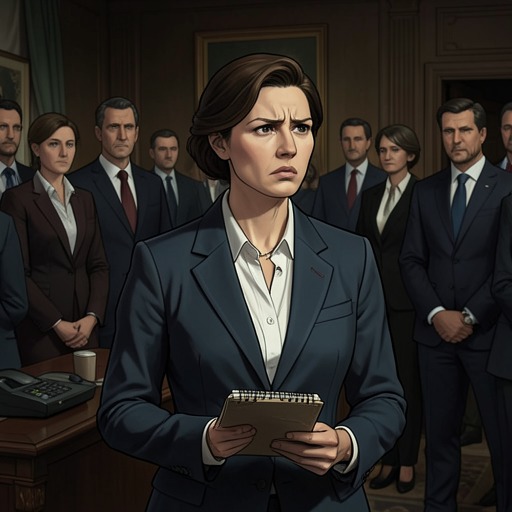
When Nella finally raises the issue in Vera’s office, she says that Shartricia feels based on an imagined version of what a Black person suffering through the opioid crisis in Ohio would be like. She calls the character a collection of unflattering tropes and points out that Shartricia remains stuck and unreconciled by the end of the novel. Colin asks for specifics, but his posture changes as Nella explains: he stops chewing the ice in his coffee, removes his cap, and lets his pen fall between their chairs without picking it up.
Colin answers by insisting that he chose one particular depiction of a Black woman in difficulty, not a portrait of every real person. His defense grows louder and more personal. He rejects the implication that he is racist, challenges the idea that he should alter Shartricia’s hair, skin, or speech, and asks whose book it is. Nella had expected at least some gratitude for an internal sensitivity read; instead, she finds herself trying to apologize for a criticism she had intended to make useful. She worries that Hazel-May McCall, the other Black woman in the office, may be overhearing the exchange. The scene makes the professional cost of candor immediate: the discussion is about representation, but it also tests whether Nella can speak without being treated as though she has challenged the author’s right to write at all.
Hazel initially tells Nella that she tried to back her up, although Hazel has not yet read the manuscript. Later, after the marketing discussion, she tells Nella that she has finished the book and shares a sharply different assessment in private: she considers it badly written, contrived, caricatured, and offensive. The contrast between Hazel’s public and private responses does not resolve the book’s reception; instead, it exposes how a positive institutional performance can coexist with a more candid judgment among colleagues. Nella also notices that coworkers who praise Colin’s books ask Hazel personal questions about her parents’ experiences during the crack epidemic, while they have seldom shown comparable curiosity about Nella’s life.
Marketing, Cover, and Institutional Stakes
At the marketing meeting, Amy introduces the fall titles by Colin and Kitty Kruegler, and Richard Wagner chooses to begin with Colin’s book. Maisy Glendower praises the novel for showing that the opioid crisis affects Black people as well as white people. Vera agrees, and Hazel says that the Black protagonist and her family may resonate with audiences of color, including readers struggling with addiction. Hazel connects the subject to stories her parents told about the crack epidemic and to how little white people seemed to care at the time. She acknowledges that some readers may object to aspects of Shartricia, but concludes that Colin has brought the story home in a way that could connect with a broad audience.
Nella experiences the meeting as a public celebration of the very character she has criticized. She considers leaving the room, then realizes that Hazel’s presence means she is no longer its only Black woman. That does not remove the pressure to represent a perspective for her coworkers, but it gives her the possibility of sharing the burden and discussing it later with Hazel. The difference is modest and practical: she does not have to be the sole person whose face colleagues might watch for a reaction.
The book’s cover meeting gives the disagreement a material form. Leonard presents three glossy proposals, one using a watercolor American flag with faces woven through its stripes. Nella first leans toward the third design because its fragmented composition might draw a bookstore browser’s attention; then she recognizes Shartricia placed prominently among the faces and recoils. The cover has made the character more visible than anyone else in the novel, and the image repeats the imbalance Nella sees in the manuscript: the Black character becomes the most immediately legible sign of the book’s diversity. Hazel, unexpectedly, calls the proposal brilliant and tells Leonard that he has understood the assignment. The cover discussion thus turns a contested editorial judgment into a branding decision, where the character’s prominence can be presented as a selling point even while Nella remains troubled by what that prominence signifies.
Consequences for Nella and the Novel’s Role
The enthusiasm around Needles and Pins grows as the project is promoted inside Wagner. Nella later sees it described within the company as a surefire bestseller, with the right packaging imagined as a route to attention from Oprah. She knows that the marketing language is partly linked to Hazel’s support for the book. The coming cover meeting, unlike those she once regarded as the most exciting part of publishing, now feels inseparable from the earlier argument over Shartricia. Nella still studies the designs, but the process no longer feels like a neutral exercise in color, balance, and typography: the proposed image carries the weight of the choices already made about the character.
Nella’s work on the project also leaves her feeling that her judgment has not earned recognition. Richard tells her he has discussed a possible promotion with Vera, but Nella’s account of her recent effort includes more than fast responses and quietly repaired production problems. At Vera’s request, she has typed an apology to Colin, although she still does not believe that an apology is necessary. Vera responds briefly and gives her another four-hundred-page manuscript to read in less than forty-eight hours. Needles and Pins therefore remains bound up with Nella’s uncertain position at Wagner: she is expected to contribute editorial judgment, but speaking plainly about a Black character can lead to conflict, while making peace with the author does not itself bring the acknowledgment she hoped for.
As an object within the larger story, the novel links representation to the practical machinery of publishing: the manuscript, the marketing meeting, the cover mock-ups, and the uneven consequences of an employee’s critique. Its strength as a topical book is repeatedly affirmed by colleagues, while Nella’s close attention to Shartricia exposes the difference between including a Black character and giving that character complexity. The disagreement does not settle whether the novel can reach readers or whether its subject matters. It shows instead how the same book can be praised as a timely account of a crisis, promoted as evidence of diversity, and experienced by Nella as a failure of representation that she is asked to help manage.