Needles and Pins Cover Meeting Controversy
The Other Black GirlThe Needles and Pins cover meeting becomes a public rupture in Nella Rogers’s working life: a design debate turns into a confrontation over who gets to define a Black character’s image and whose objections count as editorial judgment. When Hazel-May McCall backs a proposal Nella finds demeaning, Nella’s anger escapes before she can shape it into a careful argument. The outburst changes the room’s attention, but the unequal power that produced her frustration remains in place.
The proposals and their stakes
The meeting begins with Leonard, a longtime head of Wagner Books’ design department, presenting three glossy proposals from a manila folder. He has worked in the department for nearly four decades and has won awards for covers that became classics. Nella notices his checkered shirt, golf pencil, and habitual stoop, details that make the formal display of his work feel at odds with his apparent unhappiness in the office. Vera Parini offers him a forceful wink after earlier tension over Sam Lewis, a small gesture that slightly eases his posture before the presentation proceeds.
Two of Leonard’s proposals are nontraditional alternatives to the established approach for Colin Franklin’s books. The third sets illustrations of faces into a watercolor rendering of the American flag, weaving them through its red and white stripes so that the faces appear only in pieces. Nella first leans forward, drawn by the composition’s visual fragmentation and recognizing how a striking design might catch a bookstore browser’s eye. Then she recoils as she takes in the central face: dark brown skin, a wide nose, thick lips, frightened-looking eyes, and black hair in Bantu knots. The character is Shartricia, the novel’s most prominent and most fully realized character in Nella’s reading of it.
Amy presents the proposal as a way to confront the dehumanization associated with the opioid crisis. By showing a range of people Colin writes about on the cover, she argues, the design might encourage customers to spend time with the book. Vera acknowledges that it is different and artistic, though she remains hesitant. Josh supports it from a marketing perspective, invoking an article about the scarcity of characters of color on book covers and arguing that the image could draw a broader audience while confronting the country’s racist past. The reasoning makes the proposal sound inclusive; to Nella, the prominent, broken-up image of Shartricia makes that claim difficult to accept.
Hazel’s endorsement and Nella’s outburst
Nella tries to get Josh’s attention by raising her hand, but he continues speaking. Her attempt to enter the discussion is thus met, in the moment, with the very sort of disregard that has shaped her uneasy position at the company. When Hazel asks to speak, Nella silently hopes she will expose what Nella sees in the cover. Instead, Hazel calls it brilliant and agrees that Leonard has understood the problem. Vera is surprised by Hazel’s support, as Nella is; Hazel’s endorsement turns the image from a disputed design into a position taken by the colleague Nella had expected to challenge it.
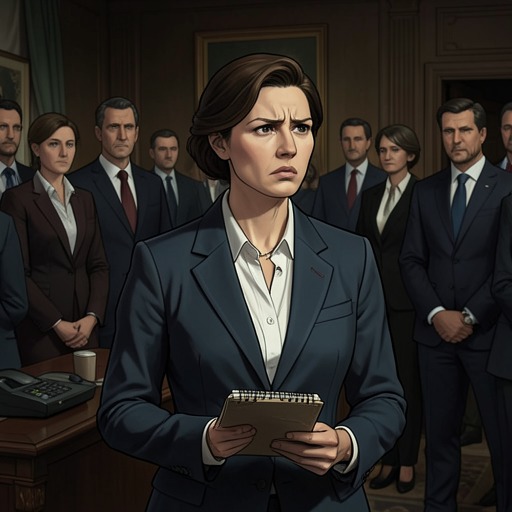
At Amy’s invitation for further thoughts, Nella says, “You people are un-fucking-believable.” She has not realized she is speaking until the room’s attention swings toward her. Amy asks whether she said something; Amy’s lip quivers, Leonard looks appalled, Vera clasps her hands behind her neck in embarrassment, and even Hazel appears caught off guard. Richard Wagner waits at the head of the table for Nella to answer. The contrast is sharp: the meeting has allowed an extended defense of the cover’s artistic and commercial value, while Nella’s brief protest immediately becomes the spectacle under scrutiny.
The outburst is rooted in more than this single image. Nella has felt that Wagner colleagues often treat her as a qualified exception rather than engage with her as a young Black woman; they rarely ask her to weigh in on Black issues or request sensitivity reads. At times that distance spares her unwanted scrutiny, but it can also feel as if taking the job required surrendering part of her identity. Her earlier experience of white colleagues discussing nonwhite hires as though they would be unqualified sharpens the contradiction between the company’s diversity language and the assumptions circulating inside it.
The meeting’s aftermath and wider context
After the meeting, Nella remains behind while others leave. When she prepares to go, Richard puts down his phone, asks her to sit, and closes the distance between the outburst and a private conversation. He says Hazel recently told him about something happening to Nella at work that he considers disturbing, and offers her the chance to speak without involving Vera unless Nella explicitly wants her included. This shifts the immediate subject from the cover to Nella’s treatment at Wagner, but the evidence presented here does not establish what Hazel reported or what Richard does with the information.
The exchange carries additional weight because Nella has reason to distrust Richard’s public embrace of diversity. She remembers that, during her first week, he brought her to dinner and his wife told her she would not succeed in publishing unless she tamed her hair and spoke as if she came from Northampton rather than Newark. She also remembers Richard describing Burning Heart as too niche, then invoking the attractiveness of its coauthor and Nella’s intelligence as reasons it might find an audience. When the book became a bestseller, he moved into its spotlight. Against that history, the cover meeting’s language of inclusion does not erase the gap between public positioning and the treatment Nella recalls.
That gap also informs the meeting’s later professional consequence. Richard offers Nella an opportunity to work with Jesse Watson, and she initially understands the offer as a possible promotion to assistant editor. He then adds that Hazel should also have an opportunity because she introduced them to Jesse. Nella’s excitement disappears; she had taken initiative by emailing Jesse and had wanted this kind of work for a long time. The meeting therefore sits within a broader contest over recognition: Nella can identify a troubling image and speak out, yet her expertise and initiative do not guarantee sole credit or advancement.
Significance
The dispute is not resolved by the evidence provided: it does not say which cover Wagner ultimately selects. Its significance lies instead in the collision between representation as a marketing claim and representation as a lived editorial responsibility. Shartricia’s face is used to promise visibility and to evoke the country’s racist history, but Nella sees the character’s features isolated and made central in a design she cannot accept as straightforwardly celebratory. The scene leaves that disagreement exposed rather than settling it.
Nella’s reaction is also shaped by the constraints on how she can object. She worries elsewhere that calling out a colleague will be heard as accusing him of racism, and that white colleagues may react defensively. At Wagner, where she has spent more than a year enduring small talk, low pay, and the daily strain of being treated as the likely person to handle a package or fix a computer whenever an unknown Black colleague appears, restraint has its own cost. Her sentence breaks that restraint, but the meeting does not show the room changing its standards in response. Instead, the scene carries the conflict into Richard’s private check-in and into the subsequent competition over the Jesse Watson project.