Nella Rogers–Kendra Rae Phillips relationship
The Other Black GirlNella Rogers and Kendra Rae Phillips are connected through a clandestine exchange of warning and evidence, not through a demonstrated meeting. Kendra’s apparent messages urge Nella to keep digging and warn that someone is coming for her too; later, Nella finds Kendra’s photograph and a record of sightings in Richard Wagner’s files. The discovery gives their connection urgent stakes: Nella suspects she has information that could help Kendra emerge from hiding, but has not yet sent it to her.
An Indirect Connection
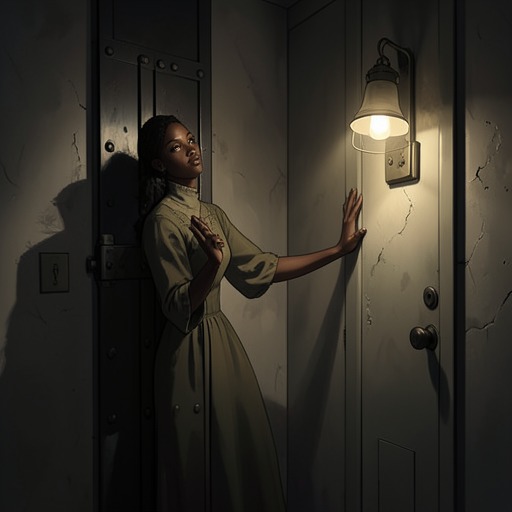
The relationship takes shape through traces rather than conversation. Days before Nella studies the file, a woman texting her has urged her to continue investigating. When Nella finds the photograph of Kendra behind her own in a folder, she recalls the warning and connects it to the threat against her. The evidence establishes the warning and Nella’s association of it with the investigation; it does not show the two women meeting or speaking directly. Their connection is therefore intimate in consequence but mediated in form: one woman sends an alarm, while the other must work out what it means from the records left behind.
That mediation matters because Nella’s own picture appears in the same material as Kendra’s. The photograph of Nella was taken on her twenty-fourth birthday in Connecticut; it had become her public profile picture and was the last photograph she had posted publicly. Finding it in the file changes the investigation from a search into Wagner’s past to evidence that Nella, too, has been singled out and tracked. Kendra’s warning now reads not as an abstract caution but as information about a danger that has reached Nella herself.
Kendra in Wagner’s Records
The folder supplies a fragmentary history of Kendra’s disappearance. Beside a wallet-sized photograph, Nella sees handwritten notes attributed to Richard, with dates ranging from the 1980s to the present. Among them are a possible sighting upstate in 1986 and a question about whether Kendra moved to Paris in 1992. The scattered dates make clear that Kendra has remained an object of pursuit or surveillance over a long period, though the notes do not explain every gap or establish what happened to her in the intervening years.
The most recent entry records a confirmed sighting near 100th Street and Broadway on October 20, 2018. It says Kendra took Shani’s phone and then went underground. Reading that note, Nella realizes that Shani was the person put into the black sedan. Kendra’s file thus connects her history of evasion to the immediate danger facing someone else, while revealing that the surveillance operation is not confined to Nella. For Nella, the record turns separate clues—a warning, a missing phone, and Shani’s removal—into parts of a single threatening system.
Evidence, Risk, and Delay
Nella’s ability to help Kendra is bound up with the risks of her own position at Wagner. Before she even joins the publisher, she worries that a Manhattan office will mean hierarchy, homogeneity, and rigid expectations; she chooses conservative interview clothes rather than wearing a Black Lives Matter shirt. Later, she hears a colleague describe nonwhite hiring as a forced practice that would bring in unqualified people. Her coworkers can treat her as an exception whose qualifications supposedly set her apart from her Black identity, a form of acceptance that also leaves her feeling that taking the job has required her to surrender part of herself. These experiences help explain the pressure around challenging Wagner, without proving that they alone cause her silence about Kendra.
Nella also knows that her understanding of the workplace is not readily shared by Owen, her white partner. When he assures her that the trouble will pass, she recognizes that he will not have many of the same conversations or experience the same accumulation of seemingly minor slights. That contrast underscores the isolation in which she must decide what to do with the file. Her uncertainty is not simply a matter of having discovered information; acting on it could mean confronting a powerful employer while she is already implicated in its records.
The Unsent Proof
By the time Nella reflects on her conduct, she has the evidence at her fingertips but has sent Kendra nothing. She sees herself as someone who has withdrawn from public engagement with Black issues and from conversations with her best friend that once reached beyond the demands of her job. Most consequentially, she recognizes that she may hold the key to freeing Kendra from hiding. The phrase makes Nella’s inaction feel like more than a missed investigative step: the knowledge that could help Kendra has become a measure of Nella’s responsibility to someone she has never been shown meeting.
The relationship remains unresolved at this point. Nella has recognized the threat, connected Kendra to the records, and understood the possible value of what she knows, but she has not yet delivered proof. Her tears and uncertainty do not complete the exchange; they mark the distance between understanding the stakes and taking action. Kendra’s unseen presence therefore shapes Nella’s choices as both a warning and an obligation, while the evidence leaves open whether Nella will turn their secret, file-mediated connection into practical help.