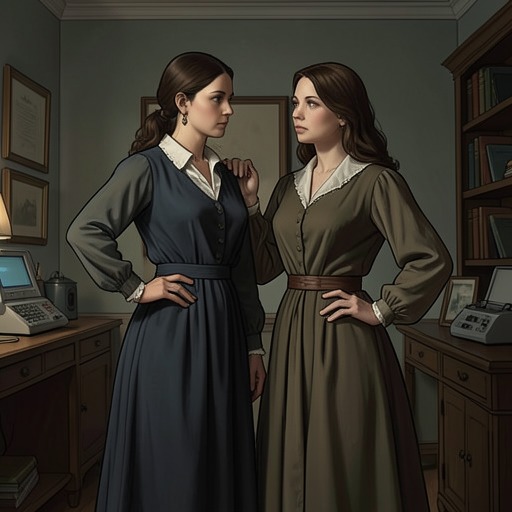
Nella Rogers—Owen
The Other Black GirlNella Rogers and Owen’s relationship is a steady source of affection and practical support, but not a shelter from every strain: Owen is attentive to Nella’s safety and increasingly at ease in her social world, while she sometimes keeps workplace fears from him. Their partnership is established through small acts of care, shared humor, and the history of Owen’s staying power, then tested by the gap between what he senses and what Nella is prepared to tell him.
A Relationship Built on Staying
Nella’s earlier dating experiences had taught her to expect men to lose interest when intimacy did not proceed on their terms. As a college freshman and sophomore, she imagined romance in familiar settings such as a dining hall, a campus walk, or a fraternity party; in practice, some men moved on when she did not want to go further. After graduating and moving to the city, she tried dating apps and became less invested in making encounters work. Owen stood apart from that pattern. Their first exchanges on OkCupid and their beers at The Jeffrey left her feeling that he was thoroughly interested, rather than someone who would abruptly change course. His continued presence gave her reason to trust the relationship, and her feelings for him gradually crystallized.
That history gives weight to Nella’s ease with Owen. Their closeness is not presented as a sudden declaration but as a judgment formed over time: he remained, and she came to believe that he was not treating her as a temporary pursuit. The contrast with her earlier experiences also clarifies why steadiness matters to her. Owen’s reliability is not an abstract quality; it is measured against a repeated expectation that men would leave when she set a boundary.
Care at the Wagner Threshold
Two years before the later scenes, Owen accompanied Nella on the Midtown-bound R train as she headed to Wagner Books for a new-hire tea with Richard Wagner. Nella had applied to the publisher partly because it had published her favorite book and because she admired the work of Kendra Rae Phillips and Diana Gordon. She was also privately curious about what had happened to Kendra Rae, whose disappearance from public view after the success of Burning Heart remained unexplained to her. Owen knew she wanted to ask Richard about Kendra Rae, but encouraged her to consider whether he might be able to put them in touch.
Nella declined. She thought it would be bad manners to arrive at the meeting asking what had happened to Kendra Rae, and worried Richard would take her for an amateur stalker. Owen’s concern ran in the opposite direction: he was uneasy about Nella going alone into the office of a powerful older man she did not know well. He rejected the idea that industry custom was enough to reassure him, and imagined being blamed for failing to ask hard questions if something went wrong. His anxiety was expressed through a comic true-crime-TV label, but the underlying concern was concrete: he wanted Nella to be safe.
When they reached the office building, Owen squeezed her hand more firmly than usual before letting go. Nella answered with affectionate teasing and reassurance, touching his unshaven cheek and reminding him that she carried pepper spray. The exchange shows both the seriousness and the intimacy of their bond: he did not conceal his worry, and she met it with tenderness rather than dismissing him. Her joke reassured him, though it did not erase the fact that she was walking into a professional situation he could not accompany her into.
Shared Humor and Social Ease
Owen’s support also appears in ordinary social scenes. At a theater event at Curl Central, he arrived late after going to the office to deal with an internet problem, encountering a ticket line, and missing a train. Moving past a group of Black women to reach Nella and Malaika, he apologized repeatedly as they watched him and tried to work out where he was headed. Nella stood to kiss him on the cheek when he reached her. The welcome is spontaneous and physical, a small reunion in the middle of a crowded public room.
The scene also places Owen among people and references that are not automatically familiar to him. Nella had told him Malaika’s joke about CP Time, and Owen laughed along, saying that Nella was rubbing off on him. Malaika had once regarded him as Nella’s latest white boyfriend, but her wariness had softened into a willingness to treat him as a worthwhile suitor and tease him about his blind spots as a white cis man in his presence. Owen preferred to be included in the joke rather than kept outside it. His comfort is qualified, not presented as proof that he understands every perspective: the humor works because his friends can name the distance between them openly.
Trust, Protection, and Partial Disclosure
The relationship’s closeness does not mean that Owen knows everything Nella is carrying. When he questions why she has called Hazel-May McCall a snake, Nella promises to explain in the car. She intends to tell him that Hazel has wronged her over Shartricia, but not about the anonymous letters. Her answer is therefore partly truthful and partly withholding: she is willing to share the workplace conflict but keeps a more frightening part of it to herself.
Owen notices the gap. He looks at her closely and says that something seems to be missing; he knows her well enough, as someone who lives with her, to recognize that her explanation is incomplete. Nella responds soothingly that Hazel has been shady and that she only wants to discuss work matters before they leave. Owen remains unconvinced, particularly as he watches Hazel with Juanita, but he does not force a confession in that moment. The exchange reveals a form of intimacy that is perceptive but imperfect: Owen can detect that Nella is holding something back, yet detection does not give him access to what she has chosen not to share.
Narrative Significance
Owen’s role in Nella’s life is defined less by a solution to her professional dangers than by the contrast he provides. He accompanies her toward an important meeting, worries over her safety, welcomes her among his friends, asks about her work, and recognizes when her account does not add up. Nella’s affection is evident in her physical tenderness and the trust accumulated through their shared life; her omissions show that even a loving partnership cannot automatically overcome the pressure she faces at work.
Across these scenes, the relationship moves between reassurance and alertness. On the train to Wagner, Nella comforts Owen before entering an uncertain professional setting; later, at Curl Central, he arrives to find that she is already navigating conflict with Hazel. His care is steady, but Nella controls how much of that conflict reaches him. This balance makes the partnership a meaningful counterpoint to her isolation without turning it into an all-knowing refuge: Owen can stay close, ask questions, and notice the truth’s outline, while Nella remains the person deciding what she can safely disclose.