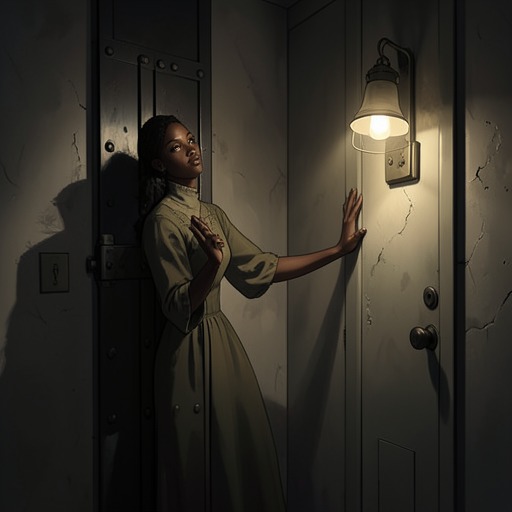
Nella overhears Richard’s private call
The Other Black GirlNella Rogers overhears Richard Wagner’s private call while preparing to explain the Colin incident, and the fragments she catches suggest that Richard had a hand in a consequential decision involving author Kenny Bridges. The exchange does not resolve who is on the other end of the line; instead, its unfinished disclosures and affectionate sign-off leave Nella with a suspicion she cannot verify. The encounter turns a planned apology into an act of listening—and sends her back into Wagner Books alert to what colleagues might conceal.
Approach and Stakes
Nella heads toward Richard’s office after taking a deep, centering breath. She is unsure whether he even knows about the Colin incident: Colin has not tweeted about it to his five hundred thousand followers, and Vera has never seemed likely to report her business to anyone, especially a man. If Richard knows nothing, Nella’s disclosure could create trouble where none exists. Even so, she decides that the practical course is to explain what happened and apologize.
Her imagined confession is also a strategy for preserving her place at the publishing house. She plans to control the story, accept blame, and present herself as the mature, principled employee Richard had met two years earlier. She hopes that reminding him of that version of her will make him less inclined to replace her. The approach depends on reading Richard correctly; the private conversation she is about to overhear makes clear how little she knows about what occupies his attention.
The Call
At the hallway desk, Nella finds Donald absent, though his Discman remains. Richard’s office light is on and its door stands open. She can hear him speaking in a low voice, almost as if to himself, and moves closer, intending to knock. His hushed, stern tone makes her stop before she can announce herself.
Richard says, “I can’t say more right now. I told you email was better.” After a silence, he objects, “Look, you don’t get to suddenly grow a conscience. Remember whose idea this was?” The call grows more pointed: “You chose to deal with Kenny the way you did, and now you—” The sentence breaks off. The words establish that Richard’s unseen interlocutor was involved in a plan concerning Kenny and that Richard places responsibility for setting it in motion on that person. They do not explain what the plan was, what happened to Kenny, or what Richard’s own role entailed.
Richard then tells the caller to stop pretending not to need assistance. He ends the exchange with “Love you, too. Bye.” The phone clicks, and Nella hears him mutter “Dammit.” The juxtaposition of an accusation about a conscience, an insistence that the other person needs help, and an intimate farewell makes the conversation difficult to place. Its meaning comes through in pieces, not a clear account.
Nella’s Inference and Retreat
Nella fixates on the affectionate sign-off. She had assumed Richard was speaking with Kenny’s agent, partly because she has heard that Kenny has been causing trouble for his publicity team and that his agent has not kept him in check. That context makes Richard’s anger seem, at first, explicable. But the words “Love you, too” unsettle the assumption. Nella knows Richard’s wife manages a chain of candle stores, from SoHo to the Hamptons, and cannot reconcile that knowledge with the call she has just heard. She wonders whether the person on the phone was Kenny’s agent, but the exchange never confirms the caller’s identity or the nature of the relationship.
The overheard reference to how someone chose to “deal with Kenny” chills Nella, and the sign-off leaves her more uncertain rather than less. She realizes she has heard something private and decides that entering Richard’s office to confess her own mistake would be badly timed—especially if he still does not know about it. As a chair rolls against the wood floor, Richard calls out to ask whether someone is there and whether Donald has returned. Nella does not wait to learn if he investigates. She hurries around the corner, nearly stepping out of her Keds.
Aftermath and Significance
For the next few days, Nella walks through Wagner Books with her head lowered and her mouth shut, but she keeps her eyes open. She watches the writing utensils her colleagues use and records when anyone stops at her desk, along with the time and what was said. The detailed note-taking marks a change in her conduct: instead of approaching Richard with a planned explanation, she begins monitoring the office and collecting observations.
The scene links Nella’s personal vulnerability over the Colin incident with a larger, still-unexplained matter involving Richard and Kenny. Its limited auditory evidence is crucial: Nella—and the reader—hears enough to suspect that important decisions are being made privately, but not enough to establish exactly what happened or who participated. Her flight from the doorway therefore does not resolve the danger or clarify Richard’s intentions. It leaves the question suspended, while her careful watchfulness carries the encounter’s unease into the following days.