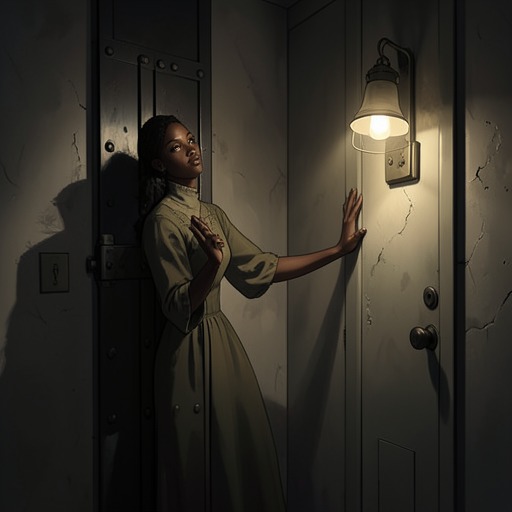
Nella uncovers Hazel’s files
The Other Black GirlNella Rogers’s discovery of Hazel-May McCall’s files transforms a suspicion into material evidence: among pages cataloguing Black women, she finds photographs of Kendra Rae Phillips and herself, with a handwritten note indicating that more jars are to be ordered for her. The scene’s danger lies in how much the documents suggest and how little time Nella has to understand them. She photographs what she can, then slips out of Hazel-May McCall’s room before the others return.
Background and Stakes
Nella’s search takes place against a history of uncertainty about how to act inside Wagner. Before her interview, she worried that the Manhattan office would be as rigid and homogeneous as the workplaces she had seen on television and in films. Her caution was practical as well as personal: she selected conservative clothes for the interview, even though she had been used to jobs behind bars and coffee counters where she could dress as she pleased.
At Wagner, that unease acquired a racial dimension. After overhearing a colleague speak resentfully about hiring nonwhite people, Nella recognizes that some coworkers treat her as an exception whose qualifications supposedly separate her from other Black people. That can spare her unwanted requests to comment on Black issues, but it also leaves her feeling that the job requires her to surrender part of her identity. Her understanding of office life differs from Owen’s, too: as a white cis man, he cannot share many of the conversations and daily pressures that shape her experience. Against that background, a folder containing photographs, names, and handwritten assessments is not an abstract workplace grievance. It is something she can see and document.
Nella’s professional position also sharpens the stakes of her encounter with Hazel-May McCall. Richard Wagner invites her to work on Jesse Watson’s project, then says Hazel-May McCall should have an opportunity as well because she introduced them. The arrangement puts Nella’s initiative beside Hazel-May McCall’s access to the project and to senior authority. When Nella searches the bedroom, she is therefore moving through a relationship shaped by workplace power as well as personal distrust.
The Search in the Bedroom
During the gathering, Nella enters Hazel-May McCall’s bedroom and makes a hurried effort to avoid being discovered. She lunges for the light switch, then returns to a cabinet using only her flashlight. She takes care not to leave fingerprints on the glass and pulls out a manila folder containing what first appear to be magazine clippings. The small, furtive actions give the search its suspense: Nella is trying to learn what the folder holds while remaining ready to explain her presence and escape.
Just as she is about to put the folder away, she notices that some of its contents are ordinary sheets of paper rather than glossy clippings. About a quarter of the folder consists of these pages. They carry rows of wallet-sized photographs of Black women, accompanied by cities, three-digit numbers, and handwritten notes. Nella recognizes Kiara and Ebonee, as well as Camille from the name beside her photograph. The patterned arrangement suggests a system, though the meaning of its numbers is not established in the moment.
The discovery confirms that Nella’s suspicions were not groundless. She briefly considers telling Malaika, who might distract Hazel-May McCall while Nella alerted the women downstairs. But she cannot yet explain what the pages mean, and she has no time to read the notes. Instead, she photographs a page and keeps searching. More sheets appear, each filled with photographs of Black girls. Most of the faces are unfamiliar to her, but the accumulating pages make the folder look less like a collection of isolated clippings and more like an organized record.
Nella and Kendra Rae Phillips in the Files
The folder’s most personal revelation comes when Nella recognizes an image of Kendra Rae Phillips. A message Kendra Rae Phillips had sent Nella days earlier, urging her to keep digging and warning that someone was coming for her too, suddenly gains force. Nella photographs Kendra Rae Phillips’s page, then turns back and photographs her own. The phone flash briefly illuminates her face and short natural hair as she records the image that links her directly to the archive.
Nella’s own page marks her out in a different way from the rows of photographs. She has an entire page, not merely a place in a row. A hot-pink sticky note beneath her photograph describes her as seemingly complacent, suggests that further efforts would not hurt, and specifies an order of eight jars coming in 10/20. The note does not explain the full purpose of the jars, but its language and placement make Nella’s inclusion feel active rather than incidental: someone has assessed her and planned further action. The contrast between her single page and the other women’s rows signals a distinction in how she is being recorded, without disclosing exactly why.
Escape and Significance
The discovery does not give Nella time to read the files or confront Hazel-May McCall. She wants to examine every word, yet also feels the impulse to destroy the folder. Hearing a toilet flush nearby, she speeds up, replaces the documents, and closes the cabinet. At the door, she hears voices and a question about whether she has left. The interruption makes the risk immediate: she has to abandon the search before she can learn what the notes say or how the records are used.
Nella waits until the footsteps have gone downstairs, counts to ten twice, and then slips out of the bedroom. She reunites with Malaika on cold, dirty benches while they wait for the train. Malaika complains about what has happened downstairs; Nella says nothing. Her silence marks the gap between obtaining evidence and being ready to disclose it. She leaves with photographs that can preserve what she saw, but without the explanation that would make the archive fully legible.
The scene shifts the investigation from inference to documentation. The names, cities, coded numbers, photographs, and handwritten notes give Nella concrete grounds for suspicion, while her own marked page and the planned order make the danger personal. Yet the files also preserve uncertainty: Nella has glimpsed a system, not read its complete instructions. Her discovery therefore functions both as a breakthrough and as an unfinished question, forcing her to carry evidence out of the room before she can safely determine its full meaning.