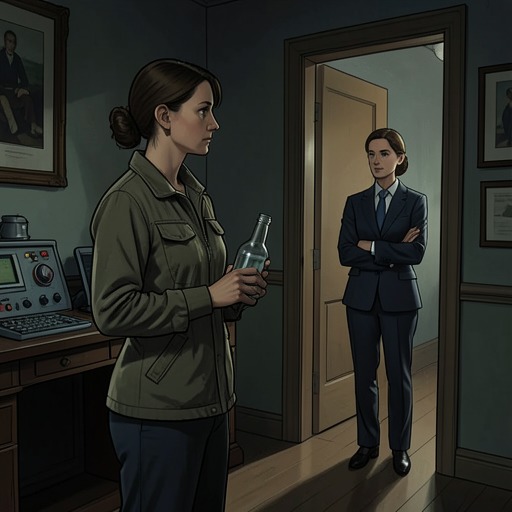
OBG transformation
The Other Black GirlOBG transformation is the profound change in behavior and temperament that marks a young Black woman as an OBG, or Other Black Girl. In the novel, it is not a makeover or a simple change of speech: it reaches into a person’s sense of self, reshapes her conduct at work, and can redirect her loyalties toward success as defined by white employers. The transformation matters both as a concealed process involving hair grease and as a widening social phenomenon whose members may threaten the solidarity of other Black women.
Definition and Observed Signs
The transformation has no single outward signature. Some women speak differently; others dress differently. Those visible changes are only part of the pattern: the narration emphasizes that the alteration reaches beneath presentation to a person’s character and inner life. OBGs are therefore not simply women who adopt a different register or style for a particular setting. They are described as increasingly devoted to getting ahead and willing to undermine Black women who stand in their way.
The distinction is difficult to detect because OBGs can blend in with women who have not undergone the change. Lynn Johnson’s account of the phenomenon highlights a shift in how they operate: earlier OBGs kept to themselves and concentrated on reaching the top, while later ones were more likely to step over anyone obstructing their progress. In this account, greater social fluency is not proof of unchanged identity. It can make the transformation harder to recognize and allow its effects to spread through ordinary professional life.
Spread and Changing Patterns
The reported geography of OBG activity expands over time. Lynn Johnson says that when she first learned about OBGs five years earlier, they were known in a handful of Northeastern cities, including New York, Boston, and Philadelphia. At the time of the later reports, sightings extended from Miami in the south to Portland in the north and Los Angeles in the west. The movement from a limited regional presence to sightings across the country makes the phenomenon a growing network rather than an isolated workplace anomaly.
A report from Joe adds a personal example from California: his daughter seems changed to him, yet she can still object to an acting agent’s repeated auditions for enslaved roles. She then explains her willingness to continue playing the industry’s game as a strategy for eventually gaining control. That reasoning complicates the signs of transformation. A woman may recognize an objectionable choice and describe it as temporary accommodation, while those around her see the broader pattern as evidence that her priorities and loyalties have shifted. The episode makes blending in part of the danger: the change can coexist with an apparent capacity to explain and justify one’s actions.
The Hair-Grease Program
The novel connects OBG transformation to a deliberate program using hair grease. A retrospective account describes an early application to Kenny, whose hair was divided into eight sections while the formula was worked through it. Before applying it, the person administering the treatment tested a small amount with a pinky and hoped it would not burn. The detail places the transformation in a concrete, intimate practice of hair care, even as its intended effects extend beyond hair.
The account says that the formula’s effect was supposed to be temperamental. Its makers initially expected to soften Kenny’s manner only enough to make others more comfortable, not to alter her in a lasting or severe way. The account also acknowledges that this expectation proved mistaken: it took years to develop a less harsh formula. Hair grease is thus both the delivery method and a disguise for an intervention whose consequences were not reliably contained.
The operation has its own roles and targets. Women who administer the treatment are called Lead Conditioners, while those subjected to it are referred to as Involuntaries. A later discussion identifies an especially troubling side effect: a recent batch has made some Lead Conditioners more competitive against other Black women, leaving them as the last Black woman standing in their offices. The stated purpose of the grease is not to produce that rivalry. The admission that the result is an unintended effect reveals a gap between the program’s claimed aims and the damage its methods can cause.
Records and Recognition
The transformation also appears through institutional records. When Nella Rogers and Malaika examine printed profiles of young Black women, the entries assess speech, social awareness, shyness, and workplace attitude. One file describes a woman’s speech as heavily marked in a way Nella later no longer observes; another records dissatisfaction with workplace treatment as a sign of ingratitude. The profiles turn subjective judgments about Black women into administrative descriptions, making the transformation legible to those tracking it while exposing how quickly ordinary complaints or differences can be classified and monitored.
The date on the page Nella examines is March 4, 2017. She connects the record’s description of Ebonee with her own present-day impression that the described speech pattern is no longer there. The contrast between a dated profile and a later observation gives the change a timeline: the files do not merely describe women but preserve assessments that can be compared with how those women appear afterward. For Nella and Malaika, the profiles help explain why the phenomenon cannot be reduced to rumor or to a single visible symptom.
Narrative Significance
The transformation reframes professional success as a contested measure. OBGs seem to advance by accommodating white employers and pushing aside other Black women, while those who resist may be treated as difficult, disloyal, or ungrateful. The novel’s workplace examples make that conflict more than an abstract division between authenticity and assimilation: the same office can reward conformity, preserve judgments about Black women in files, and leave a changed colleague difficult to distinguish from someone making a situational choice.
The hair-grease revelation gives this social pattern a concealed mechanism, but it does not erase the ambiguity of its effects. The early intention to make Kenny more relaxed, the years spent adjusting the formula, and the later complaint about rivalry all show a program whose operators cannot fully control what they produce. OBG transformation therefore links intimate grooming to workplace power: a practice presented as manageable personal adjustment becomes a means of altering temperament, encouraging competition, and weakening trust among Black women.