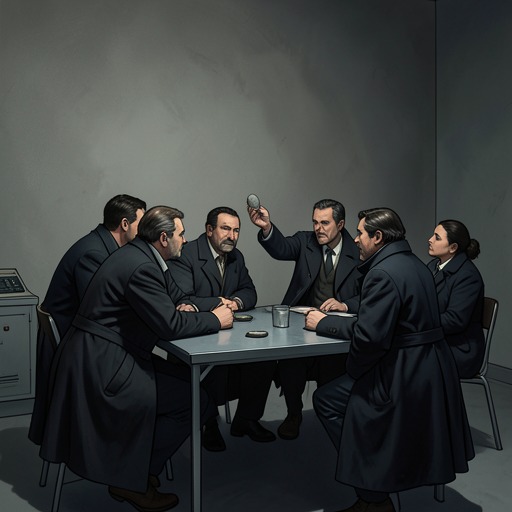
Resistance Evidence-Disclosure Rule
The Other Black GirlThe Resistance Evidence-Disclosure Rule makes proof a condition of disclosure: members are warned not to share evidence prematurely, because without absolute, definite proof, others may dismiss them as delusional. In Nella Rogers’s case, the rule governs not an abstract debate but the moment her cursor hovers over an email’s Send button, with evidence of the OBG scheme ready to leave her hands and no certainty about what will follow.
Purpose and Evidentiary Standard
Lynn Johnson’s reminder gives the rule its rationale and its high threshold: premature sharing is risky, and the Resistance needs absolute, definite proof. The warning recognizes that evidence alone may not persuade an audience predisposed to disbelieve claims that sound extraordinary. The rule therefore demands more than suspicion or a persuasive account; it treats corroboration as protection against having the truth dismissed.
The material Nella has encountered helps explain why the claims require substantiation. She recalls applying a cool, creamy formula to Kenny’s hair, divided into eight sections, after Imani assured her the batch would not burn. Nella had tested only a little of it on her pinky. That memory places her inside the process, but the limited test and the reassurance she received also show how easily a participant could mistake a promise of safety for knowledge of the formula’s effects.
Hazel describes the jars as making Black women more amenable to working with white people and less troubled by the compromises involved. She also explains that some women are referred to Richard Wagner, who sends them to her and other Black women to be “fixed”; Ebonee, she says, needed the intervention to advance her career. Nella challenges the lack of consent, while Hazel dismisses the harm with the claim that what the women do not know will not hurt them. These disclosures make the issue larger than a questionable product: the alleged intervention is concealed, directed at workplace behavior, and imposed on women who may not know what is happening.
The Rule in Practice
As Nella prepares to send her account to Gwen, the attached file contains screenshots of conversations, a log of Nella sightings, and photographs. Among them are a selfie Nella posted to her Instagram story just before Eva hugged her goodbye at Pepper’s and a photograph Nella took of Eva at Rise & Grind. The file also traces how Nella slipped away from the OBG conflict without either Lynn Johnson or Hazel-May McCall knowing where she had gone. Nella regards the collection as undeniable evidence, while the rule insists that the consequences of disclosure cannot be separated from the quality and force of the proof.
The procedure is not the only reason Nella hesitates. Three months earlier, Kendra Rae Phillips had persuaded one of the OBGs to let Nella go, promising that if they were left alone, they would leave Nella alone and everything would stay quiet. Nella believes she owes Kendra Rae Phillips silence until further instruction. By the time the email is ready, however, that instruction has not come, and Nella wonders where Kendra Rae Phillips is. The rule’s evidentiary caution thus intersects with a personal obligation whose terms and duration remain unresolved.
Consequences and Significance
Nella imagines that publication could provoke a public reckoning, but also widespread distrust among Black people as they struggled to know whom to trust. Her anticipation of possible exposure gives the rule a double edge: waiting may protect the Resistance from being discredited, while disclosure could make concealed practices visible; neither choice is without risk. She does not immediately press Send, and the evidence remains undisclosed at this point.
The rule is therefore both a safeguard and a restraint. It responds to the real vulnerability of claims that others may call delusional, yet it can also delay action when the evidence is assembled and the person authorized to guide disclosure is absent. Nella’s hesitation holds those pressures together: proof is necessary, but so are judgment, trust, and a decision about when silence has ceased to protect anyone.