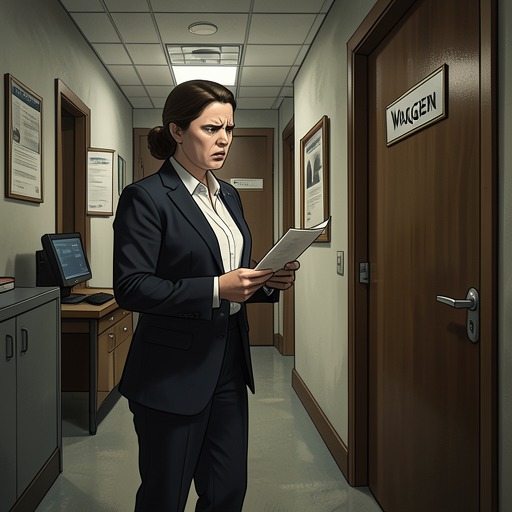
Richard Wagner
The Other Black GirlRichard Wagner is the editor in chief of Wagner Books, a powerful publisher whose habits of personal patronage and public-facing diversity commitments conceal a darker role in the surveillance and attempted transformation of Black women. To Nella Rogers, he first appears as an eccentric, prestigious executive; evidence later links his handwriting and authority to the monitoring of both Nella and Kendra Rae Phillips. His defining contradiction is that he can offer access and recognition while using the same institutional power to keep people under observation.
Identity and Authority
Richard is a wealthy figure whose money, the narration observes, does not announce itself. He is intensely attentive to publishing trends, but his importance rests on more than taste: employees understand proximity to him as a possible route to an enduring career. Wagner assistants may remain at the company for years earning only a little over twenty dollars an hour, while gaining Richard’s attention can appear to open doors across the profession. Those without a legacy connection or a place in his favor face a much narrower prospect. His influence therefore extends beyond the books he edits; it helps determine who advances and who remains economically vulnerable.
He maintains an unusually conspicuous presence at the office. Richard seldom observes Summer Fridays, and the final week of August matters to him as much as the start of autumn. His new-hire tea is not contractually required, but declining it can seem unwise for an employee’s career. His social world is similarly selective: his parties are exclusive enough that assistants search their managers’ offices for misplaced invitations. These customs make access to Richard feel both informal and consequential, a privilege granted through proximity rather than a transparent process.
The story of his rise is partly presented as industry legend. Richard was reportedly the first of the Wagners to choose books over politics. When he decided in college that he would not become a senator, his parents allegedly acted as though he did not exist for five years. Later, after he chose to start a publishing house, several notable literary figures helped him; when Wagner opened in 1972, the industry hurried to welcome him, followed eventually by his parents. The account does not establish every detail as fact, but the story reinforces the image of a man who built his position outside his family’s expected path and then became a powerful institution in his own right.
Patronage, Publishing, and Public Diversity
Richard’s authority is personal as well as corporate. Nella encounters him in the office corridor when he calls her by name. Tall and lanky, with white hair, tortoiseshell glasses, a beige jacket, striped navy-blue-and-green trousers, and a khaki leather briefcase, he carries himself with the assurance of someone whose accomplishments can make others hesitate to criticize him. In his large office, he asks why she chose publishing. Rather than deliver the rehearsed explanation she had prepared for Vera Parini, Nella admits that her interest centers on Kendra Rae Phillips and Kendra’s novel Burning Heart. The answer establishes a direct connection between the executive and the book that will later become central to questions about his judgment and motives.
Kendra’s own retrospective account sharply challenges the benevolence of Wagner’s support for Burning Heart. She recalls that Richard let her edit Diana Gordon’s book rather than edit it himself, provided little money, and arranged only a two-week author tour. Kendra reads those decisions as calculated protections against the possibility that the book would fail, and says she had to fight him at each step. Her view is explicitly her interpretation, but it exposes the imbalance behind the publisher’s support: a book could be made while its author and editor were still required to struggle for resources and confidence.
Years later, Richard’s response to a viral police shooting shows a more public mode of leadership. The victim was an elderly unarmed Black man in rural North Carolina who, according to reports, had been reaching to turn up his hearing aid. After Jesse Watson’s furious response to the killing circulated widely on Twitter, Richard sent employees an unusual company-wide email announcing Wagner Books Diversity Town Halls. Nella printed the message and pinned it in her cubicle, encouraged by the prospect that the company might finally address a problem she felt personally and acutely.
The first town hall, however, could not settle what diversity meant. Employees asked whether the discussion concerned staff, books, or authors, and some pointed to a recently published Black writer as though that example resolved the matter. Nella tried to redirect the discussion but hesitated to criticize hiring practices that favored Ivy League degrees or personal connections, since her own résumé had benefited from an editor connection made through a professor at the University of Virginia. She also wanted to point out that Wagner’s recent Black authors had come from an African country rather than being Black Americans, but did not feel able to manage the further distinctions that statement would provoke. Richard’s initiative thus opens a forum without, in the evidence shown, supplying a clear definition of the issue or an easy remedy.
Sponsorship and Image
Richard also lends Wagner’s name and money to Hazel-May McCall’s community work. Nella discovers that Richard is among the confirmed attendees at a reading hosted by Hazel’s organization at a Black hair salon in Brooklyn, with Wagner Books listed as a cosponsor. At the event, Hazel says she asked Richard to help sponsor the girls she serves. To her surprise, he donated ten thousand dollars, and she announces that he will match every dollar raised that night through hair-product sales. The donation gives the initiative substantial visible support and earns an enthusiastic response from the audience.
That generosity also becomes part of the company’s public image. In a later account, Kendra sees a headline announcing that Wagner Books’ longtime editor in chief has donated a large sum to a diversity initiative. She studies a photograph of Richard beside a Black woman Hazel had redirected from Cooper’s to Wagner, and interprets his concern for appearances as the reason he has continued watching Kendra: in her view, Kendra knows too much and has become a liability. The photograph itself establishes their public association; the claims about Richard’s motive belong to Kendra’s understanding of it. The contrast between an announced donation and concealed monitoring gives his philanthropy an uneasy double meaning without making the public act itself disappear.
Nella Rogers and Jesse Watson
Richard’s relationship with Nella moves from professional courtesy toward apparent protection, then takes on a more threatening meaning. When he learns from Hazel that something disturbing has been happening to Nella at work, he invites her to speak and says he did not want to involve Vera unless Nella explicitly wished it. The gesture offers Nella a private channel to the highest-ranking editor at Wagner. In isolation it might look like care; against the later evidence that he has been monitoring her, the offer also shows how easily concern and control can occupy the same relationship.
He gives Nella another consequential opportunity by telling her that Jesse Watson will visit the office and that he wants her among the employees who meet him. Nella is thrilled by the news. At the meeting, Richard introduces her as one of Wagner’s finest assistants with a sharp eye. Nella notices a warning in his tone, however, and the brief commendation does not settle her suspicions. When Jesse says he wants to take a break and begins describing how an idea for a graphic novel came to him while he sat in a park, Richard prompts him to return to that point, directing a sharp look at Nella. The scene places Richard between Nella and a potentially important professional connection: he facilitates her presence, but also polices what happens in the room.
The possibility that her position is at risk has already taken root. After Nella sees a list of assistants and wonders whether Vera is being given new hires, she fears that Wagner might replace her with another Black employee and thereby avoid criticism for removing her. Richard’s status makes him the person she decides she must approach. Later, when Hazel tells Nella that Richard does not value her and has kept her at Wagner only to watch her, the claim is no longer merely an anxious suspicion. The records Nella finds supply corroborating evidence that she and her actions have been tracked, even though Hazel is the one who states Richard’s purpose directly.
Surveillance and the Hidden Scheme
The most incriminating evidence comes when Nella and Malaika examine photographs of Richard’s files. One entry, dated June 2016, describes Nella as smart and quirky, notes her white boyfriend Owen and Connecticut origins, and treats those details as potentially useful. Another records that she accepted grease without asking questions and notes that a mysterious warning had unsettled her, raising the possibility of an alternative plan. Nella recognizes the handwriting as Richard’s, matching the cursive signature on his contracts and holiday cards. The files transform his customary written correspondence into evidence of a private record-keeping system directed at her.
The same collection tracks Kendra over decades. Nella sees notes dating from the 1980s onward, including a possible sighting upstate in 1986 and a note wondering whether Kendra moved to Paris in 1992. The final entry, dated October 20, 2018, records a confirmed sighting near 100th Street and Broadway, says Kendra took Shani Edmonds’s phone, and states that she went underground. Because this note appears in Richard’s handwriting, the documents connect his office to the continuing effort to locate Kendra. They also reveal that the information extends beyond an employee’s ordinary career file: it includes movements, sightings, and an abrupt disappearance.
Nella concludes that Hazel is helping Richard with whatever scheme the files describe, and wonders whether Hazel came to Wagner to make her compliant or hypnotize her. Those are Nella’s uncertain interpretations, not confirmed explanations of every note. Hazel later supplies a broader account: Black women are referred to Richard, who then sends them to Hazel or other Black women to be fixed. She says some remain in their internships longer than they otherwise would have and need the intervention, and claims that with time they come to love the change. Nella objects that the women are being changed without informed consent. Hazel’s response—that ignorance protects them—makes explicit the coercive logic of the scheme as she presents it.
Narrative Role and Significance
Richard’s character is built around the difference between visible sponsorship and concealed administration. He announces town halls after a national crisis, funds Hazel’s initiative, invites Nella into a meeting with Jesse Watson, and offers to listen to her workplace concerns. Yet his own records appear to document Nella’s behavior, the timing of her acceptance of hair grease, her reaction to an anonymous warning, and Kendra’s movements across decades. What makes his power unsettling is not that every public gesture is proven false, but that generosity and access coexist with a system that classifies women as subjects to watch and manage.
He is also the hinge between Wagner’s formal hierarchy and its clandestine operations. Employees’ hopes, pay, and advancement are organized around the attention of the editor in chief; Hazel’s account likewise places him at the point where referrals of Black women become interventions. His influence reaches from literary decisions about Burning Heart to a company response framed as diversity work, and from an invitation to meet Jesse to the surveillance revealed in his handwriting. By the time Nella recognizes that handwriting among the files, Richard’s polished authority has become inseparable from the question of who controls the story of a woman’s career—and whether that control extends to changing the woman herself.