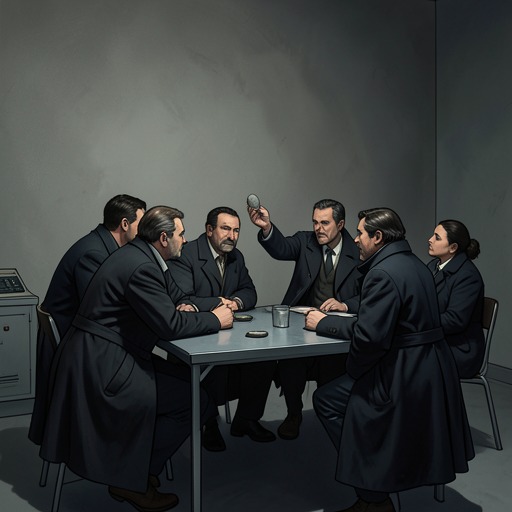
Shani Joins the Resistance and Monitors Hazel and Nella
The Other Black GirlShani Edmonds’s entry into the Resistance turns a private decision to start over into a disciplined campaign of concealment and observation. By September 27, 2018, she has left Boston for New York City, severed her visible ties to ordinary social networks, and begun monitoring Hazel-May McCall and Nella Rogers. At Joe's Barbershop, her account shows both the force of the evidence that persuaded her and the restrictions that keep her from acting on suspicion alone.
Recruitment and departure
Shani recalls that Lynn Johnson impressed two rules on her with particular force: stay off the grid and tell nobody anything. Lynn spent nearly an hour explaining why Shani had to promise to follow them. The length and severity of the warning initially made the Resistance seem so rigid that Shani wondered whether she wanted to join it at all. Her hesitation, however, did not survive the evidence Lynn sent.
That evidence included a list of Eva’s shifting identities and a map charting her erratic course and the destruction left in its wake. Shani describes this material as enough to settle the question. She deleted Twitter, Facebook, and Instagram, and cut off years of hair. These were concrete breaks with her previous life, not merely an agreement to keep secrets. The account does not specify every practical reason for the haircut, but places it alongside the Resistance’s demand to avoid digital traces and conceal information.
Shani gave her mother a partial explanation for leaving Boston: she said that she had experienced something unspeakably racist at work and wanted to start over in New York. The explanation was not wholly detached from the truth, but it concealed the Resistance and the reason the organization mattered to her. Her mother accepted the news with little questioning. Shani understood that response in light of her mother’s own history of starting over, including moving to Detroit shortly after becoming pregnant with Shani. Her mother had once said New York was her first choice, imagining a life in Queens near Shani’s Aunt Whitney, but had not been able to make that move.
The departure was already arranged: Shani had bought a ticket before telling her mother she was going. When Aunt Whitney met her at Penn Station, her gaze moved from Shani’s face to her shaved head and back, but she asked no questions. The quiet arrival echoes the secrecy Lynn had demanded. Shani reaches New York without disclosing the Resistance to either her mother or her aunt.
Rules and the limits of action
The organization’s rules govern not only what Shani tells others but what she is allowed to do when she believes she has recognized an OBG, or a potential OBG. Lynn says that the Resistance will need more complex ways to distinguish itself from them and must remain vigilant. The rule Shani dislikes most forbids confronting an OBG or possible OBG unless directed. It makes restraint an operational requirement even when anger feels immediate and justified.
That prohibition has already shaped Shani’s encounters with Eva. She says it kept her from confronting Eva when she saw her with Nella at Nico's in August. It also kept her from interrupting Eva the previous night, when Eva spoke at Curl Central about solidarity and diversity. Shani describes wanting to leap from her seat, seize one of Eva’s locs, and challenge her to repeat the confident message. The image of holding up a piece of Eva’s hair like a captured flag makes the impulse vivid, but the rule prevents the confrontation. Shani’s anger is real; so is the restraint imposed by a movement built around secrecy and caution.
Watching Hazel and assessing Nella
At the barbershop, Lynn asks Shani for an update. Shani reports that she sat in the front row at Hazel’s event and that Hazel barely looked at her. She interprets Hazel’s failure to notice her as a consequence of paranoia: Hazel is watching for threats in the shadows rather than seeing what is plainly present. Lynn understands the comparison, and Shani’s report presents her as an observer attempting to remain inconspicuous while close to the person she suspects.
Lynn also asks about Nella. Shani says she is not compromised, though she has seen Nella and Hazel in an intense-looking exchange at the end of the event. That judgment is provisional, not a declaration of certainty. When Lynn presses the point that Nella remains at Wagner and attended Hazel’s gathering, Shani notes that Hazel handed things to other people and might have offered one to her as well. Lynn suggests these could simply have been promotional favors for Hazel’s organization or the shop, but insists that their apparent harmlessness does not establish Nella’s reliability.
Their disagreement draws on earlier injuries. Lynn reminds Shani that an OBG remains in place at the magazine where Shani was harmed, and that Lynn herself lost the opportunity to complete a medical-school program while another OBG benefited from her research. Shani knows the warning by heart. She counters that the injury at the magazine happened five years earlier and that the Resistance is still hiding without learning how Black girls are changed. She identifies the limits of what they know: they have seen havoc in Hollywood, but do not understand the mechanism of the transformations. For Shani, the danger of waiting is that the Resistance may remain in the shadows while its opponents become more convincing.
Suspicion without certainty
Shani’s vigilance is rooted in more than the recent event at Curl Central. Recalling an earlier search for Eva in a crowd outside Anna’s office, she remembers finding Eva at the back, arms held tightly across her body and eyes described as hard and dark. Shani connects that sight to the warning she had heard from a woman met on the train: that she had said too much and was in danger. In retrospect, she recognizes that something was wrong with Eva, yet also remembers her as seemingly low and human. The memory complicates any easy division between visible vulnerability and concealed danger.
That complication helps explain why the Resistance’s prohibition matters to Shani even as she resents it. She believes Eva has spoken persuasively about solidarity while posing a threat, and she is angry that Nella may be close to her. But she has not established that Nella is compromised, and Lynn’s history shows why premature trust can have lasting costs. The scene ends with the two women still disagreeing over how much can be inferred: Shani wants movement and new knowledge; Lynn insists on distance and caution. Shani’s role in the Resistance is therefore defined not simply by watching Hazel and Nella, but by the tension between what she sees, what she suspects, and what the rules permit her to do.