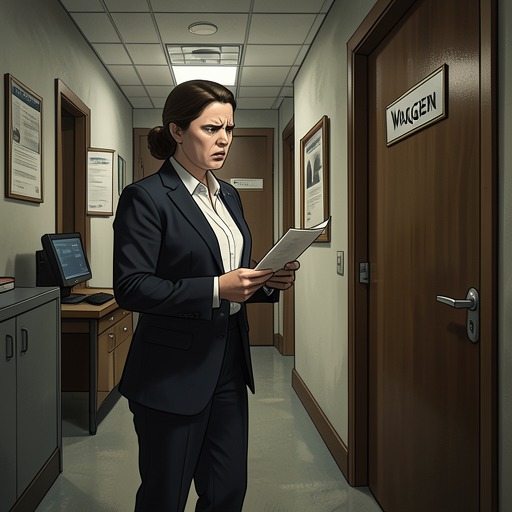
Wagner Books offices
The Other Black GirlWagner Books offices are both Nella Rogers’s professional home and the setting in which her confidence in that workplace erodes. Cubicles and publishing meetings first represent the craft she hopes to master; after an anonymous warning, the same desks and rooms become places she studies for clues. By the time she meets Jesse Watson there, the office’s routine has become inseparable from her suspicion that Hazel-May McCall is connected to a disturbing change in him.
Setting and Working Life
The offices are introduced through the rhythms and objects of editorial work. Nella is drawn there unusually early one summer morning, arriving around a quarter to seven, before even the most diligent editors would normally be expected. On the way in, she hurries past a woman searching for her MetroCard and trips in the lobby, catching herself with her hands. The small mishap places her in a workplace she knows well but is approaching in an unsettled state.
When Nella reaches her cubicle, the office no longer feels familiar. She had wanted to return and explore the premises without interruption, but the bright lighting seems clinical to her and the air-conditioning seems ineffective. That altered impression makes the workplace itself part of her unease: it is still the office she knows, yet she can no longer experience it as neutral or safe.
The surrounding desks give the office a legible, practical order. Hazel’s neighboring workspace is especially organized, with separate piles marked for tasks and for matters to check with Maisy, supplies arranged along the back wall, and writing instruments collected in a jar. Nella counts the pens: black, one red, two blue, and no purple. The inventory is a precise observation rather than an explanation, and its detail shows how closely she has begun examining a colleague’s ordinary surroundings.
Suspicion and Observation
After telling Malaika that she has received a strange note, Nella’s relationship to the office changes from that of an employee moving through familiar routines to that of a watcher gathering information. For several days she keeps her head down and her mouth shut while paying attention to the writing utensils her colleagues use. Whenever someone stops by her desk, she records the time and what was said. The cubicle, a place for routine conversations, becomes the point from which she documents those interactions.
Her attention extends to Hazel and to Hazel’s exchanges with Vera Parini. After accidentally overhearing Richard Wagner outside his office, Nella returns to find Hazel and Vera still discussing The Lie. Hazel spends approximately sixty-eight minutes behind Vera’s closed door. Nella waits at her desk, worrying that she might be fired, and eats through the large bag of pretzels kept in her emergency snack drawer. The scene combines ordinary office details—a closed door, a conversation, a snack—with Nella’s fear of what the conversation may mean for her position.
This method of watching does not immediately give Nella certainty. Instead, the office supplies details she can record but not yet resolve: who speaks to whom, for how long, and which objects might matter. The difference between observation and proof becomes part of the setting’s tension. The offices permit Nella to keep watch because she belongs there, while her growing mistrust makes every familiar interaction seem potentially significant.
Shared Spaces and Editorial Rituals
The offices also contain the less formal infrastructure of work. At the Keurig, Nella repeatedly strikes the machine when it will not function as expected; it continues hissing rather than brewing. She considers other ways of making it work and thinks of Jocelyn, who, according to office rumor, will not return because Germany has taken her back. A coworker’s absence, a malfunctioning appliance, and the press of the day all converge in a shared space that offers no quiet escape from workplace irritation.
Editorial meetings once gave Nella some of her strongest sense of belonging. When she first joined Wagner Books, cover meetings were the highlight of her week. She would arrive early to take the corner seat by the window, where she had the best view of Leonard’s cover mock-ups for Amy, Richard, and the editors. She listened as Amy and the designers considered color, balance, font size, and kerning, taking notes in the hope of learning what she would need when she eventually occupied the editor’s seat. Although Vera had the final decision, contributing her own opinions made Nella feel powerful and close to the making of books.
That anticipation has changed by the time Nella is due at a meeting for Needles and Pins. Running short of time, she makes tea instead of buying coffee and expects to sit through the meeting undercaffeinated. The contrast is not simply between enthusiasm and fatigue: the meeting remains part of the same publishing process that once exhilarated her, but her changing experience at Wagner makes this particular gathering feel different. In another editorial discussion, on September 14, she brings Vera printed, high-resolution cover options and email replies concerning Crystal Soul. The office’s work continues in concrete tasks and paper records even as Nella’s trust in the people around those tasks diminishes.
Meeting Rooms and Shifting Power
After a meeting ends quickly, Nella finds Richard still seated at the head of the table, occupied with his phone. As she prepares to leave, he puts the phone facedown, asks her to sit again, and begins a private check-in. She notices that the door has been closed without her realizing it. The room changes character: what had been a place for a meeting now holds an unscheduled conversation in which Richard controls the pace and asks her to keep new information private.
Richard tells her that Jesse Watson will visit the following week and that he wants her among the people who meet him. For Nella, the news briefly eclipses her usual composure; she is struck by the prospect of meeting the writer. The invitation ties the offices to Nella’s professional hopes, but the request for secrecy and the closed door also place those hopes within a relationship of unequal authority.
On October 26, Wagner Books is again marked by routine. Hazel gives Nella her usual greeting, Nella responds lukewarmly, Vera asks her to read two manuscripts, and an email reminds her of the noon meeting with Jesse in the small conference room. Nella walks there fifteen minutes early, expecting Jesse to arrive late, and checks her phone as she enters. The familiar schedule and the meeting room’s reputation as the most intimate room at Wagner make the scene feel ordinary even as Nella waits anxiously.
The Office as a Site of Recognition
When Jesse arrives, Nella struggles to speak. Vera enters cheerfully and greets him; Richard appears soon afterward and exchanges greetings with him. Nella feels a chill at Richard’s presence, and the arrival of Amy and a high-school intern briefly changes the room’s social balance. Hazel is not there when Nella checks for her, prompting Nella to wonder whether she has stayed away or is occupied with the hair grease Nella suspects her of preparing.
As Jesse describes the focus he wants for his book, Nella studies a changed appearance: his beard is closely cropped, the small twists she remembers are gone, and his hair lies flat and smooth. She recognizes the hair as greased. The meeting room thus becomes the place where details gathered elsewhere in the offices converge. Nella feels a force turning her attention toward Hazel; after three slow breaths, she meets Hazel’s eyes and sees what she takes to be unmistakable triumph. She begins coughing and asks to leave for a moment. The office has not changed its furniture or schedule, but its rooms now hold the evidence through which Nella understands the workplace as a place of concealed influence, not merely editorial opportunity.