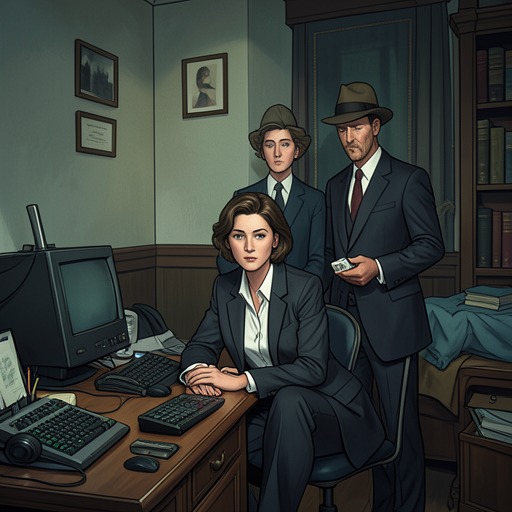
Wagner Books’ unwritten dress code
The Other Black GirlWagner Books’ unwritten dress code is a system of informal expectations, not a formal policy: employees are told what counts as professional through looks, chilly reactions, and the consequences of refusing to conform. Its significance lies in the gap between the workplace’s stated openness and the racialized judgments that shape which appearances are treated as acceptable.
Definition and Enforcement
The standard is never written into an employment contract. Wagner formally leaves room for employees to dress as they choose, but an unspoken idea of professionalism governs how they are received. When an intern breaks with that norm, employees correct the perceived breach through raised eyebrows or a chilly, withering stare. The absence of a written rule does not make the expectation powerless; it leaves colleagues to enforce it indirectly, making conformity seem like common sense rather than an explicit demand.
That same informal pressure helps explain why Richard Wagner’s new-hire tea carries weight despite not being contractually required. Nella Rogers learns from her predecessor that declining the invitation would not help her career. The workplace thus communicates expectations through customs and social consequences as well as through appearance: the rules are unwritten, but employees are expected to read them.
Nella’s Appearance and Early Caution
Before her interview, Nella worries that Manhattan office work will bring the hierarchy and rigidity she has seen in television and films. Her previous jobs behind bars and coffee counters had exposed her to people in many occupations and let her wear what she wanted. For the interview, she chooses caution: inexpensive Payless flats in case she needs to chase a train, old black stockings, a conservative blue dress, and a tote from the Nation’s booth at the Brooklyn Book Festival as a small expression of personality. She also doubts she could have worn a Black Lives Matter shirt to meet Vera Parini.
The outfit captures the code’s double demand. Nella tries to appear suitably conservative without erasing herself completely, and even this careful preparation cannot control how she is read: on her way to Wagner, she discovers that a run in her stockings has traveled down to her ankle. Her early anxiety is not simply about fashion. It reflects the uncertainty of entering a workplace where the standards are unstated and where a small visible departure may carry more weight than a written policy admits.
Hair, Speech, and Racialized Professionalism
The standard extends beyond clothes. Nella’s uncertainty about styling Black hair has a personal history: her parents raised her in a predominantly white neighborhood and schools while deliberately affirming her Black identity, but the idealization of straight hair still reached her. Her mother had relaxed her own hair since becoming a dean, and when Nella wanted to do the same at nine, neither parent objected. From sixth grade, Nella accompanied her mother to the salon every six weeks; the ritual ended as Nella grew older and more independent. The account places her later workplace discomfort within a longer history in which straightened hair could appear ordinary, expected, and professionally useful.
Richard makes the racial dimension of that expectation explicit when he invites Nella to dinner during her first week at Wagner. His white wife tells her that she will not succeed in publishing unless she tames her hair and speaks as if she came from Northampton rather than Newark. The demand joins hair and speech as signs of acceptable professional identity: Nella is not merely being advised how to dress for an office but being told to alter features through which race and background are made legible.
Narrative Function and Consequences
Years later, Nella recalls Richard’s advice alongside his description of her and Diana Gordon’s book, Burning Heart, as too niche for a real audience. He also suggested that Diana’s looks and Nella’s intelligence might help the book gain traction, then angled for a place in their spotlight after it became a bestseller. This history makes his later public support for diversity suspect to Nella: the contrast between his earlier private judgments and public positioning casts professionalism and inclusion as standards that can shift with institutional advantage.
The novel also uses hair as a visible clue in a more immediate crisis. When Nella meets Jesse Watson, she notices that his beard has been closely cropped and his former twists are gone; his hair lies flat, smooth, and greased. The altered appearance helps her recognize that something has changed before she meets Hazel-May McCall’s triumphant gaze. In this scene, grooming is not merely a matter of workplace etiquette: it becomes evidence through which Nella reads the effects of the hair-grease scheme. Across these moments, the unwritten code’s apparent neutrality gives way to a sharper pattern of judgment and control over whose hair, speech, and presentation may count as professional.