Bull Hammer
The OutlawsBull Hammer is a lawman whose official power and reputation for violence are inseparable. The marshal of Baggs and a deputy in counties on both sides of the state line, he was hired by cattlemen to stop rustling and horse theft; in the account of The Kid and John Smith, that mandate has left the region with a different danger rather than dependable justice. Del Delaney initially knows none of this, and their confrontation turns his impulsive defiance into a test of the local power Hammer represents.
Authority and Background
Before Hammer came to the area, rustling and horse stealing had troubled the cattlemen. They hired him to put a stop to those crimes, giving him a lawman’s authority across a broad territory: he serves as Baggs’s town marshal and as a deputy in the counties on either side of the state line. His appointment thus has a practical origin in the cattlemen’s desire to protect their property, but the protection he provides is portrayed as coercive.
The Kid describes Hammer as a man who kills and escapes consequences because he is the law, while John Smith confirms the breadth of his official reach. Smith says that people are now burdened with Hammer, and doubts that his rule is an improvement on the thefts the cattlemen originally wanted stopped. The contrast is central to the character: the badge that authorizes Hammer to enforce the law also shields him from challenge when his own violence goes unchecked.
Reputation and Reported Violence
Del learns about Hammer from The Kid and Smith after striking him with a gun barrel. The Kid’s warning is emphatic: Hammer is exceptionally tough, few people oppose him, and Del should not assume that challenging a man with a badge is an ordinary fight. Smith supports the warning with a more restrained account. He says he had heard of Hammer only after reaching Rawlins, and explains that Hammer is dangerous with both his gun and his fists.
The Kid says that he and his companions have seen Hammer kill two men since riding into the area. The reasons they later heard are presented as reports, not as facts independently established in the scene: one man was said to have beaten Hammer in a poker game, and the other to have taken his woman. This distinction matters. The account shows the gap between Hammer’s formal role and the local understanding of his conduct, but it does not provide a hearing or an official explanation for either death.
Del does not initially appreciate this reputation. He says he does not retreat merely because a man wears a star and considers himself capable of defending himself in a fight. He also recognizes that Hammer is substantially larger than he is, by roughly thirty pounds, but believes he has beaten larger men before. The warning changes what Del understands about the risk, though it does not persuade him to avoid the conflict.
Conflict with Del Delaney
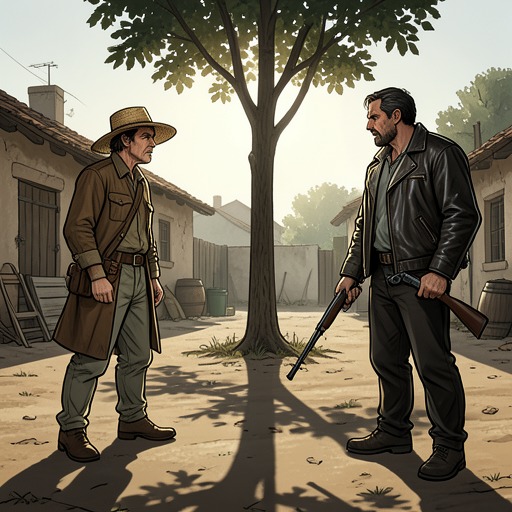
The two men’s first confrontation leaves Hammer with a lump on his head after Del strikes him with a gun barrel in Baggs. About a month later, at a ranch where Stub Rawls’s crew is preparing to brand horses, Hammer rides in with his deputy, Rip Hughes. Hammer has come to question Jerry Sewell about the horses in the corral and demand a bill of sale. Del interrupts before that inquiry can continue, reminding Hammer of the earlier blow.
Hammer turns away from Sewell and recognizes Del as the man he has been looking for. His anger shifts the encounter from an investigation of the horses to a personal challenge. He removes his gun belt and gives it to Hughes; Del hands his own gun belt to John Smith. The exchange leaves the confrontation to be settled without their guns. The Kid and Smith had already warned Del that they once intervened to protect him because he did not know the danger Hammer posed. At the ranch, they do not step in again: Del understands that this time he must face the lawman himself.
The Ranch Fight
Hammer begins by rushing Del, then changes tactics and throws punches. Del keeps moving to avoid most of them, but is eventually struck and knocked down. He recovers during the struggle, gains a brief advantage, and continues the fight after Hammer gets back to his feet. Del then lands an uppercut that knocks Hammer down again, as he had been knocked down in the earlier encounter at the Baggs saloon.
Del retreats to the corral bars, leans there while still dizzy, and tells Hughes to put Hammer on his horse and leave. The people watching look first at Hammer, who is not moving, and then at Del. The scene gives no further account of Hammer’s condition or subsequent actions, so it does not establish more than that he has been knocked down and that Del orders his deputy to remove him. The immediate reversal is nevertheless clear: the man whose reputation had made others cautious has been publicly defeated in a fight he initiated after recognizing his challenger.
Narrative Role
Hammer embodies the failure of a badge, by itself, to guarantee lawful or restrained authority. The cattlemen hired him to answer a real problem, but the testimony of The Kid and Smith depicts a community in which his power makes people afraid to oppose him and his violence goes unchallenged. Del’s ignorance of the local history exposes how reputation functions as practical protection for Hammer; Del’s refusal to back down briefly breaks that protection’s hold over the scene.
The fight does not erase Hammer’s official position or settle the wider question of who controls law enforcement in the region. Its significance is narrower and more immediate: Hammer’s reach has made his name a warning, but Del’s victory shows that the man behind that name can be resisted. The sequence also distinguishes Del from The Kid and Smith, whose knowledge leads them to avoid an unnecessary encounter, while Del’s temper and confidence bring him directly into it.