Cattle
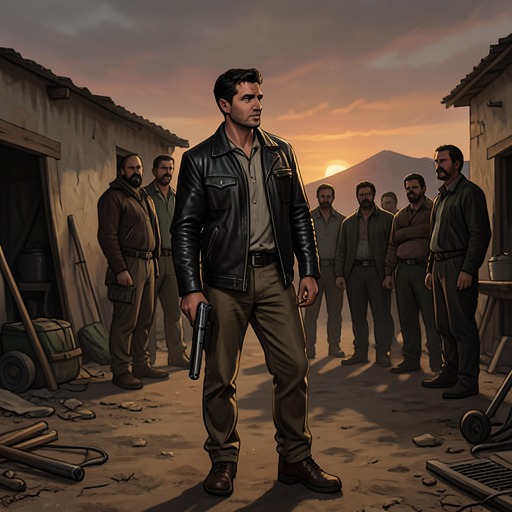
The OutlawsCattle are both working animals and an economic measure in The Outlaws: their movement follows the limits of grass and season, while the fortunes of ranches and even Roily’s struggling county depend in part on the business they sustain. Their role is practical rather than romantic. Herds must be shifted across difficult country, yet ownership and profit are entangled with the concealed interests of ranch bosses and the decline of the mining economy.
Herd Work and Seasonal Range
At the J Bar Ranch, Del Delaney and his companions arrive at a moment when Stub Rawls can put them to work moving a substantial herd of two-year-olds. The cattle are grazing on bottomland near the river, and the crew drives them toward higher country to the east. This is ordinary ranch labor, but its timing reflects pressure on the range: winter had been hard, mountain grass was slow to come up, and the bottomland had already been badly overgrazed. The move to higher pasture had therefore been delayed. The cattle’s route registers the season’s conditions in the land itself, as well as the consequences of waiting too long to redistribute grazing.
The herd’s planned movement also establishes the kind of work available to the newly arrived men. Rawls gives Delaney and his companions a place in the crew and a concrete task before they know who owns the ranch. The cattle operation appears to be a functioning enterprise, with a crew and animals to move, even though the larger purpose of the ranch soon becomes doubtful to them. In that contrast, the herd is not merely scenery: it is evidence of real ranch work taking place inside an operation whose legitimacy the men question.
Ranching and Suspicion at the J Bar
Delaney initially finds the J Bar’s cattle holdings difficult to reconcile with what he hears about its owner. When the boss appears, Rawls explains that the man is more interested in horses than in cattle. Delaney considers that peculiar because the ranch has so many cattle, which represent substantial value. His reasoning is economic: a large herd ought to matter to an owner concerned with the ranch’s returns.
The men’s suspicion sharpens when John Smith concludes that Jerry Sewell is a horse thief and that the cattle operation may be a cover for appearing legitimate. Delaney agrees with Smith’s guess that the horses Sewell brought in are intended for Colorado, where the law would not be looking for them. These are the men’s deductions, not a confirmed account of the cattle being stolen or used in a specific crime. Their significance lies in the contrast they draw: the visible herd suggests a conventional ranch, while the owner’s apparent preference for horses leads the newcomers to suspect that ranching is not the operation’s true purpose.
That uncertainty accompanies the men’s assessment of the crew. Delaney sees mostly young, friendly cowboys and suspects some may be drifters, like himself and his companions. The cattle work supplies employment and gives the ranch a public appearance of routine, but the men’s observations prevent that routine from settling their doubts about the enterprise.
Cattle, Land, and Roily’s Decline
The broader country gives cattle a place in an economy transformed by the collapse of mining. When Delaney and his companions reach Roily, they find a town marked by abandoned buildings, mine dumps, and the remains of mills. The saloon bartender speaks hopefully of renewed mining if silver can find a market, but describes the present town as having little to sustain it beyond a few cattle outfits and dry farming. Ranching is not presented as a replacement for the old boom; it is one of the limited activities keeping the area going after mining has ebbed.
The mine country also intersects directly with Red Muldoon’s seasonal cattle use. Kate Muldoon remembers going with her father to the Enterprise Mine, where he kept a small herd around the mine. The range was high, and grass came slowly, so he moved cattle up late and made several trips in the summer to check on them. Her childhood visits connect the family ranch to a landscape also shaped by mining: cattle used the upland pasture near a large but failed industrial site. At the time Kate and her companions later visit, no cattle are there. The contrast between past seasonal use and the empty range makes the former ranching routine visible through its absence.
Property, Livelihood, and Local Power
Cattle also belong to the material basis of the Diamond M Ranch, the principal large ranch in a poor county. Judge Bailey explains that ranches contribute some taxes, but most are small outfits; the Diamond M is the exception. With the mines no longer paying taxes and some town property owners failing to pay, the county has too little revenue. The ranch economy therefore matters to local government, but the limited number and size of ranches cannot make up for the loss of mining revenue. Bailey’s account places cattle within a broader chain linking land use, private property, and the county’s weakened ability to function.
Red Muldoon’s will similarly treats the ranch as an estate composed of land, stock, and money. Bailey describes the ranch and Red’s accounts as his principal assets, distinguishing the operating funds for the Diamond M from the larger inheritance. The will leaves the property, land, stock, and cash to Kate, while directing that Max Landon continue as foreman and eventually become a partner if Kate employs him. Thus the stock, which includes the ranch’s cattle, is part of the property at stake in the conflict over who controls the Diamond M. The will makes that conflict explicit: ownership of the working ranch is not only a matter of pasture and livestock, but also of authority over the operation and its assets.
Significance
Across these episodes, Cattle mark the difference between visible ranch labor and the less certain motives of those who control a ranch. At the J Bar, a large herd and a move toward better grass make the place look like a conventional cattle business even as Delaney and Smith suspect that its owner’s real interest lies elsewhere. In the Diamond M country, seasonal pasture connects cattle to the high-altitude landscape, while ranch holdings help support a county weakened by mining’s decline. The herds do not resolve the conflicts around them; instead, they show what is being worked, inherited, taxed, and potentially concealed beneath the struggle for land and power.