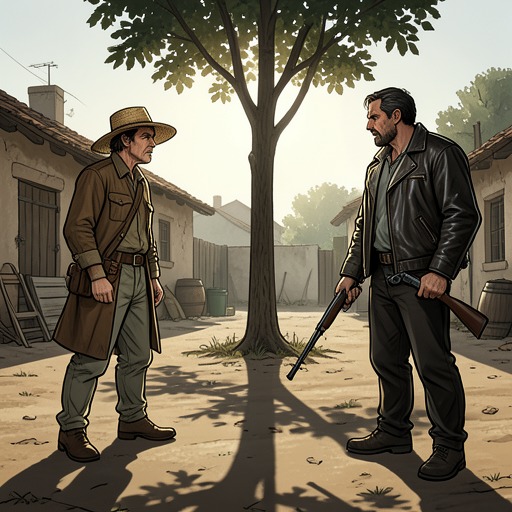
Delaney and Bull Hammer’s Duel at J Bar
The OutlawsThe J Bar fight is the first decisive test of Del Delaney’s ability to face Bull Hammer, the powerful lawman who has been looking for him since their earlier encounter in Baggs. Del chooses the confrontation both to find out whether he can beat Hammer and to draw the lawman’s attention away from Jerry Sewell. He wins the fight, but the victory does not secure his place at the ranch: it brings a threat of retaliation, exposes the strain between Sewell and the J Bar’s visitors, and sends Del and his companions riding south.
Causes and Background
Del’s challenge comes as he and John Smith and The Kid are preparing to leave the J Bar. They had told Stub Rawls after breakfast that they were quitting; Rawls paid them and shook hands with them. At the corral, however, the three saw two riders arriving from Baggs: Bull Hammer and his deputy, Rip Hughes. The Kid judged that they had no reason to get involved with the pair that morning, but Hammer and Hughes soon dismounted and approached the group.
Hammer’s arrival changed the immediate situation for Sewell, who was preparing to brand horses with four of his men. When Del looked toward him, he saw that Sewell was petrified. Del later explains that he did not especially care about Sewell, but the J Bar had sheltered him for a month and provided him with money. He also felt indebted to Rawls. Those considerations gave him a reason to intervene, though they were not the only reason: since The Kid and Smith had hurried him out of the Baggs saloon, Del had been wondering whether he could handle Hammer. With the lawman now at the ranch, he decided to find out.
The Challenge
Del walked toward Hammer and first confronted Sewell about the horses in the corral, asking for a bill of sale. He then called Hammer’s attention to the blow he had received in Baggs about a month earlier. The provocation worked. Hammer turned away from the question of the horses, recognized Del as the man who had struck him, and said he had been searching for him. He removed his gun belt and handed it to Hughes, making clear that the immediate contest would be physical rather than a gunfight.
Del handed his own gun belt to Smith without looking at either of his companions. He understood that Smith and The Kid had once saved him, but that this time he would have to face Hammer himself. The decision was risky. Hammer was larger and stronger, and Del expected him to try to overpower him. Del’s plan was to avoid being caught in Hammer’s grasp and to finish the contest before his own stamina gave out. The confrontation therefore rests on a sharp contrast: Hammer has the advantage in size and strength, while Del hopes to rely on movement, timing, and a quick end to the fight.
Course of the Fight
Hammer began by throwing a punch. Del ducked it and struck back, then moved aside when Hammer tried to seize him. For a time, Del kept clear of Hammer’s reach and continued to land blows, but he could not end the fight quickly. The longer it lasted, the more dangerous it became for him. Hammer changed tactics and began punching rather than simply rushing to grab him. Del avoided many of the blows, until one caught him on the side of the head and knocked him down.
Del’s next actions were partly instinctive: he rolled away as Hammer tried to fall on him, then managed to get above him and strike him while they were on the ground. Hammer shook him off and struggled upright. Del was waiting for that moment. As Hammer stood, Del landed the uppercut he had been seeking, and Hammer went down. Del then retreated to the corral bars and told Hughes to get Hammer onto his horse and leave. The onlookers watched Hammer and Del in turn; Del’s head was still spinning, and he recognized how much the result had depended on landing the right blow at the right time.
Consequences and Significance
Hughes helped Hammer back into the saddle, and the two rode away. The Kid praised Del’s performance, but Rawls immediately warned him to make himself scarce: Hammer would kill him if he caught up with him. The victory had established that Del could defeat Hammer in a fight, not that he was safe from the consequences. Rawls’s warning turns the win into a temporary reprieve rather than a lasting solution.
The encounter also brought the danger directly to the people and work at the J Bar. Sewell, no longer frozen by fear, angrily accused Del of making an enemy of Hammer and bringing trouble down on the ranch. Sewell threatened to beat him, but Rawls stopped the confrontation, reminding him that Del and his companions had already quit. Smith returned Del’s gun, then warned Sewell and the four men with him to stay back. They backed away, and Sewell allowed the group to leave. Rawls’s distasteful look toward Sewell makes plain that the men at the ranch are not united in their response to the visitor who has drawn Hammer’s hostility.
Del, Smith, and The Kid saddled up and rode south before Sewell could change his mind. They did not speak until they had crossed the Little Snake River. By then Del’s head, shoulders, and arms were hurting, and he knew he could not remain on his horse much longer. They stopped among cottonwoods, where Smith helped him remove the saddle. The immediate consequence of Del’s victory was thus both physical exhaustion and another forced departure. The fight resolves Del’s question about whether he can beat Hammer, but it also confirms the cost of testing himself: even a win can deepen the danger for the people sheltering him and send him back onto the road.