Diamond M Ranch
The OutlawsDiamond M Ranch is both the Muldoon family’s home and the economic center of the country around Roily. Founded by Red Muldoon during the region’s early settlement, it prospered by selling cattle to miners; after mining faded, it remained the county’s largest ranch and its only major concentration of wealth. Red’s death turns the property into the prize at the center of a conflict over inheritance, possession, and the limits of local law.
Setting and Economic Foundations
The ranch was established on a river about twenty miles below Roily, after Red brought cattle into the newly opened country. The timing connected its fortunes to the mining settlement: the Roily strike had begun shortly before Red arrived, and miners provided a market for his cattle. The ranch grew into the largest outfit in the county, while Red’s success made him the area’s richest resident.
That prosperity outlasted the boom that had helped create it. By the time of the story, Roily has the appearance of a largely abandoned mining town, and its remaining silver is not being worked because extraction needs a market. The local economy now depends on a few cattle outfits and a little dry farming. In that diminished landscape, the Diamond M is more than a family holding: its cattle and income make it a principal source of private economic power.
The ranch’s importance also has a public dimension. Red said that he kept the county going, though the revenue he contributed was not enough to meet all its needs. With the mines no longer producing tax revenue, the county struggles to pay officials and maintain its operations. Ranching provides some taxes, but the other outfits are small, and even some Roily property owners do not pay. The Diamond M therefore stands against a background of shrinking public resources: its prominence reflects both Red’s success and the wider collapse of the mining economy.
Land and Buildings
The ranch lies beyond Roily along the river. On the ride south from town, the valley opens out before giving way to desert vegetation, with sagebrush, rabbit brush, and junipers replacing the aspens, pines, and spruce along the route. The river bends west near the ranch, whose buildings sit on a bench above the stream. The approach crosses an alfalfa field, linking the property’s working land to its residential center.
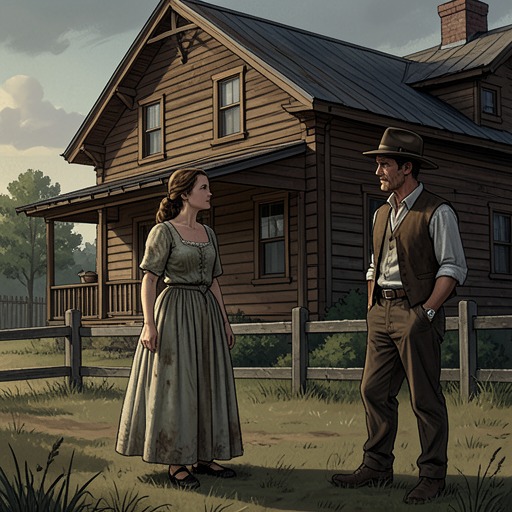
The main house is a large, two-story frame building with one-story additions at both ends. Its size and wings suggest the authority and wealth Red acquired, although the narrator reads this appearance as an impression rather than a confirmed account of Red’s intentions. By the time of the visit, the house has become neglected: the doors and window frames need paint, roof shakes need replacing, and the barbed-wire fence around the house, woodshed, and privy is down in two places. The gate hangs from a single hinge. The contrast between the substantial house and its disrepair gives physical form to a property whose former prosperity has not prevented deterioration.
The ranch also used high-country grazing ground. In summer, cattle were brought to good grass near timberline, where Red had taken them to pasture. When Kate’s party reaches that area, no cattle are present. The abandoned Enterprise Mine stands nearby, its broken windows, sagging doors, rusting machinery, and collapsed roofs recalling a separate failed investment in the region’s mineral wealth. The mine is not part of the ranch, but its ruin places the Diamond M’s continuing cattle operation beside the remains of the boom that once supported local fortunes.
Red Muldoon and the Ranch’s People
Red’s authority extended beyond ownership. He served two terms in the state legislature and remained county commissioner almost until his death, even when his declining health kept him at home. Though he was never sheriff, he backed the sheriff and pressed for enforcement when he believed the officeholder was not doing the job. The ranch’s economic weight and Red’s political influence reinforced one another: he was not merely a wealthy landowner but a figure who helped shape county affairs.
Max Landon’s place at the ranch began when he arrived in Red’s life at fifteen. Red took him in, and after Max had been given food and decent clothes, he proved to be an exceptionally hard worker. Red effectively raised him, kept him in the house after Red’s wife died, and eventually made him foreman. At twenty, Max took that position after the previous foreman had to quit following a stampede. Red regarded him as nearly a son and expected him to manage the outfit, a history that helps explain why the eventual inheritance dispute is not simply between an owner’s child and a hired hand.
The ranch workforce changes as Red’s control gives way to Max’s. Kate has not been out to the property during the summer and is told that only Bill Rogers, the cook, remains from the old crew. Rogers had been with Red when the first herd was brought across the San Juans from the San Luis Valley. Max has dismissed the former crew and hired men he considers loyal to himself. This change leaves Kate without the working support she might have expected to find on her father’s ranch, while making clear that control of the property includes control over its employees.
Inheritance and Possession
After Red dies, Max has possession of the ranch, while Kate’s right to inherit remains uncertain until the will is read. She believes the estate, including the ranch and cash in the Roily bank, may exceed one hundred thousand dollars. The uncertainty matters because the ranch is not the estate’s only asset: Red also had savings accounts and a checking account used for operating expenses, and Max had access to that checking account.
The will names Kate as heir to Red’s land, stock, and cash, apart from his personal possessions. It expresses Red’s wish that Max continue as foreman under Kate and eventually become a full partner. If Kate dies, however, the entire estate is to pass to Max. The document thus recognizes Max’s long service without making him the present owner, while placing the future partnership under Kate’s authority. Because Max already occupies the ranch, the legal declaration does not itself settle who will exercise control on the ground.
The conflict exposes the distance between ownership and possession. Before the will is known, Kate’s supporters anticipate that Max may refuse to leave even if the property is hers; they also consider the possibility that she might have to challenge a will that favored him. Once the actual terms are read, Judge Bailey tells Max that he must vacate within twenty-four hours if Kate does not want to employ him. The ranch’s succession therefore turns on more than the language of the will: it also depends on whether its terms can be enforced against the man already controlling the property.
Narrative Significance
The Diamond M concentrates the story’s economic and political stakes in a single place. Red’s cattle business prospered when the mines created a market, but the decline of mining left the ranch unusually powerful even as the county’s tax base and ability to enforce decisions weakened. The property’s value is consequently both material and institutional: it comprises land, livestock, and money, but its contested control also tests whether a formal inheritance can prevail over possession.
Its changing household and workforce sharpen that test. Max’s history as a boy Red took in and a foreman trusted with the outfit gives him a genuine connection to the ranch, while the will makes Kate its heir and leaves any future partnership conditional on her employing him. The old house, still imposing but visibly uncared for, reflects the gap between the Diamond M’s former prosperity and its present uncertainty. Against Roily’s abandoned mills and faltering county government, the ranch remains a working source of wealth—and the contested ground on which family loyalty, authority, and legal rights collide.