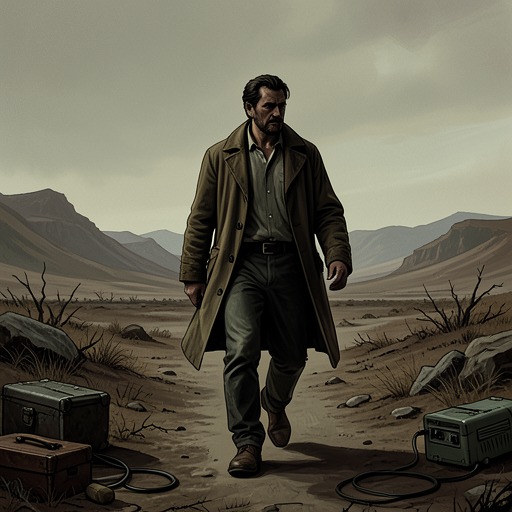
John Smith
The OutlawsJohn Smith is a fugitive whose quiet manner conceals a life shaped by a killing, a bank robbery, and a decision to leave the road behind. His story distinguishes him from The Kid: both are wanted men, but Smith is burdened by remorse over a killing he believes he could have avoided, and he ultimately resolves to return home and face the law.
Identity and Introduction
Smith enters the story as the older man seated with The Kid. When Del Delaney joins them, The Kid introduces the older man by the name John Smith. Del remarks on how many people bear that name, and Smith responds with a wry acknowledgment that it is common enough to be the real name of some of them. The exchange establishes the name without clarifying whether it is Smith’s birth name or an alias.
Smith’s reserved disposition emerges through Del’s observations over time. Del has often seen a grave, even sad expression on Smith’s face, and says he has never known him to laugh and has seldom seen him smile. That bearing acquires meaning when The Kid later explains the killing Smith has been carrying with him: unlike The Kid, Smith is sorry about what happened.
The Killing and the Charge
According to The Kid’s account, Smith had worked at a bank and killed a man who had been his employer. The Kid says Smith liked the man, which makes the killing more than a simple act of hostility. Smith discovered the man in bed with his wife and shot him before he could leave the house. The novel gives this account through The Kid’s retelling to Del, rather than through a scene from Smith’s past.
The Kid presents the killing as an act Smith regrets, and as the source of the sadness Del has noticed. Del thinks a jury might not have convicted Smith, reasoning that many communities would regard a husband’s killing of a man found with his wife as justifiable homicide. The Kid confirms that Smith himself believes he might have been acquitted. But a trial would also have meant enduring the proceedings and exposing his wife to them; Smith chose to leave instead. The account therefore separates the likely legal argument from Smith’s own decision: even if acquittal seemed possible, he did not want to pursue it.
Smith faces a first-degree murder charge in his home community. He tells Del that, in practical terms, he is also implicated in The Kid’s criminal life: he helped The Kid hold up one bank, and being recognized could bring consequences. His circumstances are not identical to The Kid’s record, however. The Kid says he has killed three men and held up, or helped hold up, six banks; Smith’s acknowledged bank involvement is helping with one robbery. The distinction matters: association and shared flight put Smith at risk, but do not make their histories interchangeable.
Flight and Companionship
Smith and The Kid become Del’s companions as he flees Montana. Del crosses into Wyoming, avoids larger towns and county seats, and lives with discomfort in exchange for freedom from the prospect of Deer Lodge penitentiary. The evidence does not establish the precise circumstances of Smith’s own departure from home, but it places him among men whose movement is constrained by the possibility of arrest and recognition.
In one early saloon episode, after Del strikes a man and the room falls still, Smith takes Del by one arm while The Kid takes the other. Both urge him to leave, and Smith warns him not to argue if he wants to live to old age. Del registers an urgency in their voices that he had not noticed before. Smith’s intervention is practical rather than showy: he helps move a companion out of a situation that has abruptly become dangerous.
Later, Smith and The Kid are working with Del at the J Bar, hazing cattle back from the river that marks the ranch’s southern boundary. Their work provides the setting for The Kid’s disclosure of Smith’s past. The conversation also clarifies how the three men differ. The Kid is glad he killed a man who had bullied him; Smith, in The Kid’s account, regrets killing a man he had liked. Del’s own hope of avoiding further crime contrasts with The Kid’s insistence that men like them cannot simply go back. Smith’s position is less absolute: he recognizes that his past has made him vulnerable, yet does not present continued outlaw life as his only possible future.
Loyalty Under Pressure
Smith’s loyalty becomes clearest when Del considers whether he and The Kid should avoid taking on still more trouble. The Kid answers that he is already deeply involved, citing his killings and bank robberies. When Del asks Smith whether he is in as deep, Smith says he is, both because he helped with a bank robbery and because the murder charge at home remains. His answer acknowledges the danger without claiming that every part of his past is the same as The Kid’s.
After Del returns to Mrs. Horton’s place, Kate Muldoon runs to meet him and embraces him. Smith comes from the barn with a broad grin and greets Del warmly. Later, when Del and Smith discuss the danger posed by Max Landon’s influence over local law, Del asks whether Smith wants out. Smith refuses. He says he has less at stake than Del but signed on to see the matter through, then asks Del to tell him what happened without making it sound easy. The exchange presents his commitment as deliberate: he understands that the odds are poor and still chooses to remain beside his companions.
Decision to Return
At the close of the evidence, Smith is walking beside Del and Kate after Kate declares her attachment to Del and Del affirms that the bond is mutual. Smith appears pleased, as though he had expected this resolution. He then says he has been having the notion of going back home to face the music, judging that it would be better than continuing to run, whatever the outcome.
The choice reverses the pattern that has governed his life since the killing. Smith once avoided a trial to spare himself and his wife its ordeal; now, after years of flight and further entanglement through a bank robbery, he contemplates returning to face the consequences. The evidence does not say what happens when he gets home or whether he is tried. His ending is therefore a decision, not a reported legal resolution. It nevertheless marks a clear departure from The Kid’s conviction that an outlaw can only keep evading capture: Smith sees facing judgment as preferable to running indefinitely.