Justice requires enforcement of the law
The Outlaws“Justice requires enforcement of the law” is the principle Del Delaney reaches when he finds that formal rules alone cannot secure fairness or safety. The novel tests the idea from two directions: Delaney is pursued under a false accusation, while in Roily the judge recognizes that he cannot make the law protect Kate Muldoon from a powerful adversary.
The Principle and Its Limits
The expression is stated directly in Delaney’s reflection that justice cannot exist where the law is not enforced. It is not an argument that legal procedure is irrelevant: Delaney arranges for Red Muldoon’s will to be read, and Judge Bailey can preside over a trial. The problem is that procedure without the ability to ensure a fair outcome or enforce a decision becomes an empty assurance.
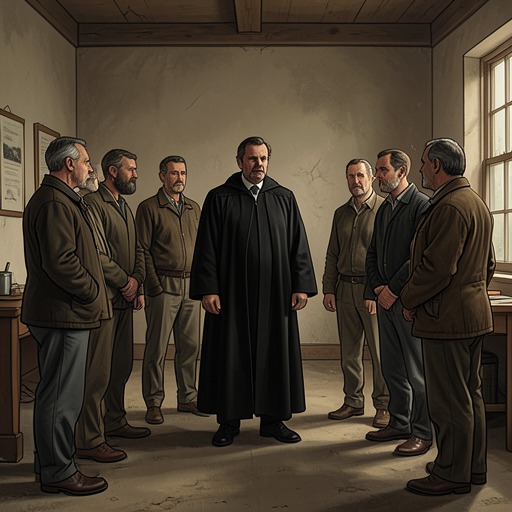
Bailey describes the limit in practical terms. He can conduct a trial, but he cannot make jurors decide justly when they fear the consequences of ruling against Max Landon. Nor can he force Landon off the Diamond M or protect Kate from an attack. The judge’s account makes enforcement more than a matter of arrest or punishment: it includes the ability to secure testimony, sustain a fair decision, and protect the person whom the law is supposed to serve.
Delaney as the Accused
Delaney’s own history shows the law operating against an innocent person. His name appears on reward notices in Montana because of a rape charge he says is false, a crime he insists he would never commit. In Prairie City, Sid Blackwell arrives at Delaney’s home with a gun and arrests him on that charge. The episode establishes an important contrast: law’s coercive power is readily exercised against Delaney, but that force does not make the accusation just.
Later, in Roily, another authority uses the reward notice to detain him. The official orders Delaney to surrender his gun belt and enter a cell, then says he will wire Prairie City to have Delaney collected. He treats the drawing on the notice as a match and speculates that Delaney may have assaulted a banker’s daughter, although the evidence in the scene does not establish that claim. Delaney sees that resistance would be suicidal and complies. Across these encounters, official procedure can confine him quickly, while the truth of the charge remains unresolved in the immediate situation.
Roily’s Unequal Protection
Bailey also explains why Kate’s position is precarious. He says that, if a case came to trial, it would be her word against Landon’s, and that a stranger’s testimony carried little weight in the county. The danger is compounded by the jurors’ knowledge of what may happen if they decide against Landon. Law exists in name, but fear distorts the conditions under which it could operate.
The judge is candid about his own limits rather than claiming powers he does not possess. He can notify Landon and preside over a trial, but he cannot compel a jury to be impartial, remove Landon from the ranch, or guarantee Kate’s safety. His admission turns the legal crisis into a direct question of responsibility: when the recognized institution cannot enforce its judgments or prevent violence, who can act in its place?
Delaney’s Response
Delaney answers Bailey that he can protect Kate and will do so. His commitment does not erase the distinction between justice and private force; instead, it exposes the dangerous gap between them. The law remains the standard by which Delaney judges the county’s failure, but its practical absence pushes him toward personal intervention.
The will reading provides a limited counterpoint. Bailey explains that Red left the ranch and his money to Kate, while Landon had access to the operating account and knew its balance. The document gives the dispute a formal legal framework, but the judge’s warnings make clear that a written entitlement is not by itself a guarantee of security. The expression therefore links legal authority to its material consequence: rules can define what is right, yet justice depends on whether someone can make those rules effective.