Little Snake River
The OutlawsThe Little Snake River is a practical landmark in the novel’s western landscape, joining concealment, travel, and ranch work. Its banks offer temporary cover to Del Delaney and his companions, while later crossings mark their progress through a country where the river’s bottomland is both a route and a resource for cattle. It is not merely scenery: the river helps shape where people stop, how they move, and how the land is used.
Setting and Terrain
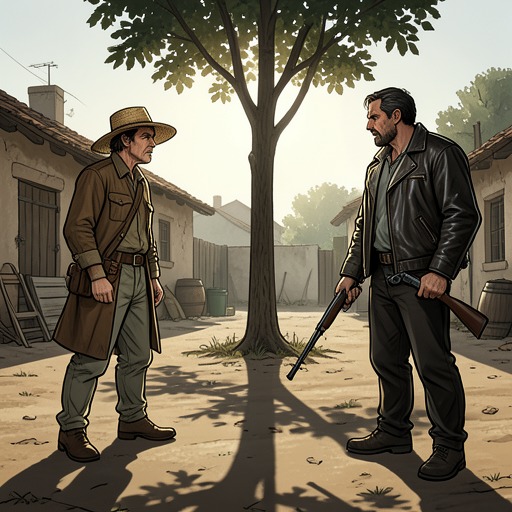
The river appears as part of a working, open country of cottonwoods, grass, and grazing land. On one journey, after riding about three miles, The Kid directs the group off the road toward the river. They reach its north bank through a thick stand of cottonwoods, dismount, remove their saddles, and stake their horses. The trees and riverbank make a concealed stopping place rather than a settled destination.
The river also helps orient the ranch landscape. The J Bar Ranch buildings stand on a ridge overlooking it, placing the water and its bottomland within view of a working cattle property. Nearby bottomland has been heavily grazed, and the available grass is part of the reason a herd of two-year-olds is moved away from the river toward higher country to the east. The account links the river’s low ground to the seasonal management of pasture, not just to the travelers’ route.
Shelter and Exposure
At the north-bank camp, the group chooses not to build a fire. The Kid explains that a fire could reveal their position if Bull Hammer came looking for them. The decision gives the river setting an immediate tactical purpose: the cottonwoods offer a place to stop, but concealment depends on avoiding signs that would disclose the camp. The riverbank is therefore a brief refuge, not a guarantee of safety.
The stopping place also becomes the setting for Del Delaney’s frustration with being watched over. He objects to being treated as though he needs care, while The Kid and John Smith explain why they have intervened on his behalf. They describe Bull Hammer as a forceful lawman in the surrounding area, making the camp’s secrecy part of a wider concern about power and danger. The scene ties the quiet river setting to the uneasy circumstances of men living beyond ordinary security.
Crossing and Movement
The Little Snake River recurs as a point of passage. After a violent encounter at the J Bar Ranch, Del Delaney and his companions saddle up and ride south. They do not talk until they have crossed the river; afterward, they stop in a grove of cottonwoods, where Del, exhausted and badly aching, spills from his saddle. John Smith takes the saddle off for him. In this episode, crossing the river separates the immediate departure from the pause that follows, and the river’s grove provides a place where Del’s condition can be attended to.
The river’s role in movement contrasts with its role at the first camp. There, the group leaves the road and stays concealed on the north bank; later, they ford the water while traveling south. The repeated use of the same landscape feature gives the route continuity without making the river a fixed boundary or a destination. It is a place to turn aside, cross, and regroup as circumstances change.
Ranching and Narrative Significance
The river’s bottomland belongs to the practical economy of the J Bar Ranch. Stub Rawls puts Del Delaney and his companions to work moving a sizeable herd of two-year-olds from the low ground near the river toward higher country. The winter has been hard, mountain grass has come up slowly, and the bottomland has already been overgrazed. The drive is thus a response to both pasture conditions and the need to move cattle when the upland range is ready.
Across these episodes, the Little Snake River connects vulnerable travelers with the routines of ranch life. Its banks shelter men trying to remain unnoticed; its crossing marks a southward departure; and its adjoining grassland is part of the work of sustaining a herd. The river’s significance lies in this recurrence through different uses: it is simultaneously a route, a temporary hiding place, and a feature of the land that cattlemen manage.