Max Landon
The OutlawsMax Landon’s life is bound to the Diamond M Ranch, where a chance arrival as a penniless teenager becomes the foundation of his authority and, ultimately, his conflict with Kate Muldoon. Patrick Muldoon raises him almost as a son and entrusts him with the ranch’s management; the will makes him a prospective partner but leaves the estate to Kate. Landon’s refusal to accept her independence turns that unequal inheritance into a struggle over both the ranch and the law that protects it.
Identity and Background
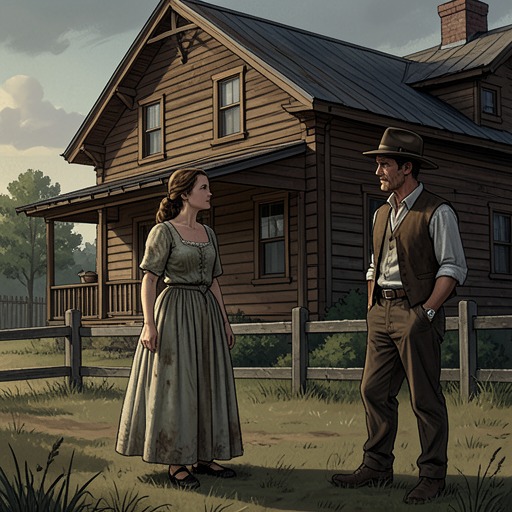
Landon enters Patrick Muldoon’s life at fifteen, arriving one evening on a horse Patrick considered nearly worthless. The boy wanted work. Though Patrick was ordinarily strict with cowboys seeking food and employment, he took pity on him. Patrick’s wife would not initially let the filthy newcomer into the house; after Landon was cleaned up, given decent clothes, and fed, however, his diligence became evident. He proved an exceptionally hard worker, a quality Patrick admired.
After Patrick’s wife died, Landon continued living in the house. Patrick had him in mind to manage the ranch once he was old enough, and Landon’s practical knowledge of ranch work seemed to suit the role. When Landon was twenty, the foreman was injured in a stampede and had to leave the job. Landon took over and remained foreman. Patrick regarded him as nearly the son he had never had, while Kate later described him as someone who had been raised alongside her without becoming a brother in affection.
Position at the Diamond M
Landon’s authority rests on more than his early employment. As foreman, he occupies the position Patrick had prepared for him, and the will sets out a path toward an even greater stake: Patrick leaves the ranch, livestock, and cash to his daughter, Katharine Ann Muldoon, while wishing that Landon remain foreman under her and eventually become a full partner. If Kate dies, the will directs that the entire estate go to Landon. This is a conditional inheritance, not an immediate transfer of ownership.
Landon had access to the Diamond M’s checking account for operating expenses, giving him knowledge of the available funds. The ranch and Patrick’s savings and cash were the will’s principal assets, though the exact amount was not established in the passage. The arrangement reflects Patrick’s trust in Landon’s management, but it also leaves Kate with the authority to employ him or refuse to do so. Judge Bailey tells Landon that, if Kate does not want him as foreman, he must leave the property within twenty-four hours.
Relationship with Kate Muldoon
Patrick’s affection for Landon complicates the father-daughter relationship. He had hoped Kate would be a boy and, after her mother’s death, did not know how to raise her; housekeepers did much of that work, and he eventually sent her away to school. He nevertheless took her hunting and fishing and loved her, while, in Kate’s account, giving Landon some of the affection she felt she might have received had she been a son. Patrick also wanted Kate to marry Landon, believing marriage would keep the ranch under Landon’s management and that a woman could not run it herself.
Kate says she never could stand Landon. She describes him as brutal and sneaky, and suspected he was stealing from Patrick, though she had no proof. Landon had pursued marriage with her since she was fifteen. When Kate threatened to kill herself rather than be forced into the marriage, Patrick did not press her, but she understood that he still wanted the match. Bill Rogers later says that Landon had never forgiven her refusal and might want her dead for that reason as well as for control of the ranch. The will reading confirms the distinction between Patrick’s trust in Landon and Kate’s distrust: she is the heir and can dismiss him, while he is not entitled to ownership as long as she lives.
Power, Violence, and the Law
The conflict becomes lethal when Landon hires men to kill Kate. Del Delaney tells Adam Jessup that three men have been sent after her; two are dead, and one identified Landon as the man who hired him. The dying would-be assassin confirms that Landon paid him, while describing Landon as safe. The disclosure makes Landon’s pursuit of Kate more than a dispute over marriage or ranch management: he is using hired violence to remove the person whose survival bars his claim to the estate.
His power is also sustained by a local justice system too weak to oppose him. Judge Bailey describes Landon as the effective law in the county, with a sheriff who sides with whoever is winning and no meaningful help expected from neighboring counties or the state. Bailey believes the people who remain in the community cannot withstand Landon by force. The judge’s account gives institutional weight to Kate’s danger: the legal will names her as owner, but its protections have little practical force while Landon commands the stronger position locally.
Delaney intends to tell Landon that Kate is alive and will attend the will reading, hoping Landon will react violently and give him a chance to kill him. At the reading, Bailey states the will’s terms and tells Landon he must leave if Kate will not employ him. Landon challenges the will’s validity, accusing Bailey of having written it and claiming Patrick would not have signed it while sound of mind. His objection does not change the terms Bailey has read aloud; it exposes Landon’s unwillingness to accept Kate’s authority over the ranch.
Death and Narrative Significance
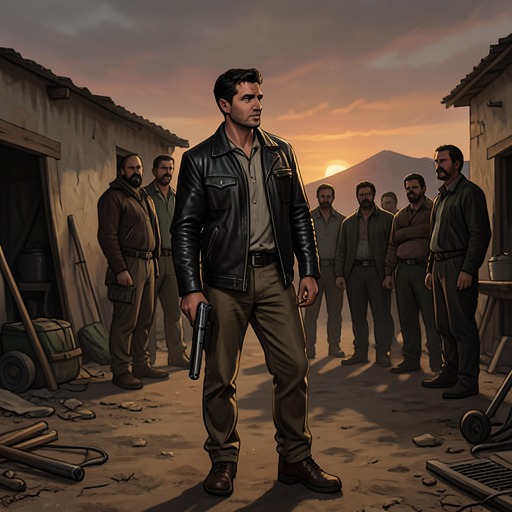
In the street confrontation, Landon draws his gun and fires first, narrowly missing Delaney. Delaney returns fire. Landon is struck and falls, his second shot going wide; Delaney approaches and concludes that Landon will never again carry out a killing or hire an assassin. Landon’s death ends the immediate threat he posed to Kate and removes the person whose survival, under the will’s terms, stood between him and the estate. The evidence establishes the will’s terms and the end of Landon’s violence, but does not specify the subsequent operation or ownership of the ranch.
Delaney’s account of Landon’s motives emphasizes greed for a fortune that was not legally his while Kate lived, alongside jealousy or resentment over her refusal to marry him. Landon had been treated by Patrick as a son, yet that intimacy did not produce brotherly loyalty toward Kate. His arc turns on the contrast between the place Patrick gave him and the place the will actually grants him: trusted foreman and possible partner, but not heir ahead of Patrick’s daughter. When lawful authority proves unable to protect that distinction, the plot resolves the conflict through a gunfight rather than through the county’s institutions.