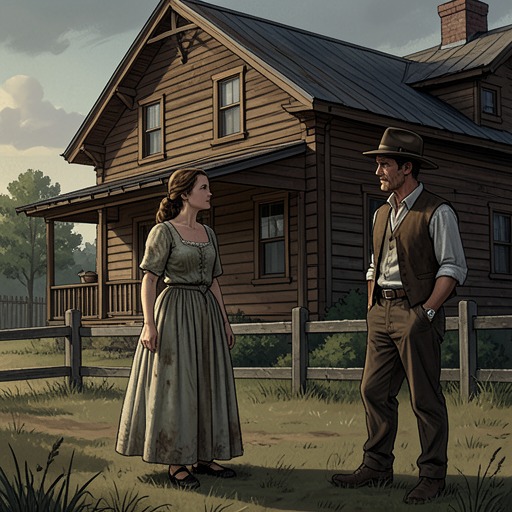
Mrs. Horton
The OutlawsMrs. Horton is the proprietor of a remote country lodging on the North Fork and, when Kate Muldoon arrives seeking safety from Max Landon, becomes the person who can give her refuge. Her welcome is practical rather than sentimental: she takes Kate into her arms, then scrutinizes Del Delaney and restricts how his companions may protect Kate inside the house. The contrast defines her role. She is a source of shelter, but not an unquestioning ally to the men surrounding Kate.
Identity and Setting
Kate remembers the place as somewhere her father used to take her fishing when she was a child. Later, she rode there alone and stayed for weeks. Mrs. Horton runs what Kate describes as a country hotel for people who fish or hunt, as well as visitors seeking relief from the lower-altitude heat around Cortez and Durango. The property lies in a valley reached by turning off the road and traveling several miles up the North Fork; its relative remoteness makes it a possible refuge from the danger in Roily.
Kate calls the proprietor Aunt Becky, but Mrs. Horton makes clear that this name belongs to Kate alone and identifies herself as Mrs. Horton. That distinction suggests a private bond rather than a general title by which the local community knows her. She is at least seventy, and her first encounter with Kate is marked by astonishment: she had thought Kate was in New York and needs a moment to accept that she is standing at the door. Her surprise gives way to an embrace and repeated reassurance, before she turns her attention to the unfamiliar man accompanying Kate.
Refuge for Kate
Kate tells Mrs. Horton that Del has saved her life twice that night and that Max has tried to have her killed. She asks to stay, explains that two friends are outside, and says she has hired them as bodyguards and will pay for their keep. Mrs. Horton accepts the arrangement. She directs the men to a corral and a cabin beside the house, and tells them she will call them for breakfast, with punctuality attached to the invitation.
Her hospitality is concrete but bounded. She does not invite Del into the house or respond warmly to him; instead, she ushers him back outside and shuts the door. Del takes this reception as evidence that she has more than a conventional fishing and hunting resort: he believes she also provides a hideout for outlaws and recognizes him as one. That conclusion belongs to Del’s interpretation, not to an independent account of Mrs. Horton’s business. Still, her willingness to accommodate Kate’s armed protectors at a secluded property gives his impression a clear basis in the scene.
Suspicion and House Rules
Mrs. Horton’s caution extends to the entire party. When she meets John Smith, she remarks that she has encountered many people called John Smith but that he does not resemble the others. Her observation is wry and guarded rather than welcoming. She also expects three men, and her later rules distinguish among them: Del and John may divide the overnight watch inside the house, but The Kid must remain outside.
The restriction produces an open clash. The Kid laughs at Mrs. Horton’s distrust and accuses her of being willing to betray Kate to Max. The accusation is his, not an established account of Mrs. Horton’s intentions. Her furious response, however, confirms that the distrust between them is real; she rises and begins to threaten to throw him out. The exchange shows that her protection of Kate does not erase her reservations about those who claim to protect her. Nor does the text establish that she trusts Del or John completely: she permits them a place in the house for a watch, while keeping The Kid beyond its nighttime boundary.
Character and Narrative Role
Mrs. Horton’s conduct combines care with command. She comforts Kate without hesitation, accepts the responsibility of sheltering her, and sets the household terms herself. Her care is personal, grounded in Kate’s childhood connection to the place, while her acceptance of the men is conditional and shaped by her judgment of their character. She can welcome the endangered woman and reject the presumed entitlement of her protectors in the same encounter.
That distinction matters because the three men do not share an identical history. The Kid admits to killing three men and taking part in six bank robberies; John Smith says he helped in one robbery but also faces a first-degree murder charge at home. Mrs. Horton’s exclusion of The Kid from the house therefore sits alongside a group whose members have different pasts and different prospects. The narrative does not explain the full basis for her decision, so it should not be treated as a verdict on their relative guilt. It does show her asserting control over who may stand watch within her home. As Kate’s host, Mrs. Horton is not merely a hiding place: she is an independent, wary presence who makes refuge possible while refusing to let gratitude or danger dictate all the terms.