One for all and all for one
The OutlawsOne for all and all for one is John Smith’s phrase for the solidarity among himself, The Kid, and Del Delaney. It gives their companionship the shape of a shared pledge, formed under the pressure of outlaw life but not strong enough to erase their distinct histories or determine a common ending.
The Phrase and Its Immediate Context
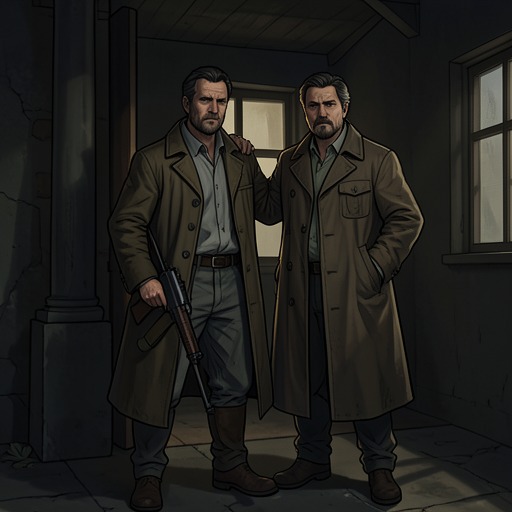
Del Delaney considers leaving rather than drawing his companions further into trouble. The Kid answers that the three are not breaking up, and John Smith likens them to the three musketeers, invoking the motto as a compact statement of their unity. The Kid does not recognize the reference; Del Delaney does, having read the book in his mother’s library. The exchange sets the literary ideal of fellowship beside the group’s rough, practical circumstances, with John Smith supplying a cultural allusion that The Kid cannot share.
Solidarity Under Pressure
The pledge is grounded in more than affection. The Kid insists that he has no way back: he has killed three men and held up, or helped hold up, six banks. John Smith likewise regards himself as deeply implicated because he helped The Kid rob a bank and faces a first-degree murder charge at home. Their circumstances make mutual loyalty consequential: staying together means sharing exposure to the law, not merely claiming a bond.
The contrast with Del Delaney’s position sharpens the phrase’s meaning. He privately considers taking a riding job and avoiding further crime, hoping that the charges against him may eventually be dropped. His companions’ commitment to one another does not automatically settle his choice; instead, the exchange makes visible the tension between the possibility of individual escape and the group’s insistence that it remains intact.
Limits and Later Reversal
The motto expresses a moment of unity, not an unbreakable pact. Later, as Kate Muldoon and Del Delaney prepare to marry, John Smith says that he has been considering going home to face the consequences rather than continuing to run. His decision gives the earlier declaration a changed meaning: solidarity has marked their life together, but it does not require each man to evade the law indefinitely or to follow the same path. The phrase captures a real bond while leaving room for separation through individual choices.