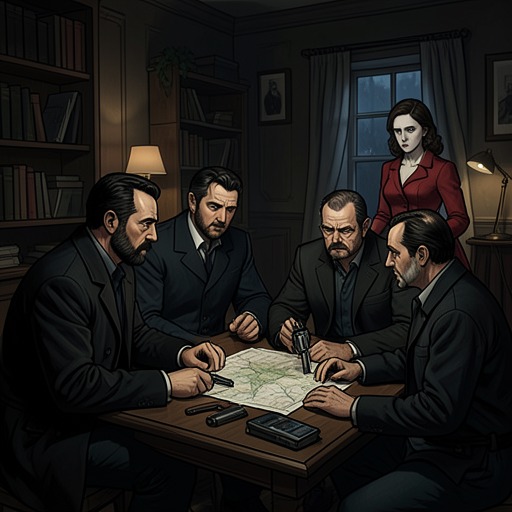
Plan to Rob the Bank in Roily
The OutlawsThe Plan to Rob the Bank in Roily is a proposed crime that brings Del Delaney, the Kid, and John Smith to a crossroads between continuing as fugitives and imagining a more settled life. First suggested as a way to raise money for a ranch, the robbery becomes a practical scheme because each man believes that lawful life is already beyond his reach. Its importance lies not only in the proposed theft but in the different motives the three attach to it—and in how quickly events in Roily redirect them.
From flight to the prospect of a stake
Del’s willingness to consider the robbery grows out of his flight from Montana. After crossing into Wyoming, he avoids larger towns and county seats, obtains food by hunting or buying supplies at country stores, and endures late-spring rain and occasional snow. He prefers discomfort and uncertainty to imprisonment at Deer Lodge penitentiary, but freedom on the run offers little security or future. That predicament gives Rawls’s suggestion its force: the choice is framed not as an ordinary opportunity for profit but as a way to secure a stake before the law catches up with them.
Rawls raises the possibility while discussing the young men’s prospects. He points out that the three seem to get along and could pool their efforts to buy an outfit, but recognizes that they lack the money to do so. As a possible source of capital, he names Roily, an old mining camp in the San Juan Mountains. Its mines have played out, but the town remains a county seat, with officials and clerical workers among its residents, and it still has a bank. Rawls supposes that the bank may contain little money, yet enough for the purpose he has in mind. His proposal turns a general wish for independence into a specific destination and target.
Del does not assent immediately. The thought of prison, a posse, or having to shoot to avoid capture has made him question whether a life of flight is bearable. At the same time, he recognizes that the charges against him might eventually be dropped if he commits no new crime. At Trout Lake, he asks the Kid how deeply he is involved with the law, testing whether there remains a possibility of breaking away before the group commits another offense.
The companions’ different stakes
The Kid answers that he has little room to retreat: he says he has killed three men and held up, or helped hold up, six banks. He has spent much of the money gambling and says women in Helena and Butte received the rest. His record makes the robbery seem to him less like a fresh fall into crime than a continuation of a life from which he sees no return. Yet he also admits that he would like to own something and work with partners he trusts. The ranch prospect therefore appeals to him as more than a way to spend stolen money: it suggests property, work, and a small circle of dependable companions, even though he cannot identify a place where they would feel safe.
Del’s position is different. He has been considering leaving the others, finding a riding job, and avoiding further trouble while there may still be a chance of clearing his name. The Kid’s admission forces the decision into sharper terms: Del can reject the scheme, but cannot pretend that all three face equal legal risks. He ultimately agrees to proceed with the Roily bank plan and asks whether the Kid will put his share toward the ranch rather than spend it. The Kid readily agrees, while acknowledging that the desire to change may not make him a different man.
John Smith also considers himself unable to return safely to an ordinary life. He has helped the Kid hold up one bank, and he faces a first-degree murder charge at home. Del observes that Smith might have a chance of acquittal because the killing could be treated in many communities as justifiable homicide, but Smith considers the charge an enduring fact. The proposed robbery thus gathers three distinct histories under one plan: Del’s flight from an accusation, the Kid’s extensive record of violence and bank robberies, and Smith’s participation in a robbery alongside a serious charge at home.
The proposed method and its disruption
The Kid describes a straightforward approach. The three are to ride into town as cowboys looking for work, stable their horses, take rooms at a hotel if one is available, look over Roily, and eat breakfast before going to the bank when it opens. For their departure, he proposes riding down the canyon rather than returning the way they came. That route would avoid making the escape an uphill ride; timber in the other direction might also offer concealment if something went wrong. He has not been to Roily before, so this is a provisional plan, based on his expectation of the terrain rather than firsthand knowledge.
Before the scheme can proceed as intended, a girl pleads with Del not to leave her alone, saying that the men after her will kill her if he does. Del worries that her dependence will bind him indefinitely and anticipates the Kid’s and Smith’s anger if the plan is spoiled. He considers getting her out of town and letting her choose where to go, but also decides he need not abandon the robbery. The moment makes the two demands collide: the planned theft with his companions and the immediate responsibility he feels toward someone in danger. The evidence establishes his attempt to hold both possibilities open, not that the robbery is carried out the next morning.
A plan overtaken by Roily
The subsequent Roily conflict brings a different danger to the fore. Adam Jessup explains that townspeople fear opposing Max Landon because the Diamond M’s business sustains his bank and other local livelihoods; he admits that residents have discussed resistance but have been unwilling to risk their security. A preacher, by contrast, promises to help when the time comes. Later, with Landon’s men threatening the town, Jessup says that the old submission has become intolerable and that the town will have to begin living freely or die. Kate Muldoon understands that the outcome will affect the county, not only herself and Del.
These later developments change the meaning of the original plan. Rawls presented Roily primarily as a vulnerable source of money, and the three fugitives initially assessed it through the practical needs of escape and survival. But the town becomes a place where the question is no longer simply how to get away with a crime: local people must decide whether to resist a powerful man whose interests shape their livelihoods. The supplied narrative does not show the bank robbery being completed. Instead, the Kid’s plan is overtaken by the confrontation in Roily, and Smith later says he is considering going home to face the consequences rather than continuing to run. The intended route toward a ranch and a fugitive life gives way to choices about responsibility, public resistance, and whether the men can stop living as outlaws.