Roily's boom days
The OutlawsRoily’s boom days are the vanished mining prosperity against which the town’s present decline—and even its renewed violence—is measured. The mines once supported a busy camp and a functioning county government; after their business ebbed, empty buildings and fragile public finances made the past visible in the landscape and consequential in local power struggles.
The boom in the landscape
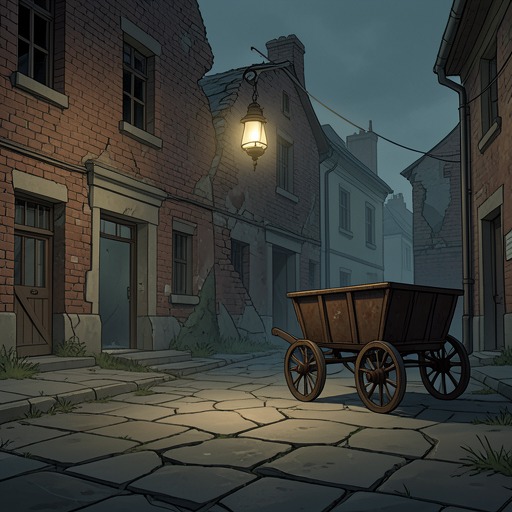
When the narrator reaches Roily, the town lies in a narrow canyon beneath immense mining dumps. The remains of ore mills stand skeletal on the mountainsides, while many log cabins are empty, their windows broken and doors hanging askew. Boarded-up buildings and padlocked storefronts make the former camp feel remote in time, although its busy past is described as comparatively recent. The courthouse, a substantial brick building above the business block, is a surviving sign of civic ambition amid the desolation.
The traces of mining do not mean that the region’s silver has simply vanished. A bartender insists that silver remains underground, but that extraction needs a market to make it worthwhile. His recollection of the camp’s former activity—and of the people who came to it—sets the abandoned mills against the possibility of resources still present but no longer economically accessible. Roily’s decline is therefore tied not only to the mines themselves but also to the conditions required to work them.
Mining wealth and local dependence
The boom had once provided the county with substantial tax revenue. Judge Bailey recalls that officials were paid in those days and that the courthouse employed two janitors. With the mines no longer paying taxes, the county struggles to meet its expenses: Bailey sometimes waits three months for his salary, and even some town property owners do not pay their taxes because business is so poor. The lost mining economy has thus diminished the capacity of local government as well as the town’s commercial life.
Ranching partly fills the gap, but it does not restore the old balance. The ranches are mostly small operations, with the Diamond M the major exception; Red Muldoon maintained that his ranch kept the county going, though Bailey says its contributions were not enough to make the finances whole. Red also backed the sheriff when enforcement failed, continuing to press him until Red’s health grew too poor for him to leave the house. The contrast is telling: the county’s authority once relied in part on a wealthy rancher’s support, while in the present Bailey cannot make his rulings effective if the sheriff will not enforce them or collect fines.
The decline is also apparent in everyday work and commerce. The town’s remaining livelihood comes from a few cattle outfits and a little dry farming, while the bartender describes the loss of the establishments and visitors that had animated the boom camp. The business block and its bank remain, but they stand amid mostly shuttered buildings. Roily’s former prosperity survives more securely in recollection than in its current economy.
The mines’ human cost and afterlife
At the Enterprise Mine, the narrator and Kate see broken windows, sagging doors, rusting machinery, and roofs collapsed under winter snow. Kate recalls that her father said the owners spent more than a million dollars developing the property. He did not know how much silver was recovered, but the company went bankrupt, and Eastern investors—including widows and older people—lost their savings. The scale of the abandoned machinery records the scale of the investment, while the mine’s failure registers as financial loss reaching far beyond the canyon.
The surrounding high country also retains a practical connection to Red’s ranching. Near timberline, the grass is good, and the narrator understands why Red brought cattle there in summer; none are present when the party passes. The abandoned industrial site and the empty grazing ground offer different signs of a diminished working landscape: one recalls costly development and failure, the other a seasonal use that has ceased, at least for the time being.
A measure of the present
Roily’s past is not merely a backdrop to its current conflicts. When the narrator seeks help against Max Landon, the banker explains that the townspeople fear losing the Diamond M’s business and cannot risk opposing a man they know. The bank is his livelihood, and he expects that Landon could ruin him by withdrawing the ranch’s business. The boom’s legacy of dependence has therefore not disappeared with mining: the town remains vulnerable to whoever controls a major source of local income.
The old days also provide a measure of danger. A stableman says that men have been shot to death in Roily, something he associates with the boom days, and reports gossip that Landon intends to confront the narrator. Whether or not the threat is true, residents are staying indoors. The memory of the boom thus carries two contrasting meanings: it recalls a town full of activity, but also an earlier era of lethal disorder. In the present, Roily’s diminished economy leaves its people with little security against either kind of power.