The Kid
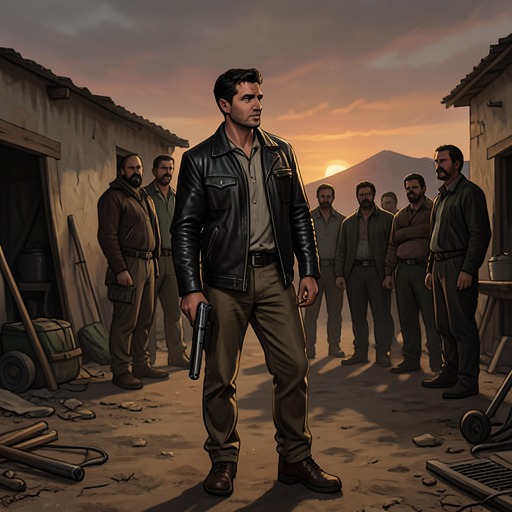
The OutlawsThe Kid is an outgoing young outlaw whose easy friendliness conceals a capacity for lethal violence. He joins Del Delaney and John Smith on the trail and later in their confrontation with Max Landon, where his willingness to act decisively proves costly: wounded in Roily, he dies after helping drive Landon’s crew out of town. His story sets personal loyalty beside an accumulating criminal record, and ends with a choice that he understands as preferable to capture.
Identity and Introduction
The Kid first meets Del Delaney in a Baggs hotel dining room, where he notices Del eating alone and invites him to share a table with John Smith. He introduces himself by the name people use for him, not by a fuller personal history. Del judges him to be roughly eighteen to twenty: slight and small-boned, with a thin mustache. The invitation is a simple act of welcome, and it matters to Del, who has been isolated during his flight and work in the West.
At first, The Kid seems to make a friend of every stranger. Del likes him, but also senses that the genial manner conceals a dangerous person. That impression is later confirmed by The Kid’s own account of having killed a man. The contrast between his sociability and his capacity for violence becomes central to how Del understands him: friendliness is genuine, but it does not make him harmless.
The Kid says he came from a cowtown in eastern Oregon. When Del meets him in Baggs, he and Smith have already been there for a couple of days and plan to travel up the Little Snake River to take work with a cattle outfit. By the end of their fourth week at the J Bar Ranch, Del suspects that nearly everyone in the crew, apart from Stub Rawls, is on the run from trouble. The Kid’s past eventually gives that suspicion a concrete basis.
Violence, Flight, and the Outlaw Life
While moving steers back from the river along the J Bar Ranch’s southern boundary, The Kid tells Del about killing a man. The incident took place during supposed horseplay in which the men pretended to shoot at each other. The Kid describes the other cowboy as bigger and stronger, a bully who used his size to mistreat him while presenting the abuse as a joke. Del cannot be certain whether The Kid intended the killing, but the hard feelings behind it lead him to suspect that the shot may not have been accidental.
The Kid fled because he expected the sheriff not to accept the episode as harmless play. Del’s first impression of him thus becomes more than a passing suspicion: The Kid’s pleasant manner coexists with a readiness to kill, and the threat of law has already set him moving from place to place. His flight is not, however, the whole explanation for his outlaw identity. He presents himself as someone who has gone too far to return to an ordinary life.
When Del suggests that he and Smith might avoid making their situations worse, The Kid answers with the scale of his record: he says he has killed three men and held up, or helped hold up, six banks. He has little money to show for those robberies, having gambled most of it away and spent the remainder on women in Helena and Butte. The detail undercuts any simple image of criminal success: repeated robberies have not made him secure, and the proceeds have not provided a way out.
The Kid urges Del to accept that they cannot simply go back and proposes robbing another bank. Smith, in turn, says he is implicated because he helped The Kid hold up one bank and faces a first-degree murder charge at home. Their records and circumstances are not identical: The Kid’s account emphasizes repeated violence and robberies, while Smith’s charge arose after he shot a man he found with his wife. The Kid himself distinguishes their responses, describing Smith as sorry for what happened even though he is also wanted. Together, the men’s stories show that shared flight does not erase the different causes or meanings of their crimes.
Companionship and Conflict
The Kid’s connections to Del and Smith develop through shared danger rather than a long account of their pasts. Del appreciates the companionship after prolonged isolation, and his liking for The Kid does not prevent him from recognizing the danger he presents. The Kid, for his part, speaks plainly when Del considers leaving before becoming more deeply involved. His response is not an appeal to a lawful future; he insists that he is already too far in and treats further outlaw action as the only direction left to him.
His attitude toward Mrs. Horton is sharply different from his later warmth toward Kate Muldoon. When Del finds him saddling his horse, The Kid has decided to leave rather than remain under Mrs. Horton’s roof. He complains about her and says he has had enough of her. Although he speaks dismissively of women in general, he makes an exception for Kate, whom he considers different. This contrast establishes a personal ease between them without suggesting that he has become broadly less abrasive.
When The Kid meets Del, Smith, and Kate again in Roily, he greets the men with exuberant familiarity. He has heard disturbing talk since riding into town. On seeing Kate, he removes his hat, bows awkwardly, and apologizes for swearing in her presence. Kate responds with a kiss on his cheek and says that she is accustomed to cursing because her father was known for it. The exchange briefly displaces the gunmen’s tension with uncomplicated affection, and The Kid’s embarrassment makes visible a deferential side that his earlier bravado might obscure.
Final Action and Death
As the conflict in Roily reaches a standoff, the others look to Del for a plan, but Del has no certain solution. The Kid takes the initiative, says he will fix the situation, and heads for the back door. He tells Del to stay out of it until it is time for him to act, explaining that he means to flush their opponents out of their hiding place. The move is characteristic of his willingness to turn a deadlock into action, but its consequences are grave.
During the ensuing violence, Del realizes that Charles Nathrop had shot Landon’s man from the hotel roof. He then finds The Kid down near the hotel porch, with Smith beside him. Though The Kid has been fatally shot inside the hotel, he has remained on his feet long enough to force Landon into the street and drive Landon’s crew out of town. He tells Del that Hawk Sloan drew on him and that he managed to hit Sloan, but not before Sloan’s shot took effect. The account confirms that The Kid’s final intervention helped break the standoff even as it cost him his life.
The Kid remains conscious long enough to acknowledge Del and Smith and to recall Smith’s prediction that he was born to hang or be shot. He says he is glad not to be hanging, then dies. The response around him marks the loss plainly: Smith weeps, Del holds The Kid’s hand, and a doctor confirms his death. The ending does not erase the violence or the crimes that brought The Kid there. Instead, it leaves him defined by both the danger Del recognized at their first meeting and the loyalty and resolve he shows in the final crisis.
Narrative Role and Significance
The Kid’s arc makes outlawry a condition with practical consequences rather than a single, uniform identity. His killing, flight, bank robberies, gambling, and lack of a viable return all establish the criminal life he has chosen and the narrowing options he believes remain. At the same time, the narrative distinguishes him from Smith, whose murder charge follows a different personal circumstance, and from Del, who considers avoiding further crime. Their companionship does not make their histories interchangeable.
His death gives that distinction a final shape. The Kid does not escape the consequences of violence, but at the decisive moment he uses his willingness to act for the group’s immediate safety. He helps force Landon’s men from Roily and dies before the others can carry the conflict further. His last preference—to die rather than hang—echoes the fatalistic language Smith had used about him, while his final acknowledgment of Del and Smith makes clear that he understands himself not only as a fugitive but as their companion.