2007 earthquake
The Outsider (Stephen King Edition)The 2007 earthquake is the point after which Marysville Hole is no longer treated as an accessible attraction but as a fragile, closed underground system. Though the shaking was described as only a three or four on the Richter scale, it brought down stalactites and collapsed passages; the damage made an already dangerous cave a lasting threat to anyone who entered it.
The Cave Before the Earthquake
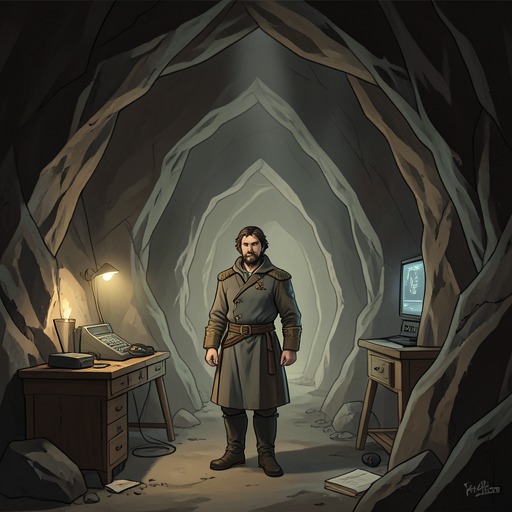
Marysville Hole had been a major Texas cave and tourist destination. Visitors were taken in groups of about a dozen, with the Chamber of Sound—described as cathedral-like—among the principal attractions. Its acoustics carried a guide’s whispered Pledge of Allegiance from a point hundreds of feet below to visitors above, while pictographs and stalactites were viewed by Coleman gas lamp. An iron spiral staircase, with more than four hundred steps, descended toward the chamber; the account of its damp conditions and rusting iron makes clear that the spectacle depended on precarious infrastructure as well as natural formations.
The cave’s complex passages had already proved dangerous before the earthquake. When two eleven-year-old boys became lost, a rescue party entered after hearing what seemed to be their cries from the Ahiga side. The sounds were misleading: the cave’s acoustics made the boys seem closer than they were. During the search, a gunshot was believed to have triggered a collapse, killing the trapped boys and rescuers. The earthquake did not cause that earlier tragedy, but it changed the conditions under which anyone might later attempt to navigate the cave.
Damage and Closure
After the 2007 earthquake, Marysville Hole was considered too dangerous to remain open. The Chamber of Sound reportedly survived relatively well, but numerous stalactites fell from its ceiling, and other passages collapsed. The Art Gallery was specifically identified as one of the damaged sections. Both the main entrance and the Ahiga entrance were believed to have been blocked, ending public access and leaving the cave’s interior altered and difficult to assess.
The modest reported Richter magnitude contrasts with the severity of the consequences underground. As Lovie Bolton explained, caves are fragile: a relatively limited earthquake could leave some chambers standing while bringing down formations and sealing other routes. The distinction matters because the danger was uneven. The familiar tourist chamber might appear to have endured, even as the surrounding passage network had become less stable and less predictable.
The Earthquake’s Later Consequences
The earthquake’s damage remains physically present during the later investigation. Deep in the cave, Ralph Anderson finds a narrowed passage crowded with rubble on both sides and a cavity in the roof where the rock has fallen away. Holly Gibney identifies the loose material as debris that a previous rescue party had pushed aside rather than removed. The visible collapse turns the cave’s history into an immediate obstacle: the investigators are not moving through an intact attraction but through a damaged space where old debris and unstable rock constrain their choices.
The Outsider uses that history to warn Ralph against firing his gun. It points to the earlier rescue disaster in Devil’s Slide, where a gunshot and falling rock brought catastrophe, and argues that another shot could bring down stalactites or cause the top of the bluff to collapse. The threat exploits a real structural vulnerability: the earthquake had already demonstrated that the cave’s passages and ceiling could fail. Thus, the 2007 event supplies no supernatural explanation for the danger, but it gives the final confrontation its material stakes—Ralph’s weapon might endanger Holly and the others as well as his opponent.
Narrative Significance
The earthquake functions as a boundary in the cave’s history. Before it, Marysville Hole is a worked and visited attraction, complete with guided routes, lamps, stairs, and promotional signage; afterward, it is closed, damaged, and increasingly defined by blocked entrances and buried passages. Its effects extend beyond the original tremor, shaping what can be explored and how safely the investigators can act years later.
That persistence also links natural catastrophe to the cave’s earlier human disaster without confusing their causes. The rescue party’s fatal collapse was attributed to a gunshot and the cave’s acoustics; the later earthquake independently weakened and altered the underground structure. Together, these histories make Marysville Hole more than a backdrop: its sound, confusing routes, and damaged roof govern movement, distort judgment, and turn any use of force into a risk of collective entrapment.