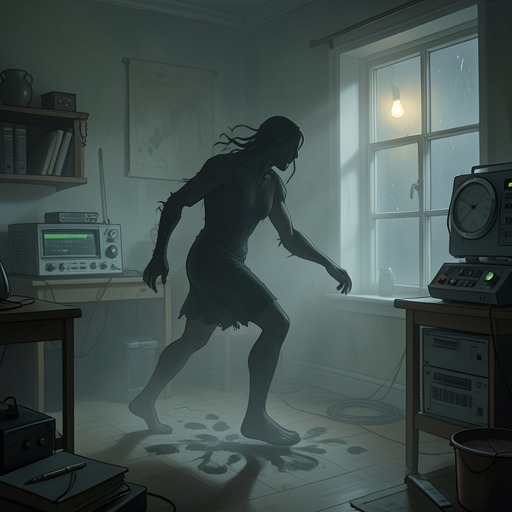
Discovery of the outsider’s residue in the Anderson home
The Outsider (Stephen King Edition)Holly Gibney’s discovery of the outsider’s residue in the Anderson home turns Jeannie Anderson’s account of an impossible visitor into something visible. Using an improvised black light, Holly finds faint stains on the chair and carpet where the intruder had been. The marks do not settle whether he was physically present or projected into the house, but they begin to erode Ralph Anderson’s disbelief; Jeannie’s recollection that the intruder also switched on the stove light makes the evidence more disturbing, not less.
The Test
At Holly’s request, Ralph closes the kitchen shades and Jeannie draws the living-room drapes, darkening the rooms before full daylight. Holly sits at the kitchen table with markers and Scotch Magic Tape bought in Walmart’s office-supplies department. She covers her iPhone’s embedded flash with two short strips of tape colored blue, then adds a third strip over them and colors it purple. The mundane materials become a makeshift investigative instrument.
Holly asks Ralph to confirm which chair the intruder sat in, then takes two flash pictures of its seat. At the archway, she identifies the spot where he had sat and photographs the carpet there as well. Ralph points out that he saw no marks on the carpet the morning after the intrusion. That absence is part of the puzzle: the test is not simply documenting an obvious trace, but searching for what ordinary sight missed.
Ralph recognizes what Holly has made: a makeshift black light, a trick he has known about for years but had not used. Holly explains that she is looking for stains or residue like the material found in the barn. A commercial kit called CheckMate can be bought online for this sort of test; she learned the technique from Bill Hodges. She cautions that any residue here may be much fainter than the barn material, which would explain why it escaped notice without the altered light.
What the Photographs Reveal
The pictures show a faint yellowish spatter on the chair seat where Jeannie’s intruder sat. Several more spots appear at the carpet’s edge by the archway, resembling small drips of paint. Holly enlarges one stain on the phone screen and points out that it forms a right angle, which she identifies as the mark of one of the chair legs. She then photographs the chair again from a low angle. Enlarging that image, she traces a stain to the point where the residue dribbled down the leg.
The marks offer a physical trace without resolving the nature of the presence that left them. Jeannie notes that the chair has left no corresponding marks in the carpet. If the visitor was there in a physical sense, she reasons, he must have been extraordinarily light—perhaps no heavier than a feather pillow. Holly’s suggestion that projection might exhaust the outsider is presented as a possibility, not as a proven explanation. The residue and the lack of ordinary pressure marks make the scene harder to dismiss, while refusing to fit neatly into an everyday account.
Evidence and Uncertainty
When daylight returns, Ralph takes Holly’s phone and swipes back and forth through the photographs. The images become a turning point in his response: he feels his wall of disbelief beginning to crumble. The change comes not from a complete theory, but from repeated, inspectable details on a small screen—the stain on the seat, the drops by the archway, and the right-angle mark Holly connects to a chair leg.
Jeannie asks the practical question the pictures cannot answer: whether the intruder was truly in the house. Holly says she has not yet done enough research to offer an answer she trusts, but if forced to guess, she would say he was both there and not there. Her formulation preserves the contradiction rather than explaining it away. Holly is confident that something was present when Jeannie came downstairs, and Ralph agrees; the precise relationship between physical residue and projection remains unsettled.
The Stove Light
As Holly starts to leave, Jeannie remembers an additional detail: the light above the stove burners was on. It has its own button and must be switched on deliberately. Her earlier excitement gives way to fear as she draws out the implication: the intruder had been present enough to operate it. Holly and Ralph say nothing in response. The memory does not prove that the visitor carried Jeannie or establish how he entered or left; it adds one concrete action to the traces in the photographs, and sharpens the question of what kind of presence could leave stains, move through the house, and activate a switch without leaving the expected marks.
The discovery therefore changes the investigation without closing it. Holly’s improvised phone test makes the outsider’s visit materially legible, while the chair’s lack of impressions and the possibility of projection keep that material evidence uncanny. For Ralph, the photographs weaken a conviction that had resisted his wife’s account; for Jeannie, the stove light turns an eerie report into a specific memory of agency inside her home. The evidence supports both a real intrusion and an unresolved contradiction about how the intruder was there.