Flint City Golden Dragons
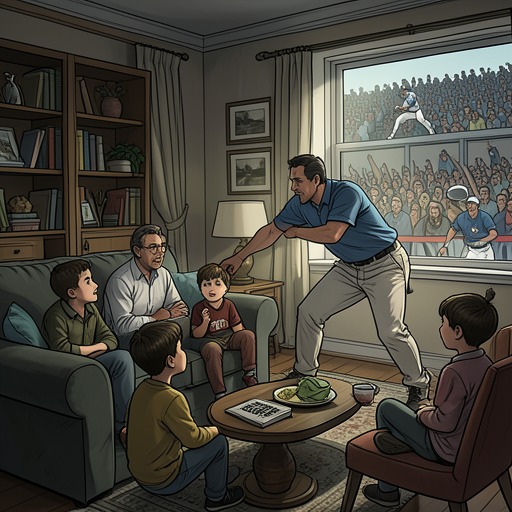
The Outsider (Stephen King Edition)The Flint City Golden Dragons are the youth baseball team coached by Terry Maitland. Their tense league semifinal at Estelle Barga Field becomes the setting for Terry’s arrest before a crowd of nearly sixteen hundred people, including his wife and daughters. The team’s game is interrupted at its most consequential moment, making the ballfield a public stage for an accusation whose evidence has not yet been fully tested.
The Team and Its Home Field
The Flint City Golden Dragons play in the City League, whose tournament games are all held at Estelle Barga Field, described as the best baseball field in Flint County and the county’s only venue equipped with lights for night games. Because no team has a fixed home-field advantage there, that advantage is decided by a coin toss. The shared venue gathers supporters of both teams and turns the semifinal into a community event.
On the July evening of the game, the parking lot is full. Cars bear Golden Dragons stickers, while rear windows display slogans anticipating victory and a trip to Cap City. The field lights are already on, though daylight remains, and cheers and rhythmic clapping rise from the stands. These details establish the scale and enthusiasm of the occasion before the police arrive: Terry is not taken from an isolated workplace but from a crowded game where his role as coach is visible to the community.
Terry Maitland as Coach
Terry calls tails before the game, following a superstition passed down from his own City League coach. He likes to get his “lasties”—the final opportunity to bat—and repeats that preference to his players. The ritual links his present authority as a coach to his earlier experience as a player, while the phrase also anticipates the team’s final chance in the semifinal.
In the bottom of the ninth, the Bears lead by one run. The Golden Dragons have two outs and the bases loaded, so a walk, wild pitch, error, or infield hit could tie the game, while a hit into the gap could win it. Terry keeps Trevor Michaels in the batting order rather than replacing him with a pinch hitter. Trevor is short and nervous, but he often draws walks and can sometimes make contact. Terry weighs the immediate chance of winning against the lasting embarrassment Trevor might feel if taken out, and against the pride the boy could carry for years if he succeeds. His choice presents coaching as attention to a young player’s future, not merely an effort to maximize the team’s chances in one at-bat.
The Arrest Interrupts the Game
The Bears’ closer throws a first pitch down the middle, and Trevor watches it pass for strike one. Before the next pitch, the home-plate umpire calls time as two officers enter the field. The interruption shifts attention away from the bases-loaded game situation and toward the police, while the crowd falls quiet and the umpire orders the officers off the field.
Troy Ramage and Tom Yates ignore the umpire and enter the Golden Dragons’ dugout, a makeshift space with a bench, equipment baskets, and a bucket of practice balls. Ramage produces handcuffs. The players and spectators can see what is happening; a teammate, Gavin, hurries toward the officers, insisting that the game must be finished, but Yates pushes him back. The Bears’ players stop preparing for the next pitch and watch. The game’s ordinary contest is suspended as the arrest takes precedence.
Public Humiliation and Its Aftermath
Terry is handcuffed and read his rights in front of almost sixteen hundred people. His wife, Marcy, reaches the chicken wire separating the spectators from the field and demands to know what the officers are doing and why they are doing it there. Sarah and Grace are crying nearby. Terry understands that the scene is not simply an arrest: it is a public shaming, and he cannot comprehend why it is happening. He tells Gavin to step back, then asks Marcy to contact his lawyer, Howie Gold.
As the officers take Terry to an unmarked car, a newspaper photographer follows and takes pictures. Terry notices the scoreboard Marcy had helped fund and sees her standing near it; her expression becomes part of what he knows he will remember about the arrest. The team’s field, ordinarily the place where Terry leads children through a game, has become the backdrop to a public accusation. He recognizes that his life will not soon return to normal.
Narrative Significance
The Golden Dragons’ semifinal brings together the story’s central contrast between ordinary communal trust and the force of a criminal accusation. Terry is introduced in the scene as a coach making a considered decision for a child, but the police action abruptly makes him the object of suspicion before a large audience. The interruption also gives the accusation a public form: spectators witness the arrest before the investigation has resolved the conflict between the case against Terry and the evidence that later complicates it.
That conflict is sharpened by the investigation’s haste. Ralph Anderson knows that the police do not yet have all the background and that Terry may claim an alibi, yet he and the prosecutor decide the danger of delay outweighs further checking. Ralph later recognizes that the investigators should have examined Terry’s movements in advance; at the time, they had feared that inquiries would alert a dangerous suspect and believed the existing evidence was strong. The Golden Dragons’ game thus marks not only Terry’s removal from the field but also the visible consequence of an investigative decision made before its most important contradiction had been tested.