Flint County Courthouse
The Outsider (Stephen King Edition)Flint County Courthouse, known locally as the Chicken Coop, is the nine-story glass building where Terry Maitland is brought for arraignment and where the case against him reaches a fatal public climax. Its role is not merely administrative: the move from jail to courthouse carries Maitland past reporters and a hostile crowd, while the public setting makes the consequences of the investigation visible and ultimately irreversible.
Setting and Relocation
Until 2015, the courthouse stood beside Flint County Jail, allowing prisoners awaiting arraignment to be escorted directly between the two buildings. After the old courthouse ceased to serve that function, a partly constructed Civic Center occupied the neighboring site, and prisoners had to be transported six blocks to the new courthouse. The replacement was a nine-story glass box, mockingly called the Chicken Coop.
That distance changes the character of the trip. The arraignment is no longer a short transfer between adjoining institutions; it becomes a procession through the city, with police vehicles, a transport bus, and a crowd able to gather along the route and at the courthouse steps. The building’s exposed, modern appearance contrasts with the former courthouse’s Gothic stone setting, but the more consequential difference is how the new route brings the accused into public view.
The Arraignment and Public Spectacle
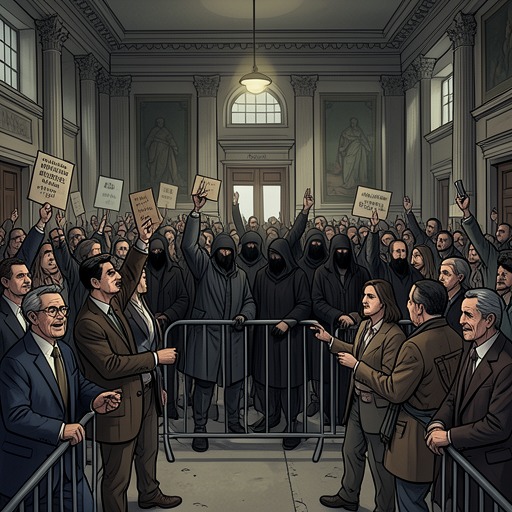
On the morning of Maitland’s arraignment, police cars and a short blue bus wait outside the jail. Reporters, camera operators, and spectators assemble behind police barriers, some carrying signs that call for Maitland’s execution or condemn him as a child killer. Marcy Maitland sees the signs as she comes down the jail steps; Howie Gold takes her hand and urges her not to give the photographers anything but the top of her head.
The crowd grows as the procession reaches the courthouse. Reporters press for positions, spectators jostle, and the police struggle to keep the steps and sidewalk clear. As Sheriff Doolin and the assistant district attorney escort Maitland toward the entrance, Marcy reaches for her husband but is pushed back. The crowd’s hostility intensifies into a chant as the party starts up the steps. The legal transfer has become a public judgment before the arraignment can proceed.
Shooting and Immediate Consequences
During the ascent, Ralph Anderson recognizes a man in a newspaper sack and summer watch cap as Ollie Peterson, Frank Peterson’s brother, and sees that he is reaching into the bag. Anderson fires. A fleeing spectator collides with him, and the shot strikes a television camera instead of Ollie. Ollie fires again, and Anderson shoots back; the final shot kills Ollie on the courthouse steps. Maitland, still handcuffed, is also struck and dies there, while Marcy reaches him and cries for help.
The violence collapses the distance between the courthouse’s formal purpose and the consequences of the investigation that brought Maitland there. The arraignment does not resolve the case. Instead, a public legal proceeding ends in two deaths, leaving Maitland unable to answer the accusation and his family to confront his death in front of the same crowd that had come to condemn him.
The Courthouse and the Case’s Reversal
The courthouse’s place in the novel is tied to the investigators’ earlier certainty. Before Maitland’s arrest, Ralph had reservations about proceeding without fully testing the alibi he expected Maitland to offer, but he and the district attorney believed the evidence justified moving ahead. The alibi and later information undermine that confidence: witnesses place Maitland elsewhere, and an account of his presence at a Harlan Coben lecture in Cap City conflicts with the time of the abduction described by a witness.
Later, the district attorney explains publicly why the prosecution proceeded: investigators did not have all the relevant facts at the time of the arrest and arraignment, and DNA evidence appeared to match Maitland, though the samples from Figgis Park were mixed. That explanation underscores the courthouse’s double significance. It is where the state’s case is formally advanced, but also where the cost of treating an incomplete evidentiary picture as settled becomes impossible to ignore. The Chicken Coop’s public steps turn legal process into spectacle, while the events there expose the gap between accusation and certainty.