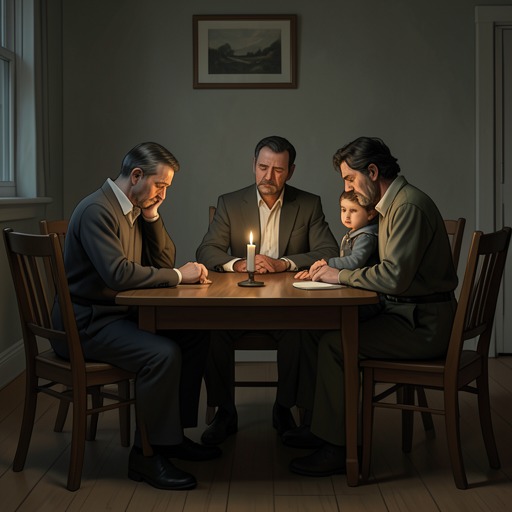
Fred Peterson
The Outsider (Stephen King Edition)Fred Peterson is the father of Frank Peterson and Ollie Peterson, and the husband of Arlene Peterson. After Frank is murdered, Fred’s family is caught in a succession of losses: Arlene collapses and dies, and Fred later attempts suicide. He survives but is left in a coma with minimal brain function. His story gives the murder’s aftermath a domestic scale, tracing how bereavement disrupts family roles and silences those left to endure it.
Identity and Family Life
Before the family’s crisis, Fred and Arlene had divided their household responsibilities: Fred earned the money, while Arlene handled bills and practical arrangements. At his last physical, their doctor had urged Fred to help Arlene manage her type two diabetes and lose weight; Fred still regarded her as beautiful, but the advice became one more ordinary concern eclipsed by Frank’s death. Ollie, their older son, was seventeen. Frank’s murder made Ollie the only surviving son in the household, a change Fred recognizes even while trying to think about what his remaining family needs.
Fred is not accustomed to organizing the family’s affairs. After Arlene dies, he understands that he must take responsibility for her funeral because there is no one else to do it, but even the question of how to pay for a second funeral so soon after Frank’s overwhelms him. That reversal of roles—the spouse who relied on Arlene’s practical competence now having to manage the arrangements—makes grief inseparable from daily obligations.
Frank’s Memorial and Arlene’s Death
At the gathering after Frank’s funeral, Fred and Ollie clean up while condolence visitors stream through the house. The gathering had been winding down when news arrived that Terry Maitland had been arrested for Frank’s murder; the announcement brought a second wave of visitors, some of whom spoke angrily about the possibility of the death penalty. Fifty or sixty people passed through, including neighbors, well-wishers, and members of Father Brixton’s church. Fred and Ollie worked quietly, unable to offer one another the consolations they had spent hours receiving from other people.
Arlene remained on the sofa after the last guests had left. Fred had thought she might finally be able to release the grief she had held in, but the scene instead turns abruptly into another family emergency. In the kitchen, Arlene begins laughing; the laughter rises into a hysterical episode, and she says she thinks it may be her heart. Fred tries to catch her as she falls. Ollie calls for help, while Fred checks for a pulse and attempts CPR. For a moment Arlene opens her eyes and Fred believes she has returned, but the apparent recovery does not last.
At the hospital, a doctor tells Fred and Ollie that Arlene has died despite the medical team’s efforts. Fred’s response is to cry out in disbelief. Ollie later thinks of the family as having changed in a single week from a household of four to one consisting only of himself and his father. The loss does not simply add another funeral: it removes the person who had organized the previous one and leaves Fred and Ollie to face their grief without her.
A Household Without Arlene
When Fred and Ollie return from the hospital, they sit together watching a soccer match neither particularly cares about. Fred eventually retrieves Arlene’s faded red address book and finds the funeral home’s number. Its worn cover and the familiar sight of it in her hands bring back years of her keeping track of family business, and Fred begins to cry. The address book is both a practical tool he now needs and a reminder of the everyday care that has vanished with her.
The practical arrangements expose the extent of Fred’s dependence on Arlene’s work. Ollie finds the burial-insurance papers in a folder in her desk, between the mortgage agreement and appliance warranties. He also finds blank obituary forms that Arlene had copied from the form she used for Frank. Even in grief, she had prepared carefully for the possibility of making a mistake. Ollie fills out an obituary and cleans the kitchen after dealing with the funeral home; Fred is not the one who takes on these immediate tasks. Their roles shift as Ollie quietly manages work that his mother had anticipated and his father struggles to carry out.
After Frank’s memorial, Ollie had surprised Fred by helping clear the house without complaint. Fred understands that his son is grieving too, and that the work Ollie can manage tonight should not become an expectation that he stop being a boy. Fred hopes to let him return gradually to ordinary adolescence, even as he cannot yet think of what to say to him. The silence between father and son is not a lack of care; it is one of the forms their grief takes.
Failed Suicide Attempt and Aftermath
The deaths of Frank and Arlene, together with the prospect of attending two funerals at the same mortuary on the same day—one for his family and one for the man held responsible for Frank’s death—leave Fred unable to imagine enduring the next morning. He attempts suicide in his backyard, using a footstool and a rope. The attempt fails when the branch breaks. A neighbor, Mrs Gibson, gives him mouth-to-mouth resuscitation and helps save his life.
Fred is taken to the hospital with severe consequences. When Ralph Anderson visits, Fred lies in intensive care with his neck bandaged and supported by a cervical collar, breathing with the help of a respirator. The monitors show very low readings, and Jack Hoskins says that he does not think Fred will recover. The doctors give Fred only about a one-in-a-hundred chance of coming back; later, Ralph sees the remaining Peterson family member in room 304, largely unresponsive and still dependent on the machine to breathe.
Fred’s attempt therefore does not restore the family he hopes to rejoin. Instead, it leaves Ollie without either parent able to care for him and turns Fred himself into someone who must be cared for. The attempt is also part of the consequences Ralph observes as spreading outward from Frank’s murder: not only the Peterson family but the Maitland family and people connected to the investigation carry lasting harm. Ralph thinks the damage feels unusually personal, almost as if these families have been targeted, but the account presents that as his perception rather than an established explanation.
Narrative Significance
Fred’s trajectory is shaped by the contrast between the mundane work of family life and the scale of what the murder sets in motion. Funeral arrangements, insurance papers, an address book, cleaning dishes, and a son’s return to being a boy are all practical details; together, they show the lives the violence has fractured. The family’s roles change in quick succession: Arlene first organizes Frank’s funeral, then dies; Fred recognizes that he must handle her arrangements, but Ollie finds the paperwork and fills out the obituary; Fred’s suicide attempt then leaves Ollie without an active parent.
The narrative also makes the damage legible through Fred’s silence and absence. At Frank’s memorial, he and Ollie cannot console one another; afterward, Fred cannot find words for his son. Once hospitalized, he can no longer speak for himself, and Ralph leaves his bedside overwhelmed by what the case has done to the Petersons and others. Fred’s story thus marks the human cost of the investigation’s central crime without reducing that cost to the question of whether one suspect is guilty: the murder’s consequences persist in bereavement, disrupted care, and a household left without its parents.