Marysville Hole Cave Disaster
The Outsider (Stephen King Edition)Marysville Hole Cave Disaster is the failed rescue of the Jamieson twins, whose disappearance drew Roger Bolton, his sons, and other searchers into the cave and ended with a collapse that killed those who went in. Recounted by Lovie Bolton to Ralph Anderson and the investigators, the disaster is both a family history and a practical warning: the cave’s confusing passages, misleading sounds, and fragile rock make it a place where a rescue effort can become a catastrophe.
The Cave and the Missing Twins
Marysville Hole was a vast cave in Texas, with a popular main chamber known as the Chamber of Sound. Its acoustics carried even a quiet voice across a depth of several hundred feet: a guide at the bottom could whisper the Pledge of Allegiance and be heard by visitors above. The chamber also displayed pictographs on its walls and stalactites overhead. Visitors descended by an iron spiral staircase of more than four hundred steps, while guides used Coleman gas lamps to illuminate the cave.
Roger Bolton had explored the less accessible Ahiga side of the cave before taking work as a guide. He and the other guides led groups of tourists through it, but the passages beyond the public areas formed a much less controlled environment: narrow openings branched away from routes such as Snake’s Belly, and the cave’s scale and acoustics could make distance and direction hard to judge.
The Jamieson twins, Carl and Calvin, were eleven when they disappeared. They had entered Snake’s Belly with their parents, near the end of the group, but did not come out with them. Two or three small openings off the passage had not been barred because adults considered them too narrow to matter. The twins could fit through them. Their parents realized they were missing, and the cave’s overlooked side passages turned a family outing into a search.
The First Search and the Collapse
Roger was not leading the group the twins had entered with, but he joined the search party and may have directed it. His sons, who worked part-time at the Hole, came as soon as they heard what had happened. Others joined as the news spread. The searchers could hear the boys calling from openings off Snake’s Belly and identified one opening by a small plastic Chief Ahiga toy that had fallen from a boy’s pocket. But the rescuers could not fit into the opening or reach the toy. They called for the twins to follow their voices and initially thought the boys were getting closer; instead, the calls faded away. The cave’s acoustics had made the apparent direction of the voices unreliable.
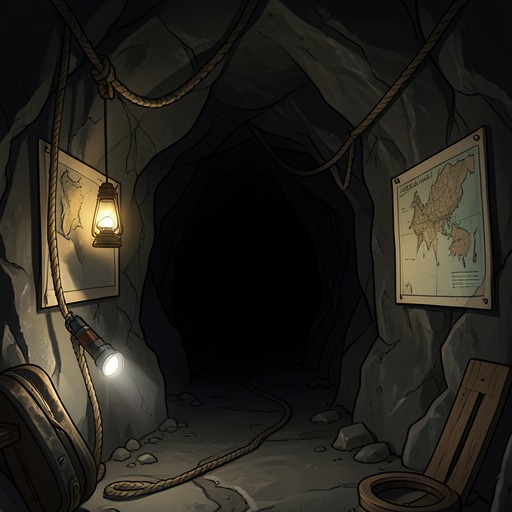
Roger proposed going around to the Ahiga side, which he knew from his earlier explorations. The group heard the boys again there and entered with ropes and lights to reach them. The cave was a maze. Ev Brinkley remained behind to pay out the rope and attach more if needed; he was the one searcher known to have survived, later leaving town for Austin. The others went on, but the rescue did not bring the twins back.
When Brinkley had about a hundred feet of free rope left, he heard a report he compared to a cherry bomb in a closed toilet. Lovie believed that someone fired a pistol in an attempt to guide the rescuers toward the boys, and that the sound brought down part of the cave roof. She specifically rejected the idea that Roger had fired it: whatever his other failings, she did not believe he would have been reckless enough to shoot in a cave. The precise chain of events remained uncertain, but the result was clear to the people waiting outside: the searchers had been cut off by a collapse.
A Second Rescue and an Unfinished Trail
Lovie and her husband, George, reached the cave after dark. The parking lot was nearly full, and work lights and activity around the entrance made the response seem, to her, like a film set. Searchers entered through Ahiga carrying powerful flashlights and wearing hardhats and insulated coats. They followed the rope through sections of standing water to the collapse. Clearing enough rock to pass took the rest of the night and half the following morning. By then, people in the main cave could no longer hear the missing searchers.
The rescuers had left traces as they went: marks on the walls, coins, scraps of paper, and a bowling card from Tippit Lanes. Those clues came to an abrupt stop in the middle of a gallery. A second rescue party continued for a time, but the cave’s many descending branches offered too many possible routes. The searchers feared that shouting could provoke another fall; when one man shouted and a piece of ceiling came down, they withdrew. No one could establish where the first party had gone after its trail ended. Whether its members thought they knew a route back or were trying to avoid further collapse was unknowable.
The disaster was not a single isolated loss: the twins never emerged, and neither did the people who went after them. Lovie says Roger and his two sons, along with other men, are buried less than four miles from where the investigators meet her; she describes the experience as an entire party taken by the cave. Her account also reaches backward into Claude Bolton’s history. Claude was serving six months in the Gatesville reformatory for stealing when the disaster happened. Lovie had been angry and ashamed about his sentence, but later believed it may have saved his life: had he been free, he would likely have joined his father and cousins in the cave.
Closure, Memory, and Later Danger
Over the years, around a dozen search parties entered Marysville Hole. The 2007 earthquake, although only a three- or four on the Richter scale, changed the cave’s status. Caves were fragile, Lovie explains; the Chamber of Sound survived relatively well, but stalactites fell and other passages collapsed, including one called the Art Gallery. After the earthquake, the cave was closed and its main entrance, and probably the Ahiga entrance as well, were blocked.
When Ralph later travels into the cave with Holly Gibney, the old disaster is no longer only a story. They pass signs marking breaks in the downward passage and reach an area where rubble narrows the route. Ralph sees a deep cavity in the roof and recognizes the place where the roof collapsed; the largest pieces had apparently been removed during the second rescue, with smaller rubble pushed aside. The abandoned cave preserves the physical consequence of the old search while complicating the investigators’ own movement through it.
The Outsider exploits that history during the confrontation underground. It reminds Ralph that a rescue party searching for two lost boys suffered a collapse and warns that firing a gun in the present cave might bring down stalactites or cause a larger landslide. It places the threat in a specific geological and historical setting: the same enclosed passages where a gunshot may have helped turn a rescue into a mass death. Lovie’s account thus prepares the investigators—and the reader—to understand why the cave’s acoustics and unstable roof matter beyond atmosphere. The disaster establishes that in Marysville Hole, a sound can mislead, a route can disappear, and an attempt to reach someone in danger can expose everyone involved to the same danger.