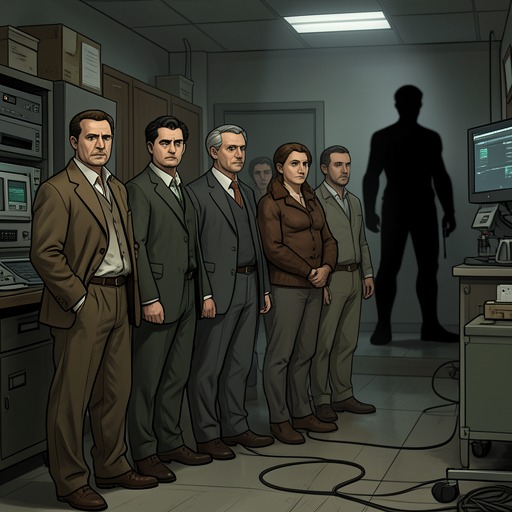
State Police Forensics Unit
The Outsider (Stephen King Edition)The State Police Forensics Unit is the forensic arm involved in examining evidence in the investigations surrounding Frank Peterson’s murder and the later cases connected to it. Its work provides investigators with laboratory findings and comparisons, but those findings do not speak for themselves: the chain of custody, the condition of samples, and the interpretation placed on results all affect their meaning. Across the cases, forensic evidence first seems to close around suspects and later reveals the limits of that apparent certainty.
Role in the Investigations
During the early investigation, the Unit’s work is part of a broader multi-agency effort. Detective Ralph Anderson and Trooper Yunel Sablo convey evidence from the crime scene for forensic processing, while Sablo later supervises the Unit’s examination of fresh evidence. When a new lead sends investigators back toward Dayton, Anderson asks whether the Unit can analyze the material found in the barn; the team’s immediate response is to pursue the location and gather more answers while laboratory analysis remains pending.
That role depends on evidence handling as well as testing. The report on the branch and vehicle samples records who conveyed them and asserts that the chain of evidence remained intact. The details establish a procedural basis for presenting the results, even as the story later questions what those results can establish about identity and guilt.
Physical and Biological Findings
The initial forensic account distinguishes the victim’s blood type from a second type found on the branch and in other locations. The report identifies O-positive blood as Frank Peterson’s and notes traces of AB-positive blood, which the examiner believes may belong to the perpetrator. It recommends checking suspects’ blood types promptly because AB-positive is comparatively rare. These findings offer investigators a concrete avenue for comparison, but the report presents the attribution of the second type as a belief, not an independently conclusive identification.
The Unit also processes samples for DNA testing. Because the crime is exceptionally serious and the victim is a child, samples are moved ahead in the queue, although the report still anticipates that results may take until the following week. The semen sample is identified as a priority for potential matching, alongside skin samples from the branch and blood evidence. The distinction between a sample being prioritized and a result being available matters: early investigative confidence precedes the laboratory comparison that might test it.
Later, fingerprints on a belt buckle are matched to Terry Maitland’s known prints. Yet the technician describes the impressions as faint and broken in places, with an appearance more like the prints of an elderly person. The match is considered sufficient to stand up in court, but the unusual condition of the impressions troubles the investigators. Anderson initially calls the anomaly probably non-substantive, then recognizes that repeatedly dismissing anomalies has itself become a pattern in the investigation.
Repeated Evidence Patterns
The investigation of the Howard sisters’ murders echoes the earlier case. Evidence against Heath Holmes appears to accumulate in familiar forms: a vehicle, fingerprints, surveillance photographs, clothing, and a DNA match between a custody cheek swab and semen recovered at the scene. The parallel makes the cases seem to reinforce one another, but also raises the possibility that forensic and circumstantial clues can be arranged to point convincingly toward the wrong person.
The novel makes that concern explicit through Holly Gibney’s explanation of the apparent biological evidence. The residue recovered from the barn and the Anderson home is not semen or pre-ejaculate, despite its resemblance. She expects that testing may classify its unknown components as contamination rather than recognize it as a distinct substance. She also interprets the semen in the Peterson case as part of the outsider’s pattern of leaving traces, alongside hair and fingerprints. In this account, material evidence is not simply false or true: a genuine sample can still be misunderstood when investigators have no adequate category for it.
Limits and Retrospective Assessment
The later public account of the case sharply qualifies the DNA evidence. The samples from Figgis Park contained DNA from both perpetrator and victim, and they were exposed to ultraviolet light during an unrelated testing procedure. The department consequently regards them as degraded and inadmissible; in the prosecutor’s plain-language characterization, they are worthless. What once appeared to be a direct forensic match is thus undermined by the composition and subsequent condition of the samples.
The Unit’s narrative significance lies in this tension between procedural rigor and interpretive uncertainty. Its reports document blood types, fingerprints, DNA, and custody, while the investigations show how those details can be given more certainty than they warrant. Forensic work is indispensable to reconstructing the crimes, but the novel refuses to treat a laboratory match as an automatic verdict: a sound chain of custody cannot by itself ensure a sound interpretation, and scientific evidence can be compromised, misread, or made to support an already favored conclusion.