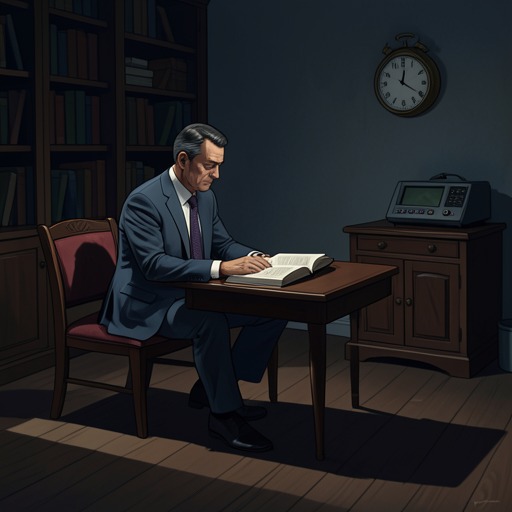
Terry Maitland
The Outsider (Stephen King Edition)Terry Maitland’s public identity as a teacher, coach, husband, and father makes his arrest for Frank Peterson’s murder both shocking and devastating. The evidence appears to place him at the crime, but a strong alibi and a second, impossible set of matching fingerprints eventually expose the deeper truth: Terry was framed by an entity able to take on his appearance. He dies still insisting he is innocent, leaving his family to bear the suspicion that the investigation later formally repudiates.
Identity and Public Life
Terry teaches English at Flint City High School and is known across the West Side as Coach T. The nickname reflects how thoroughly coaching is woven into his life: he coaches Little League, the City League baseball team after the Little League season, and young boys playing fall football. His community reputation is built around ordinary, sustained involvement with children and local sport, not merely his school post.
That familiar standing gives his arrest its public force. During a baseball game, an officer who knows Terry from Pop Warner games arrests him before the bleachers. The crowd numbers 1,588, and a sports photographer captures Terry’s open-mouthed bewilderment as the charge is announced. The photograph appears on the front page the next day; its image of him can be read as both helpless and guilty, making public judgment part of the punishment before any trial.
Terry has a family with Marcy Maitland and their daughters. In the aftermath of the arrest, he understands that the damage will not stop with his own release: he expects Marcy to face whispers and sidelong looks at work and in shops, and fears that friends may withdraw. His roles as coach and teacher, ordinarily sources of trust and belonging, are especially vulnerable to the stigma of an accusation involving a child.
Arrest and the Alibi
Terry is accused of murdering Frank Peterson, and at first the case appears to connect him to the abduction and killing. In the police car, however, he states that he was in Cap City on Tuesday night and through most of Wednesday, returning around nine or nine-thirty Wednesday evening. He names Gavin Frick, Barry Houlihan, and Lukesh Patel as the adults who supervised the boys’ practices while he was away. Rather than treating this account as a reason to stop, Ralph Anderson calls it the famous alibi, and suspicion continues.
Terry elaborates that he did not travel alone. He says he went with Everett Roundhill, Billy Quade, and Debbie Grant, the Flint High School English Department, leaving the school at ten in Roundhill’s BMW because Terry’s Expedition was being repaired. Their destination was a Harlan Coben event. Footage later shows Terry in the audience and, near the fifty-six-minute mark, in close-up as he stands to ask Coben a question. The image confirms that a man who looks exactly like Terry was in Cap City while the case places Terry elsewhere; rather than resolving the contradiction, it deepens it.
The investigation also finds reasons Terry could not have been the person staying in a deserted barn. On the Saturday in question, he took his daughters to the municipal pool in the morning and spent the afternoon at Estelle Barga Park preparing the field as the home-field coach, with witnesses to both activities. From Saturday through Monday he was in the county jail. His known whereabouts become the central obstacle in the case: the evidence points toward him, while the chronology repeatedly places him somewhere else.
A second line of evidence emerges around the van used to abduct Frank. The van had been stolen in Dayton by Merlin Cassidy, a young fugitive who was fleeing an abusive stepfather and later traveled south toward Texas, stealing vehicles along the way. Cassidy abandoned the van in Dayton in April, when the Maitland family was visiting. Marcy insists they flew both ways and were together except when Terry visited his father, making it impossible for Terry to have stolen the vehicle there.
Forensic comparison sharpens the contradiction instead of removing it. Cassidy’s clear prints are identified among marks in the van, mostly on a toolbox; they are distinct from the blurry prints attributed to an unknown person. A blurry print from the van and one from the belt buckle appear to match, suggesting an accomplice drove the vehicle from Dayton to Flint City. At the same time, Terry’s fingerprints match prints from the van. The case therefore contains both a real connection to Terry’s identity and evidence that he could not have been the person who stole and transported the van.
Family, Stigma, and the Accusation
In jail, Terry tries to imagine what the accusation means for him, but shame, rather than anger, dominates his thoughts. He believes Howie Gold can get him released and expects the proceedings eventually to recognize the evidence, yet he also anticipates that acquittal will not restore his standing. He fears students will see him differently and believes his coaching career may be over, whether he resigns or the governing bodies find a way to remove him.
He foresees a lasting public label: the man arrested for Frank Peterson’s murder, treated by neighbors as though suspicion itself were proof. His worry extends to Marcy, who would be marked by association and exposed to the same social judgments. The narrative thus distinguishes legal innocence from the more durable verdict of rumor: even the prospect of release cannot undo what the public arrest has made visible.
After Terry’s death, Marcy still confronts the accusation directly. When asked whether she thinks Terry killed Frank, she rejects the idea, saying that although there was evidence against him, too much evidence contradicted it, and he would have been acquitted. She also points to his dying declaration, while acknowledging that others may dismiss it as an effort to avoid confessing in front of her. Her response shows that the facts do not immediately silence suspicion, even for those who know Terry intimately.
Death and the Truth About His Double
Ralph asks Terry directly whether he killed Frank Peterson. Terry meets his gaze and answers that he did not. That denial remains consistent through the last encounter between them. After being shot, Terry is asked to make a dying declaration and confess, but again says he did not kill Frank, turning the question back on Ralph: how will Ralph clear his own conscience? Terry dies before Ralph can resolve the case or undo the consequences of his arrest.
The investigation eventually makes sense of the impossible evidence through the idea that the killer could reproduce another person’s appearance and memories. The entity’s face allowed it to pass as Terry while committing the crime; Terry’s alibi and the conflicting forensic traces were not evidence of a secret second life but signs that someone else was wearing his identity. The investigation also connects this method to the later murders of Amber and Jolene Howard, in which the same entity frames Heath Holmes. Terry’s case is the first devastating instance of a broader pattern: the chosen face is made to carry the blame for acts committed by another.
The supernatural explanation does not erase the ordinary mechanisms that harm Terry. Police evidence, an arrest staged before a crowd, the newspaper photograph, and the assumptions that follow all give the false identity social force. The entity supplies the impossible double, but the accusation becomes a public reality through familiar institutions and neighbors’ judgments.
Posthumous Exoneration and Narrative Significance
At a public announcement, District Attorney William Samuels says that with more time to evaluate the evidence his office almost certainly would have dropped the charges, and that Terry was innocent under the law when he died. He acknowledges that suspicion has continued to cloud Terry and his family, states his belief that Terry had nothing to do with Frank’s death, and announces that the investigation has reopened. The inquiry remains active in Flint City, Flint County, and Canning Township as well as Texas. The statement is a formal correction, but it arrives too late to protect Terry or spare his family the ordeal he feared.
Terry’s story turns on the difference between being known and being believed. His community knows him as a teacher and coach, and the people closest to him have reasons to trust him; nevertheless, a convincing image and a mounting body of apparent evidence make the accusation seem self-evident. His calm denial, his documented trip, and finally the explanation of the double expose how little those facts can matter while the public story of guilt is taking shape.
The contrast between Terry and the entity using his appearance also gives the case its moral weight. As Ralph observes after Terry’s death, no one believed Terry, although his life was immaculate. The later official declaration restores his legal innocence in public, but cannot restore his life. Terry remains the human cost of a mistaken certainty: a good reputation turned into a disguise for someone else’s crime, and a truth recognized only after the person accused can no longer benefit from it.