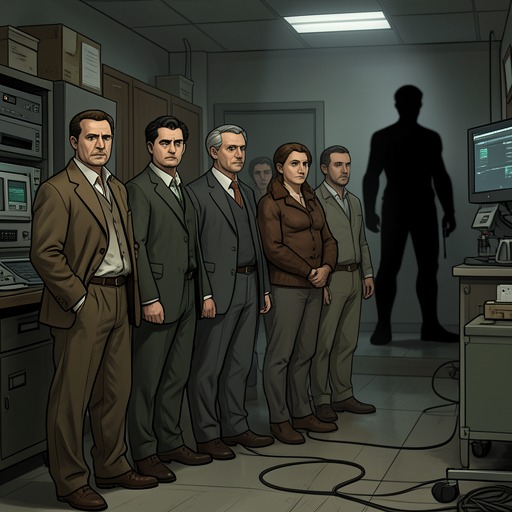
The mask of evil
The Outsider (Stephen King Edition)The mask of evil describes the gap between how a person appears to others and what may be hidden behind that appearance. In the novel, the idea is both a warning about misplaced trust and a problem of understanding: evil may wear a respectable, familiar face, while a seemingly monstrous explanation can be harder to accept than the terrible things human beings do. The outsider makes this tension literal by assuming other identities, but Holly Gibney’s argument insists that the mask is not confined to the supernatural.
Familiar Faces and Credibility
The outsider’s choice of a disguise is consequential because a face carries a history. Yune Sablo observes that it could hardly have picked a more compromising identity to hide behind: the person’s background in drug sales and service, together with an association with Satan’s Seven, would make an allegation of being framed difficult to believe. Ralph Anderson answers by recalling Terry Maitland. No one believed Terry, he says, though Terry had been beyond reproach. The contrast shows how readily suspicion can attach to a person’s past and how little a good reputation may protect someone once an accusation takes hold.
The outsider’s concealment therefore works through more than physical resemblance. An assumed identity arrives with a social record, and that record can make the person behind it seem either credible or suspect before anyone weighs the facts. The same public image that helps the creature pass among people can leave its victim exposed to disbelief. In this way, the mask operates both as a supernatural disguise and as a human habit of judging character by appearances, reputation, and the stories already told about someone.
Evil and the Limits of Explanation
Holly asks Ralph to believe in El Cuco, but she does not present supernatural evil as the only inexplicable kind. She compares the creature’s hidden face with Ted Bundy: a person could present one identity to those around him and another to the women he killed. The comparison redirects the question from whether the supernatural is strange to whether human violence is any easier to explain. Holly argues that people capable of terrible acts may be as incomprehensible as a shape-shifter.
She presses the comparison through the crime attributed to Terry: if Terry had killed the child, would that make the act more understandable than the possibility of a creature in the cave? Ralph admits that he has arrested people who committed terrible acts without understanding what drove them; often, he says, they did not understand themselves. His response matters because it does not confirm Holly’s supernatural account. Instead, it weakens the assumption that rejecting that account would leave a satisfying natural explanation in its place.
The argument also places Ralph’s experience as a detective beside Holly’s appeal. He knows what people can do, but knowledge of their actions has not given him access to an underlying reason. Holly asks him to suspend disbelief for the next twenty-four hours, framing belief as a necessary condition for confronting a possibility that ordinary explanation has not resolved. The mask thus names not only concealment but also the limits of interpretation: a familiar face does not disclose the truth behind it, and a comprehensible public identity cannot guarantee a comprehensible inner motive.
The Outsider’s Many Identities
Holly describes the outsider’s powers as shape-changing, memory-sucking, and the appearance of glowing eyes, but she also strips those attributes away rhetorically to accuse it of being a sexual sadist and a pedophile. She rejects its claim that it eats only to live, comparing its defense to a human explanation for slaughtering animals. The exchange challenges the creature’s effort to make predation sound like a neutral necessity. Holly’s accusation is grounded in its repeated choice of children as victims, despite its ability to take the form of someone trusted by adults.
That choice makes the mask especially disturbing: the creature can exploit familiarity, yet its victims are children rather than the adults whose trust its borrowed faces might secure. Holly identifies this contrast as evidence against the outsider’s self-description. Her confrontation makes the mask a question of conduct as well as appearance. Whatever shape it assumes, its repeated actions disclose what its explanations try to obscure.
False Fronts and the Face Beneath
In the Chamber of Sound, Holly strikes the outsider while it is using Claude Bolton’s appearance. As the creature’s face changes, Ralph sees a rapid succession of features, among them faces that recall Claude, Terry Maitland, and Heath Holmes. The final face to linger is not distinctive: it seems like that of an ordinary passerby, someone seen and then forgotten. The sequence turns the idea of a hidden face into a visible failure of identity. No single borrowed likeness supplies a stable self for Ralph to recognize.
Ralph interprets the changing faces as false fronts and stage dressing. That realization gathers the novel’s earlier disguises and suspicions into one image: what looked like familiar individuals was not, in this encounter, evidence of their presence, but a surface the outsider could wear. The face that remains offers no dramatic revelation of a recognizable person underneath. Its very ordinariness leaves the creature without a meaningful public identity, while its previous likenesses expose how easily recognition can be manipulated.
The mask of evil consequently works on two levels. The outsider literalizes the danger of trusting a face, but the novel’s comparisons with Terry Maitland and with human perpetrators prevent the theme from being confined to a supernatural monster. People can conceal violence behind a familiar persona, and investigators can mistake reputation or appearance for proof of character. Ralph’s recognition of the outsider’s false fronts resolves the visual puzzle without making evil itself fully intelligible: the disguises fall away, but the underlying capacity for harm remains difficult to explain.