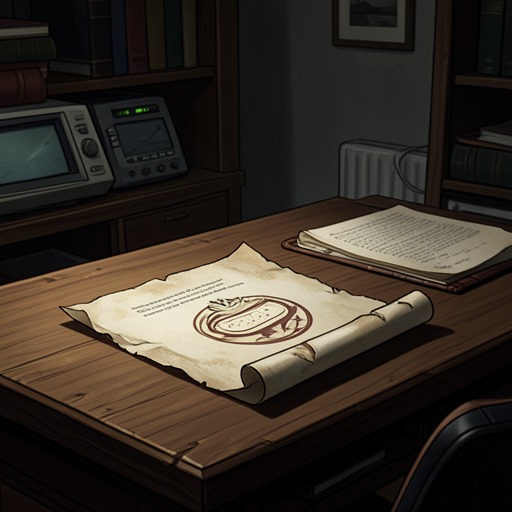
Tommy and Tuppence menu fragment
The Outsider (Stephen King Edition)The Tommy and Tuppence menu fragment is a small, torn piece of blue paper that becomes a pivotal clue in the investigation of Frank Peterson’s murder. Recovered from the stolen van, it bears the partial name of a Dayton restaurant; tracing that name leads Ralph Anderson to a parking-lot encounter that places the van in Dayton during the spring, when Terry Maitland was also there with his family. The scrap does not resolve the contradiction at the center of the case, but makes it harder to dismiss as coincidence.
Appearance and Recovery
Ralph first tells Jeannie Anderson that something was found beneath the driver’s seat of the van: a scrap that might be part of a take-out menu. He regards it as a lead worth checking, though he admits it may mean nothing. He wants to inspect the paper closely alongside security footage from the Cap City Sheraton and the restaurant where Terry says the teachers had dinner, hoping for images that could clarify whether the man in Cap City was Terry.
When Ralph later searches the VAN/SUBARU evidence box, he finds the fragment in a plastic evidence bag. It is blue and roughly triangular, with the bold black words “TOMMY AND TUP” at the top; the rest of the name has been torn away. A small drawing of a pie, its crust steaming, makes the piece’s original purpose legible: it came from a menu or promotional leaflet. The scrap’s distinctive shape and truncated lettering turn an ordinary discarded handout into something Ralph can identify and investigate.
The wider evidence inventory helps establish the fragment’s context. The case materials occupy two boxes, one marked MAITLAND HOME and the other VAN/SUBARU, plus a toolbox from the van. Terry’s fingerprints appear on none of the tools or the toolbox itself. Ralph infers that the toolbox was already in the vehicle when it was stolen and that Terry did not inspect its contents. The paper, by contrast, offers a trace of the van’s movements: not a direct identification of its driver, but a physical remnant that survived the vehicle’s passage through another city.
From Partial Name to Dayton
Ralph copies “TOMMY AND TUP” into his notebook before returning the evidence box and leaving the evidence room. The act preserves the fragment’s most useful information—the incomplete restaurant name—and lets him pursue it without treating a guess as a conclusion. At a police computer, he searches for the words with “RESTAURANT” added. The result identifies the Tommy and Tuppence Pub and Café on Northwoods Boulevard in Dayton, Ohio.
Dayton immediately connects the scrap to a separate detail from Ralph’s last substantial conversation with Terry. Terry had said he had not been to New York since his honeymoon and that his family’s recent trip had been to Ohio. They had traveled to Dayton during the girls’ spring vacation so Terry could visit his father, whose condition Terry described as scarcely living. The menu name therefore points not simply to a city but to a time and place already present in Terry’s account.
Ralph asks Yunel Sablo to contact El Paso, where the original van thief’s run ended, and find out whether the van had been abandoned near the Dayton café. He also wants the date of the abandonment, particularly whether it could have happened in April. The question matters because the van had traveled from Ohio to Flint City, while Terry’s family had been in Dayton during the spring. Ralph is not yet claiming that the fragment proves Terry drove the van; he is testing whether the vehicle’s route and Terry’s trip overlap in a way the existing account cannot comfortably explain.
The Leaflet Campaign and the Van’s Route
The account relayed to Ralph places the van in Dayton. Its young original thief, Merlin, had become nervous about keeping it and parked in a free public lot without an attendant, with a McDonald’s a few blocks away. He did not remember passing the Tommy and Tuppence café, but did remember a young man wearing a shirt with “Tommy” in the name, carrying a stack of blue papers and putting them under the windshields of cars at the curb.
The leaflet distributor offered Merlin two dollars to place menus beneath the windshields of the vehicles in the lot. Merlin declined and went to get lunch. When he returned, the distributor had disappeared, but menus had been placed on every car and truck. Merlin took this as a bad omen and decided the time had come to change vehicles. Jeannie observes that without the boy’s nervousness he might have been caught much sooner: his reaction to the leaflets altered the van’s route and delayed its discovery.
Asked whether he had left a menu beneath the van’s windshield wiper, Merlin says that he had. That detail supplies a likely sequence for the fragment’s appearance inside the van. Someone who later stole the vehicle in the parking lot must have torn away the leaflet and left behind its triangular corner. Ralph considers several ordinary possibilities: the driver may have pulled the scrap free after setting off and dropped it on the floor, held onto it rather than littering, or tried to throw it out only for the wind to blow it back into the cab. His explanations remain conjectural, but each begins from the same physical fact: the fragment’s torn edge suggests it was removed from a leaflet attached to the van.
What the Fragment Changes—and What It Cannot Prove
The timing makes the scrap consequential. Merlin tells Yunel that he thinks the van was left in Dayton in April, while acknowledging that the boy may not have kept careful track of dates. His description of spring—leaves already out and the weather not yet hot—supports April without fixing an exact day. April is also when Terry visited Dayton with his family. The overlap gives Ralph a concrete connection between the van and Terry’s documented destination, but it does not establish who stole the van from the lot or when the fragment was torn free.
That distinction sustains rather than resolves the case’s central problem. Terry had traveled to Dayton, but he was there with his family and had flown round-trip. Ralph knows those facts; he also knows the same stolen Ford Econoline van later turned up in Flint City. He finds it difficult to accept that both connections are coincidence, and Yunel has floated the possibility that Terry had an accomplice. The menu fragment cannot identify such a person, prove Terry’s involvement, or explain how the vehicle reached Flint City. Its force is narrower and more unsettling: a partial restaurant name and a torn corner make a connection that seemed abstract traceable in place and time.
In that sense, the scrap changes status as it moves through the investigation. Under the seat it is nearly overlooked debris; in the evidence box its color, shape, lettering, and pie illustration become searchable details; beside Merlin’s account it becomes a likely remnant of the leaflet campaign; and beside Terry’s Dayton trip it becomes an unresolved point of contact between the man’s alibi and the van’s journey. The clue’s evidentiary value lies not in delivering a verdict but in making a supposedly peripheral coincidence too specific to ignore.