El Cuco’s partial manifestation
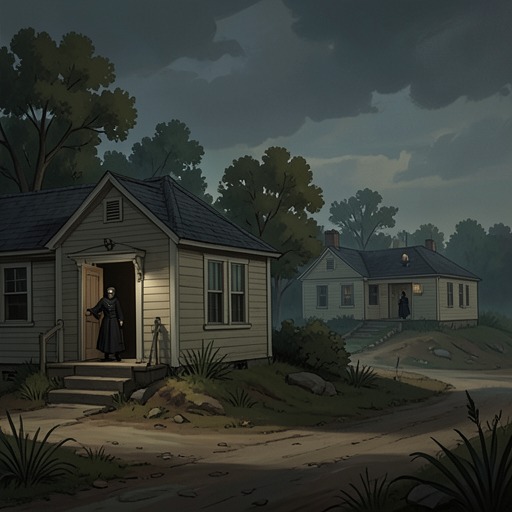
The Outsider (Stephen King Edition)El Cuco’s partial manifestation is the phenomenon by which it appears inside the Anderson home without a conventional entrance, leaving enough physical evidence to unsettle the distinction between a body and a projection. The visitor sits in a kitchen chair, leaves residue, and switches on the stove light, yet the locked house and untriggered burglar alarm offer no ordinary account of how it arrived. Holly allows that it may have been there both physically and as a projection; the scene makes that uncertainty a concrete problem of weight, touch, and evidence rather than a merely abstract supernatural possibility.
The Visit and Its Warning
Jeannie Anderson recounts seeing a light on downstairs and finding a man sitting beyond the archway on one of the chairs from the kitchen table. The visitor gives her a warning for Ralph, which she repeats to the assembled investigators: he must be told to stop. She emphasizes the fading blue letters inked on the man’s fingers, a visible detail attached to the warning and to her memory of the encounter. The experience ends with Jeannie fainting—something she says has never happened to her before.
The account is contested almost as soon as it is told. Ralph notes that Jeannie woke in bed, that there was no sign of entry, and that the burglar alarm had been set. Samuels dismisses the encounter as a dream. Jeannie rejects that explanation by distinguishing a dream, which fades, from reality. Her certainty cannot itself settle what happened, but the physical circumstances do not simply confirm the conventional alternative: the secured house makes the visitor’s presence harder to explain, not easier to dismiss.
Evidence in the House
The investigators return to the kitchen chair as a point of comparison. Holly takes another flash photograph, this time from low down; when the group studies the images on her phone, one of the chair legs appears to leap forward. Holly identifies that spot as where the material dribbled down. She then invites the others to raise the shades and open the drapes, allowing daylight into the kitchen, while Ralph goes through the photographs again. The sequence turns a domestic object into evidence: the chair is no longer simply furniture but a trace-bearing surface whose photographed details challenge Ralph’s disbelief.
The evidence remains incomplete rather than neatly forensic. Jeannie observes that residue is present but the chair left no marks in the carpet. If the visitor was there in any physical sense, she reasons, it must have been very light—perhaps no heavier than a feather pillow. This distinction between residue and weight matters: something has left a material trace, but the room does not show the ordinary pressure of a person and chair resting on the floor. The manifestation is not presented as a fully embodied intruder whose arrival and movements can be reconstructed by familiar physical rules.
The visitor’s interaction with the house becomes more difficult to deny when Jeannie remembers the stove light. Looking at the photographs had first seemed to excite her; now she is frightened. The light above the burners is controlled by a button that must be pushed, she points out, and concludes that there was enough of the visitor there to do that. Unlike the chair’s uncertain weight or the question of how residue reached the scene, the switched light records an action on a household control. It does not explain the visitor’s nature, but it tightens the connection between the apparition and the material space it occupied.
Projection and Unresolved Physicality
Asked whether the visitor was actually in the house, Holly answers that, if forced to guess, she would say both. She has not done enough research to offer a confident account, so the answer is explicitly provisional. Ralph considers the locked doors and the alarm that did not sound, and searches for a word such as ghost, only to find it inadequate. Jeannie proposes projection or an avatar like those in video games; Holly finds the idea interesting. The exchange offers several possible descriptions without declaring any one a complete explanation.
Holly’s working account is that something was present when Jeannie came downstairs, and she suggests that projection may exhaust the being. Jeannie’s observation about the residue and the chair’s lack of carpet marks gives that hypothesis a physical dimension: the visitor could be present enough to affect the room without possessing the weight of an ordinary body. The scene does not establish a precise mechanism or define the limits of such a manifestation. Instead, it leaves the investigators with evidence that points in two directions at once—material contact and insubstantiality.
Consequences and Significance
The encounter’s immediate consequence is personal and investigative. The visitor’s warning is directed at Ralph, while Jeannie’s testimony brings the threat into the home he had understood as secure. Its method of appearing also makes the warning harder to contain as a question of belief: the absent signs of entry support skepticism, but the residue, photographs, and switched stove light resist treating Jeannie’s experience as only a dream. Samuels chooses to withdraw from the case, calling it closed from his perspective even as he acknowledges Holly’s case for the fantastic; Marcy responds sharply to his apology for her loss. His departure underscores that the investigators do not reach a shared interpretation simply because they have examined the same evidence.
The manifestation’s force lies in this unresolved combination. A chair leg seems to shift in a photograph; residue marks a place where the carpet bears no corresponding imprint; a light requires a deliberate push, yet the alarm gives no account of anyone entering. Each detail narrows the room for easy dismissal without producing a conventional explanation. Holly’s tentative suggestion that the visitor was both present and projected keeps the event open to investigation while refusing the reassuring choice between a wholly physical intruder and an unreal apparition. For Ralph, whose disbelief begins to crumble as he studies the phone images, the house has become a place where evidence is visible but the rules that should make it intelligible no longer hold.