News Footage of the Courthouse Shooting
The Outsider (Stephen King Edition)News Footage of the Courthouse Shooting is both a record of Terry Maitland’s death and an incomplete witness to the event. The recordings capture the public spectacle around the courthouse and preserve details Ralph Anderson uses to reconstruct the crowd’s actions, but they fail to show the burned man he says stood among the spectators. That gap turns the footage from apparent evidence into a question about what a camera can record—and what its absence can prove.
The Record of the Shooting
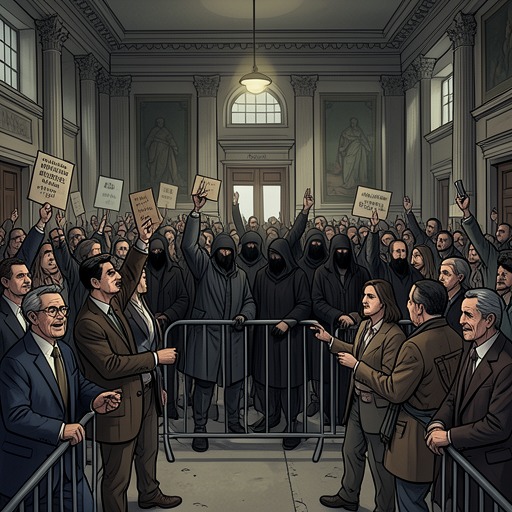
After Terry’s arraignment, four major network stations in Cap City and Channel 81 had filmed outside the courthouse. Their recordings show the crowd and, once gunfire begins, turn toward Terry: he is seen pushing Marcy Maitland out of the line of fire before he falls. The CBS recording goes blank before that moment because Ralph’s bullet strikes its camera, leaving the operator blind in one eye. The footage is therefore not a single continuous account: different cameras preserve different portions of the event, and one is physically interrupted by the shooting it was meant to record.
Ralph’s Review of the Crowd
Ralph and Jeannie Anderson watch the recordings at their kitchen table, reviewing each clip twice. He asks to see the Channel 81 footage again, with its sound muted, because the reporter’s commentary distracts him from examining the images. In the crowd sequence, he identifies himself tripping a man who had spat at Terry, while Terry helps that man back to his feet. The same passage shows two bailiffs trying to keep the courthouse steps clear, a Channel 7 anchor reacting to a sign striking her, and Ollie Peterson standing with a newspaper sack before he becomes part of the unfolding scene. The camera also passes a boy whose T-shirt bears Frank Peterson’s face. These details make the recording useful to Ralph as a visual chronology, not merely as a record of the shooting.
The Missing Figure
Ralph stops the Channel 81 recording at a frame containing a man waving a cowboy hat. He says the burned man stood immediately beside him. Jeannie does not see the figure in the available footage and closes the laptop, while still affirming that she trusts Ralph’s powers of observation. Ralph insists that the man was there; the recording does not corroborate his recollection.
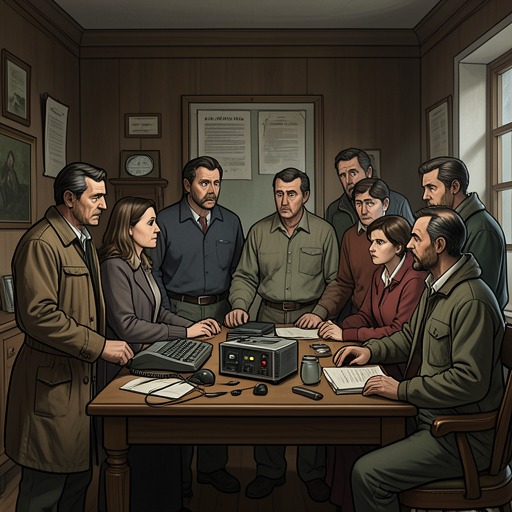
The discrepancy survives a broader comparison. Ralph plays the Channel 81 footage and the FOX footage for Alec Pelley, then replays Channel 81 at Alec’s request. Alec can locate the reporter and the hat-waving spectator in the image, but cannot find the burned man Ralph describes as standing beside them. The cameras’ shared failure to show him sharpens rather than resolves the conflict: the scene contains verifiable people and actions, yet the figure central to Ralph’s claim remains absent from every reviewed recording.
Evidence, Absence, and Interpretation
The footage has a double role in the investigation. It preserves ordinary details that can be paused and checked, allowing Ralph and his colleagues to compare what they remember with what the cameras captured. At the same time, its limits prevent it from settling whether Ralph’s claimed witness was present. A camera records a framed view, not an exhaustive account of everything within a scene; here, however, multiple recordings deepen the uncertainty because they appear to exclude the very person Ralph says he saw.
The review also changes the meaning of the courthouse images for Ralph. At first, he searches them for a figure that could confirm his perception. Repeated playback instead leaves him confronting a contradiction between his memory and the visual record. The footage thus preserves both the public violence surrounding Terry’s death and the unresolved question of an observer whom the cameras cannot verify.
Public Image and Lasting Consequences
The courthouse recordings belong to a wider chain of images that shaped how the case was seen. A photographer’s picture of Terry Maitland’s bewildered face at the baseball field appeared on the front page after his arrest, while Channel 81’s online archive later supplied Ralph with video placing Terry at a teachers’ meeting in Cap City. Those records had different evidentiary force: one fixed Terry in a public moment of accusation, while the other helped expose a conflict between the prosecution’s timeline and his alibi. The courthouse footage, by contrast, captured Terry’s death and the surrounding crowd but could not verify Ralph’s claim about the burned man. Across these media, visibility is consequential but incomplete: a recorded face or event can reshape a case, yet the frame cannot guarantee that everything important has been recorded.
The Record of the Shooting
After Terry’s arraignment, four major network stations in Cap City and Channel 81 had filmed outside the courthouse. Their recordings show the crowd and, once gunfire begins, turn toward Terry: he is seen pushing Marcy Maitland out of the line of fire before he falls. The CBS recording goes blank before that moment because Ralph’s bullet strikes its camera, leaving the operator blind in one eye. The footage is therefore not a single continuous account: different cameras preserve different portions of the event, and one is physically interrupted by the shooting it was meant to record.
The Record of the Shooting
After Terry’s arraignment, four major network stations in Cap City and Channel 81 had filmed outside the courthouse. Once the gunfire begins, the cameras turn toward Terry: he is recorded pushing Marcy Maitland out of the line of fire before he falls. The CBS footage goes blank before that moment because Ralph’s bullet strikes its camera, leaving the operator blind in one eye. The recordings do not provide one continuous account; each preserves a different portion, and one is interrupted by the shooting it was meant to capture.
Ralph’s Review of the Crowd
Ralph and Jeannie Anderson watch the recordings at their kitchen table, reviewing each clip twice. He asks to see the Channel 81 footage again with its sound muted, because the reporter’s commentary distracts him from examining the images. The crowd sequence gives him a visual chronology of the moments before the shooting: it shows Ralph tripping a man who had spat at Terry, while Terry helps the man back to his feet. The same footage records two bailiffs trying to keep the courthouse steps clear, a Channel 7 anchor reacting after a sign strikes her, and Ollie Peterson with a newspaper sack shortly before he becomes part of the unfolding scene. As the camera pans, it also briefly captures a boy wearing a T-shirt bearing Frank Peterson’s face. The recording’s value lies partly in these checkable details, which Ralph can pause and compare with his recollection.
The Unrecorded Witness
Ralph’s search reaches a decisive limit when he pauses the Channel 81 video at a frame containing a man waving a cowboy hat. He says the burned man stood beside that spectator. Jeannie cannot find him in the images and closes the laptop, though she tells Ralph she trusts his powers of observation. The distinction matters: she does not deny that Ralph saw someone, but the footage offers no confirmation. His recollection and the recording remain in conflict.
The comparison extends beyond Channel 81. At Ralph’s request, he and his colleagues review that recording and the FOX footage, then return to Channel 81 once more. Alec Pelley can identify both the reporter and the hat-waving spectator, but cannot see the burned man Ralph places beside them. Repeated playback makes the absence harder to dismiss as a moment missed in a single clip, without explaining it. The footage shows a crowd in fragments, while Ralph’s asserted witness remains outside what those fragments disclose.
Evidence, Absence, and Interpretation
The courthouse footage has a double role: it preserves details that Ralph and his colleagues can pause and compare, yet cannot settle whether the burned man Ralph recalls was present. Multiple recordings show identifiable spectators and actions, but none verifies the figure he says stood beside the man waving a cowboy hat. Their apparent agreement therefore deepens the uncertainty rather than resolving it. The cameras offer several records of a public scene, not an exhaustive account of everything that may have occurred within it.
A Record That Cannot Close the Case
The footage’s evidentiary force depends on distinctions between what it records and what viewers infer from it. The Channel 81 and FOX clips let Ralph and Alec Pelley compare identifiable figures in the crowd, including the man waving the cowboy hat and the blond reporter, against Ralph’s memory of the burned man beside them. Their repeated review finds no confirming image. That failure does not establish why the man is absent; it leaves the recording unable to resolve whether Ralph’s recollection corresponds to anything the cameras captured.
This uncertainty echoes the case’s earlier clash between a confident accusation and evidence that later complicated it. At Terry Maitland’s arrest, Detective Ralph Anderson had worried that the investigation lacked background and that Terry would claim an alibi; the prosecution nevertheless proceeded, presenting fingerprints associated with the van, bicycle, toolbox, Subaru, and branch as forceful evidence. Later, a Channel 81 archive video showed Terry at a teachers’ meeting in Cap City at a time that challenged the account of his movements. The courthouse recordings occupy a different place in that sequence: they do document Terry’s final public moments, but their apparent silence about Ralph’s claimed witness cannot by itself establish that the witness was not there. The book therefore treats recorded images as consequential records with limits, not as transparent or complete substitutes for judgment.
What the Record Can and Cannot Establish
The recordings invite comparison, but they do not turn the courthouse into a fully knowable scene. Ralph and Alec Pelley can match the hat-waving spectator and the reporter to visible figures while failing to find the burned man Ralph remembers beside them. That absence is important evidence about the recordings’ limits; it is not, by itself, proof that Ralph’s recollection is false. The footage frames and preserves parts of a public event, while leaving the dispute over who was present unresolved.
Public Image and Lasting Consequences
The courthouse recordings belong to a wider chain of images that shaped how the case was seen. A sports photographer’s picture of Terry Maitland’s bewildered face at the baseball field appeared on the front page after his arrest; later, a Channel 81 archive video supplied Ralph Anderson with evidence that Terry had attended a teachers’ meeting in Cap City, challenging the prosecution’s account of his movements. The records served different purposes: one fixed Terry in the public moment of accusation, while the other complicated the case against him. The courthouse footage, in turn, preserved Terry’s final public moments and the crowd around him without verifying the burned man Ralph said he saw. Together, the images show how recordings can alter a case while remaining incomplete: a frame can preserve a consequential face or event, but cannot guarantee that it captures everything that matters.
Public Image and Lasting Consequences
The courthouse recordings belong to a wider chain of images that shaped how the case was seen. A sports photographer’s picture of Terry Maitland’s bewildered face at the baseball field appeared on the front page after his arrest; later, Channel 81’s online archive supplied Ralph Anderson with footage of Terry at a teachers’ meeting in Cap City, challenging the prosecution’s account of his movements. These records served different purposes: the photograph fixed Terry in the public moment of accusation, while the meeting footage complicated the case against him. The courthouse footage, in turn, preserved Terry’s final public moments and the crowd around him without verifying the burned man Ralph said he saw. Together, the images show how recordings can alter a case while remaining incomplete: a frame can preserve a consequential face or event, but cannot guarantee that it captures everything that matters.
What the Record Can and Cannot Establish
The recordings invite comparison, but they do not turn the courthouse into a fully knowable scene. Ralph and Alec Pelley can identify the man waving a cowboy hat and the reporter in the Channel 81 and FOX footage, yet neither can find the burned man Ralph remembers standing beside the spectator. That absence is evidence of what the reviewed recordings fail to show; it does not, by itself, prove that Ralph’s recollection is false. The cameras preserve parts of the public event while leaving the dispute over who was present unresolved.
Public Image and Lasting Consequences
The courthouse recordings belong to a wider chain of images that shaped how the case was seen. A sports photographer’s picture of Terry Maitland’s bewildered face at the baseball field appeared on the front page after his arrest; later, Channel 81’s online archive supplied Ralph Anderson with footage of Terry at a teachers’ meeting in Cap City, challenging the prosecution’s account of his movements. These records served different purposes: the photograph fixed Terry in the public moment of accusation, while the meeting footage complicated the case against him. The courthouse footage, in turn, preserved Terry’s final public moments and the crowd around him without verifying the burned man Ralph said he saw. Together, the images show how recordings can alter a case while remaining incomplete: a frame can preserve a consequential face or event, but cannot guarantee that it captures everything that matters.
What the Record Can and Cannot Establish
The recordings invite comparison without making the courthouse fully knowable. Ralph Anderson and Alec Pelley can identify the hat-waving spectator and the reporter in the Channel 81 and FOX footage, yet neither finds the burned man Ralph remembers standing beside the spectator. That absence establishes what the reviewed images fail to show; it does not, by itself, settle whether Ralph’s recollection is false. The cameras preserve parts of the public event, but the dispute over who was present remains unresolved.