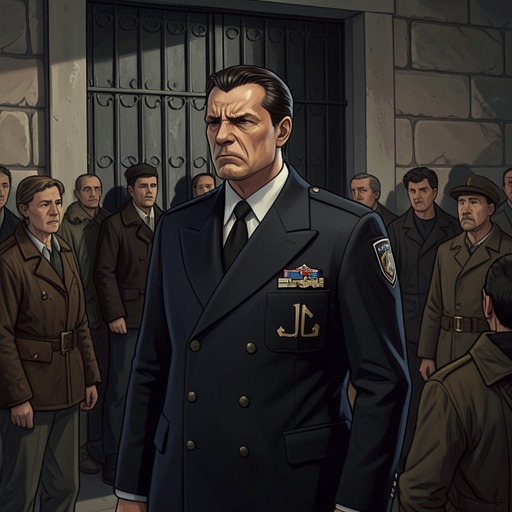
The Maitland family’s media siege
The Outsider (Stephen King Edition)The Maitland family’s media siege is the public exposure that follows Terry Maitland’s arrest: police search the family home while television crews, reporters, and neighbors crowd the street, and the family’s private grief becomes a spectacle. The siege reaches beyond the front lawn. A photograph of Terry at the baseball field fixes his bewildered arrest in public memory; later, recordings and surveillance footage help establish his presence in Cap City even as courthouse footage fails to show the burned man Ralph Anderson says he saw. Media records thus serve both as instruments of exposure and as contested evidence, never quite offering a transparent account of events.
The Home Becomes a Scene
When Marcy Maitland turned onto Barnum Court, she found police vehicles and a State Police mobile crime unit outside the family’s neat ranch house. Troopers stood on the sidewalk, while neighbors watched from their lawns. Marcy expected that many already knew why the officers had arrived; cell phones would carry the news to everyone else. The ordinary neighborhood setting offered no shelter from scrutiny: the family’s home had become visible as a place of accusation before Marcy had even gone inside.
The police search made that intrusion physical. Officers in gloves and booties moved through the house, examining rooms and belongings; they collected the downstairs medicine cabinet’s pills and Terry’s hemorrhoid cream, and dismantled his computer. In the bathroom, Marcy saw that the toilet-tank cover had been left crooked. In the dining room, Terry’s desk had been emptied, its contents scattered and its drawers removed. The objects were mundane, but their displacement made the home feel newly unfamiliar to her, as though the investigation had altered not only the rooms but her relationship to them.
Outside, a trooper called the arriving television crews vultures. A KYO vehicle and trucks from other stations came around the corner while Marcy was still at the doorway. Betsy Riggins urged her inside before the reporters reached them. Marcy went with her, understanding the choice as perhaps the first of many surrenders: privacy, dignity, and her children’s sense of security. She resisted questioning and insisted she did not have to hand over her phone, but the boundary she tried to set could not stop the cameras and neighbors gathering beyond it.
Family Life Under Public Exposure
The arrest followed a night that had begun with the Golden Dragons’ game and hopes of reaching the finals. During the search, Marcy thought that only an hour earlier the game had been the most important thing in her life. The abrupt contrast measures the scale of the rupture: a family evening had become a criminal investigation and a media event before its participants could understand what was happening.
The house itself was no longer a dependable refuge. Marcy wondered whether she could bring Sarah Maitland and Grace Maitland home that night, or whether they would have to go to a hotel that reporters might also find. In the bathroom, she tried to avoid looking at the disorder left by the search. The question was not simply where the family could sleep, but where they might escape the public attention that had attached itself to their address.
That exposure continued when the girls were staying with Tom and Jamie Mattingly. Tom told Alec Pelley that people were already angry at Coach Terry and feared the hostility would grow once the accusation spread. Jamie insisted that whatever their father might have done, the girls were not responsible; she said they were devastated, especially Grace, after seeing him led away in handcuffs. Their exchange captures the pressure exerted by public judgment before any verdict: the children were treated as part of a story about their father, even as those closest to them tried to hold their innocence apart from the accusation.
When Alec brought Sarah and Grace back to Barnum Court, the remaining television crew sprang into action. He ordered the cameramen not to film the children, but the warning stopped them only briefly. A reporter challenged him, saying he had a job to do; Alec answered that hassling a distraught woman and two children was what that job had become. Once Marcy gathered her daughters and took them inside, Alec considered them as safe as the circumstances allowed, while suspecting they would not feel safe anywhere for a long time. Neighbors returned to their lawns to watch the next turn in the street’s unfolding drama.
Images, Records, and the Case
The siege made images of the family and the accused available to a public audience, but those images had different evidentiary limits. At the baseball field, Terry heard Ralph Anderson say he was under arrest for Frank Peterson’s murder. He appeared not to understand the accusation and asked whether the officers were joking. A photographer from the Flint City Call captured him at that moment; the photograph appeared on the next day’s front page and made his open-mouthed surprise look, to an observer, both weak and guilty. The image recorded a real reaction, but its public meaning exceeded what the moment itself could prove.
The online record that challenged the case came through a different channel. After Alec sent Ralph a link, Ralph found a Channel 81 video of Harlan Coben speaking to the Tri-State Teachers of English in Cap City. The recording placed a Terry-like figure at the event, and Ralph investigated further. At the Cap City Sheraton, security footage showed a man resembling Terry in the lobby and gift shop, using the fitness room, and waiting in the autograph line. The clearer images strengthened the case for Terry’s presence in Cap City, although Ralph still struggled to reconcile them with the evidence against him. A public-access video and hotel cameras, produced and stored for different purposes, became central to a dispute over whether one man could have been present in two places.
The same dependence on recording shaped the aftermath of the courthouse shooting. The television stations had filmed the arraignment and the crowd. In the footage Ralph and Jeanette Anderson reviewed, Terry could be seen bleeding, pushing Marcy out of the line of fire, and then collapsing when the fatal shot struck him. One station’s recording went blank before that moment because Ralph’s bullet had hit its camera. The cameras preserved the event unevenly: one record ended through damage, while others showed the death but could not settle every question surrounding the scene.
Visibility and Absence
Ralph later told Holly Gibney that the burned man he said he had seen beside Terry was not present in any courthouse footage. The absence mattered precisely because the cameras had recorded so much else. When Ralph repeated that the man had been beside Terry, Jeanette closed the laptop rather than review the clips again; she told Ralph that the man was not in them, and he knew it. The recordings neither confirmed his account nor made his reported sighting disappear. Their silence became part of the conflict between what the footage could establish and what Ralph believed he had witnessed.
For the Maitlands, the cameras’ selectivity did not lessen their power. Television crews could gather outside the house, neighbors could watch, and an arrest photograph could circulate widely, while the family had little control over how any of it would be interpreted. The media siege therefore operates on two connected levels: it converts private distress into public material, and it supplies records that detectives and viewers treat as evidence. Yet the records remain partial—strong enough to expose the family, complicate the accusation, and preserve Terry’s death, but not sufficient to resolve every contradiction at the heart of the case.