Yunel Sablo
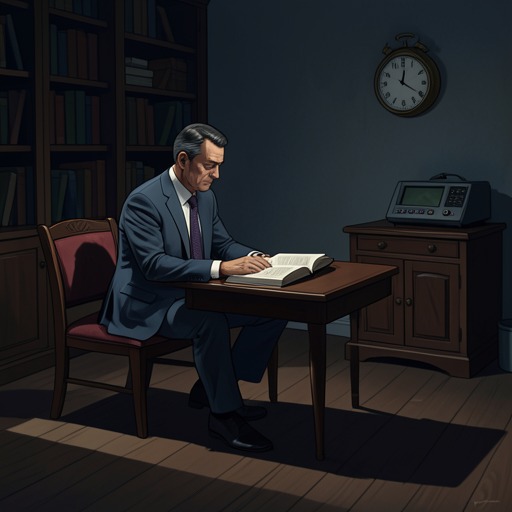
The Outsider (Stephen King Edition)Yunel Sablo is a State Police lieutenant whose work connects local investigators, state forensics, and later the agencies handling the Marysville investigation. Introduced as the officer who serves a search warrant at the Maitland residence, he becomes a sustained partner to Ralph Anderson: he documents evidence, tests apparent matches against their limitations, and helps carry the investigation through increasingly dangerous and extraordinary circumstances. His role is not simply to supply expertise; his disciplined attention to what evidence can and cannot establish helps keep the inquiry moving when certainty has already produced grave consequences.
Identity and Introduction
Sablo is identified by rank and agency when he presents a warrant to Marcy Maitland. He tells her that the warrant authorizes a search of the premises and the removal of items belonging to her husband, Terence John Maitland. The formal wording marks the arrival of state authority inside the family home, while Sablo’s participation places him directly within the investigation that has already made Terry the focus of a public arrest.
His professional identity is also established through a report headed with his name and title as a State Police lieutenant. At the request of District Attorney Bill Samuels and Detective Ralph Anderson, he goes to the Vogel Transportation Center to examine surveillance footage from the night of July 10. The center’s system covers sixteen cameras and retains footage for thirty days; Sablo works with its security director and reviews the recordings. The episode introduces him not through abstract credentials but through a concrete investigative task: making a large, monitored transportation hub yield usable information.
Work with Ralph Anderson
Sablo’s relationship with Anderson develops into a working partnership built around the movement and interpretation of evidence. He and Anderson meet with Samuels at the prosecutor’s home to discuss the case. Anderson later reflects that he, Samuels, and Sablo had agreed not to investigate Terry’s movements before the arrest, fearing that advance inquiries might alert a dangerous suspect. The decision had seemed justified by the weight of the evidence; when the supposed certainty breaks down, Sablo is part of the group confronting the cost of that judgment.
The partnership continues after the arrest. Anderson asks Sablo to check whether the stolen van’s route through Ohio passed near Tommy and Tuppence in Dayton, and Sablo agrees to find out. When a boy discovers clothing associated with Terry near a barn, Sablo reaches the location with the crime van and oversees the forensic work. Anderson values the timing: Sablo is already on site and will supervise the Forensics Unit before Jack Hoskins can arrive. This work shows Sablo operating as a field investigator as well as a liaison, taking responsibility for evidence collection where the case has moved beyond Flint City.
Sablo’s reports also give Anderson grounds to question apparently decisive evidence. The clothing includes a horse-head belt buckle recognized from a news report, and the Forensics Unit matches faint fingerprints on it to Terry. But the ridges and whorls are broken in places, and the technician says the prints resemble those of a much older person. Sablo considers whether hurried movement could explain their condition, yet reports that the technician himself was unconvinced. He does not conceal the match, but neither does he let the match erase its troubling qualification. That distinction matters in a case where evidence can appear to confirm an accusation while also carrying signs that it does not fit cleanly.
The investigation increasingly requires coordination across distance. Sablo joins Anderson, Jeannie Anderson, Howie Gold, and Alec Pelley at the Andersons’ home for a case discussion, participating remotely from Cap City through Gold’s laptop. Later, he arrives at the Regis airfield as the group prepares to travel, carrying a knapsack and finishing a phone call before joining them. The shifts between report, remote meeting, and physical travel convey how his work holds together a widening inquiry: he is present where the evidence is, even when the team itself is dispersed.
Evidence, Doubt, and the Wider Case
Sablo contributes to the reconstruction of a repeated pattern linking the Howard murders to Frank Peterson’s abduction. He notes that both killers used vehicles and left them where they could readily be found, drawing attention to the parallel between the panel truck abandoned after the Howard girls’ murders and the van left behind after Frank’s abduction. Both vehicles contain fingerprints, including unidentified prints in the van. His comparison helps turn separate crimes and jurisdictions into a connected evidentiary problem rather than treating each discovery in isolation.
This method contrasts with the earlier investigative confidence that made Terry’s arrest seem inevitable. Anderson remembers the details that now look staged or inexplicable: the man who took Willow Rainwater’s cab addresses her formally rather than by name; the van’s driver asks for a nearby walk-in clinic despite Terry having lived in Flint City all his life; teachers place Terry elsewhere at the relevant times; and Terry appears conspicuously at Harlan Coben’s talk, where his presence is recorded. Anderson also reconsiders the fingerprints on the book. Sablo’s evidence-focused role belongs to this reversal: the investigation must stop treating each item as confirmation and examine how apparently supportive facts may fit a larger deception.
Sablo’s professional range includes awareness of investigations beyond the current case. When Holly Gibney is introduced to the group, he recognizes that she and Bill Hodges were involved in stopping Brady Hartsfield, whose intended attack could have killed many young people. He then brings out his laptop and asks Howie Gold to show him how to use the projection equipment. The scene links Sablo’s institutional knowledge to his practical willingness to work with whatever tools the group has, rather than placing him outside the inquiry as a detached official.
Marysville and Aftermath
At Marysville, Sablo is part of the team confronting Jack Hoskins and the danger surrounding the investigation. In the aftermath of the violence, Holly and Anderson support him as he reaches the damaged side of the gift shop and sits down to recover. His left sleeve is bloodied, and his condition makes plain that he has been injured; the account does not make that injury his defining feature. The consequential detail is that he remains with the others and continues to take part in what follows.
Sablo then undertakes the difficult work of communicating the outcome. He speaks with Samuels, who listens and agrees, before calling Jeannie Anderson to give her a fuller explanation. She responds with tears that are largely relief: despite the deaths and Sablo’s own injury, Anderson is alive. Sablo tells her what she needs to do, and she agrees to act immediately. The exchange places him between a dangerous investigation and the families who must understand its consequences, turning liaison from an administrative function into a personal responsibility.
That role continues publicly. An official statement says the events in Marysville cannot yet be discussed because the investigation remains ongoing and is being conducted jointly by the Texas Highway Patrol and the Flint City Police Department. Sablo is named as chief liaison officer working with both organizations. The appointment formalizes the function he has performed throughout the story: carrying information between agencies, investigators, and affected people while the truth is still being established.
Narrative Role
Sablo’s significance lies in the steadiness of his investigative practice amid a story organized around impossible contradictions. He works with surveillance, fingerprints, vehicle evidence, forensic teams, and interagency communication, but the evidence repeatedly refuses to behave as a simple route to certainty. His willingness to report both a match and its weaknesses gives the investigation room to change direction; his presence at the major stages of the inquiry gives that change continuity.
He also provides a bridge between local law enforcement and a widening network of state and out-of-state agencies. From the warrant at the Maitland home and the footage at Vogel to the barn examination, the Marysville journey, and the public liaison role afterward, Sablo’s actions connect separate settings and phases of the case. The narrative does not present him as the source of the final explanation. Instead, his importance is procedural and human: he helps the investigators keep working, shares the burden of the consequences, and carries the news that allows those closest to Anderson to understand that he has survived.