East Side
The OutsidersThe East Side is the home territory of Ponyboy Curtis and the greaser gang, a working-class neighborhood on the poorer side of Tulsa, Oklahoma. It is defined by its economic hardship, its close-knit community, and its constant, violent rivalry with the wealthy Socs from the West Side. The East Side is not merely a setting but the fundamental force that shapes the identities, loyalties, and fates of its residents, marking them as outsiders in a society that judges them by their address and their appearance.
Geography and Social Character
The East Side is the domain of the greasers, a term used to class all the boys from that part of town. They are poorer than the Socs and the middle class, and their neighborhood is characterized by a lack of material wealth. The houses are run-down, and the residents often struggle to make ends meet. The area is also defined by its own set of values and a distinct subculture. Greasers wear their hair long, dress in blue jeans and T-shirts or leather jackets, and have their own slang, where "tuff" means cool or sharp. The East Side is a place where people grow up in tight-knit neighborhoods and know each other real well, forming bonds that are as close as family. The vacant lot, a wide, open field on their block, serves as a central hangout for the gang, a place for playing football, having fist fights, and holding rumbles.
The Greaser Gang as a Surrogate Family
Within the harsh environment of the East Side, the greaser gang functions as a crucial social institution, providing stability, belonging, and protection that are often absent from their families. Ponyboy, his brothers Darrel Curtis and Sodapop Curtis, and their friends Johnny Cade, Dallas Winston, Keith "Two-Bit" Mathews, and Steve Randle have grown up together and consider each other family. This bond is a matter of survival; they stick together to protect each other from the Socs, who jump greasers for kicks. The gang's code is simple: "Stick together" and "Don't get caught." For Johnny, who is beaten by his father and ignored by his mother, the gang is the only source of love and affection he has ever known. The front door of the Curtis house is always unlocked in case one of the boys needs a place to lay over and cool off, a testament to the mutual support that defines their community.
Conflict with the West Side
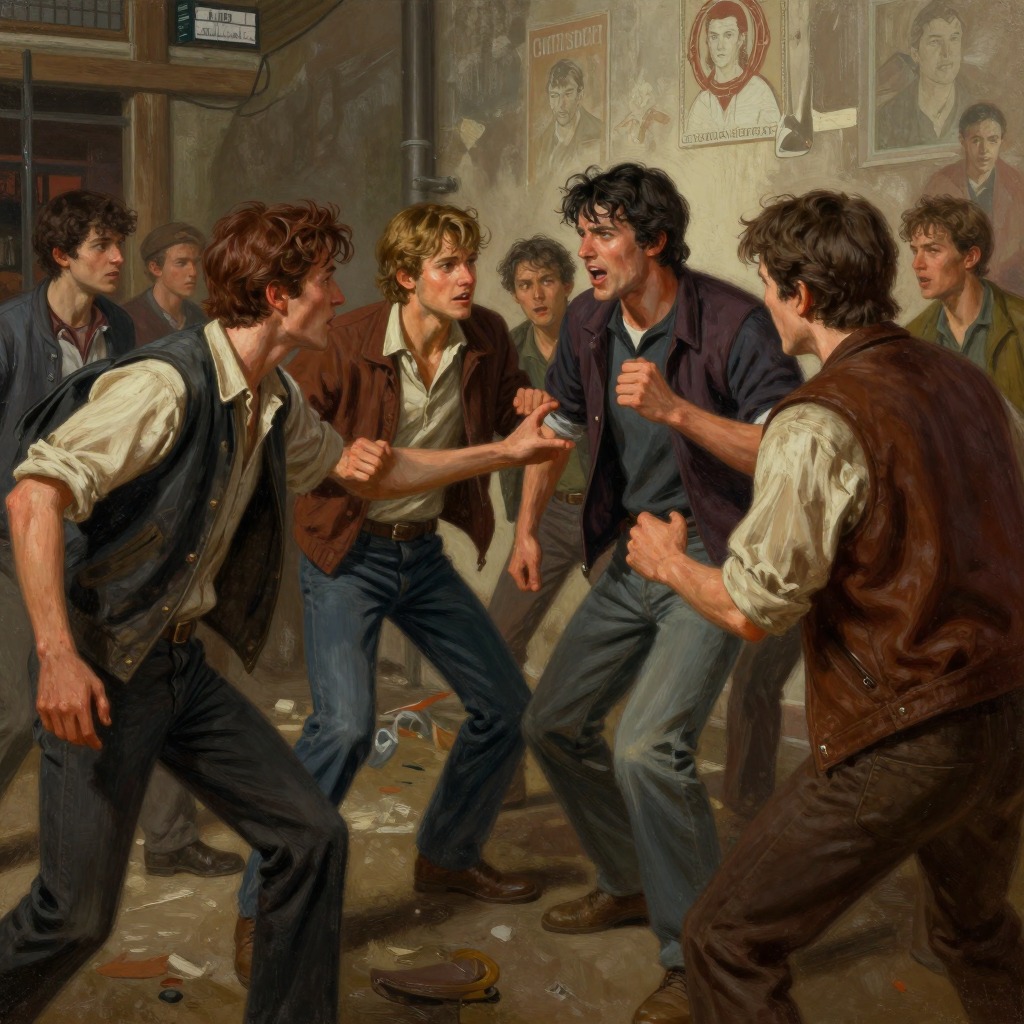
The East Side's identity is forged in direct opposition to the West Side, home of the Socs (Socials), the rich kids. This is not merely a geographical divide but a deep social and economic chasm. The Socs have all the breaks—good cars, good clothes, and money—while the greasers are judged and often condemned for their appearance and background. The conflict is a constant, violent presence in their lives. Greasers cannot walk alone too much or they will get jumped. The Socs attack Ponyboy on his way home from the movies, and they brutally beat Johnny, leaving him scarred and terrified. This ongoing warfare culminates in a rumble between the two groups, a fight that the greasers win but which ultimately proves hollow. As Randy Adderson, a Soc, tells Ponyboy, "You can't win, even if you whip us. You'll still be where you were before—at the bottom." The East Side is a place of limited opportunity, where even victory does not change the fundamental structure of their lives.
Thematic Significance: A World of Feeling
The East Side is not just a place of poverty and violence; it is also a world of intense emotion and deep feeling. Ponyboy reflects that the separation between greasers and Socs is not just about money, but about feeling: "you don't feel anything and we feel too violently." This emotional intensity is a source of both pain and connection. It is on the East Side, lying in the vacant lot and looking at the stars, that Ponyboy and Johnny dream of a place without greasers or Socs, with just plain ordinary people. The East Side is where they watch sunsets, a shared experience that Ponyboy discovers connects him to Cherry Valance, a Soc. The neighborhood's hardships forge a powerful, if tragic, sense of loyalty and love among its inhabitants, a bond that is tested by violence and loss but ultimately endures. Ponyboy's final decision to tell his story, beginning with his walk home from the movies, is an act born from this world, a plea for understanding from the other side of the tracks.