Stay gold
The OutsidersStay gold is the most resonant thematic expression in S. E. Hinton's The Outsiders, a phrase that crystallizes the novel's meditation on innocence, loss, and the possibility of preserving beauty and hope in a world defined by class conflict and violence. Originating from Robert Frost's poem "Nothing Gold Can Stay," the phrase is first introduced by Ponyboy Curtis and later becomes Johnny Cade's dying message to his friend. It functions as both a personal farewell and a philosophical injunction, urging Ponyboy to hold onto the qualities of wonder, sensitivity, and moral clarity that distinguish him from the hardened world around him. The expression threads through the novel's key moments of reflection, transformation, and tragedy, ultimately shaping Ponyboy's decision to tell his story and thereby to "stay gold" in the most meaningful way available to him.
Origin and First Appearance
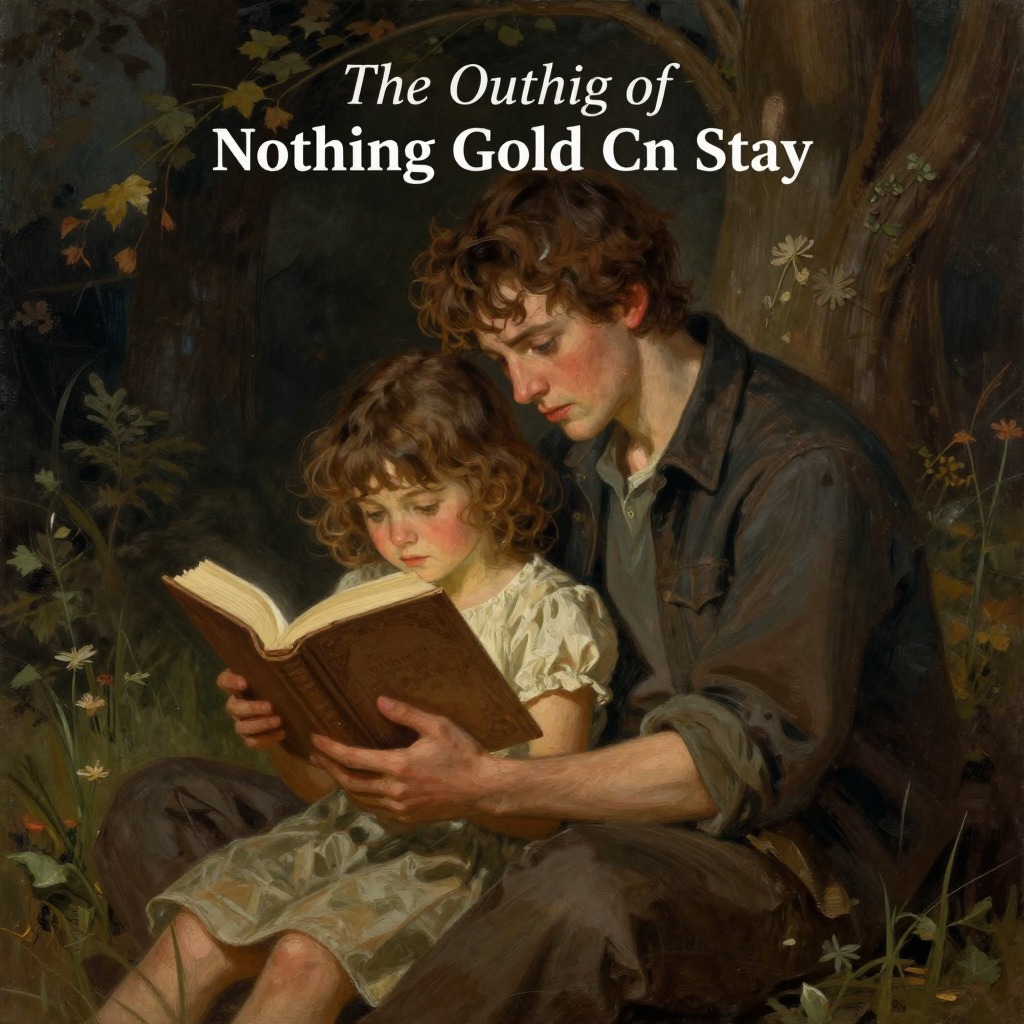
The phrase enters the novel during the days Ponyboy and Johnny spend hiding in the abandoned church on Jay Mountain after Johnny has killed Bob Sheldon. One morning, watching the sunrise transform the mist into gold and silver, Johnny remarks on its beauty. Ponyboy responds by reciting Robert Frost's poem: "Nature's first green is gold, / Her hardest hue to hold. / Her early leaf's a flower; / But only so an hour. / Then leaf subsides to leaf. / So Eden sank to grief, / So dawn goes down to day. / Nothing gold can stay." When Johnny asks where he learned it, Ponyboy explains that he always remembered it because he never quite understood what the poet meant. Johnny, however, grasps the meaning intuitively: "That was what I meant," he says. The poem speaks directly to his experience of a world where beauty and innocence are transient, where the golden moments of dawn and youth give way to the harsh light of day. Ponyboy later reflects that he could not have shared the poem or talked about sunsets with most of the gang—only with Sodapop and Johnny, and perhaps Cherry Valance. This moment establishes the poem as a private language between the two boys, a shared recognition of something precious and fragile.
Johnny's Final Message
The expression reaches its full weight in Johnny's final moments. As he lies dying in the hospital, with Ponyboy leaning over him, Johnny whispers: "Stay gold, Ponyboy. Stay gold..." The pillow seems to sink a little, and Johnny dies. These are his last words, a gift and a charge to his friend. The phrase is not merely a repetition of the poem's title; it is Johnny's distillation of everything he has learned and wants Ponyboy to remember. Later, Ponyboy finds a note Johnny left for him in a copy of Gone with the Wind. In it, Johnny elaborates: "I've been thinking about it, and that poem, that guy that wrote it, he meant you're gold when you're a kid, like green. When you're a kid everything's new, dawn. It's just when you get used to everything that it's day. Like the way you dig sunsets, Pony. That's gold. Keep that way, it's a good way to be." Johnny interprets the poem as a call to preserve the freshness of perception, the ability to see the world with wonder and to find beauty in sunsets and mist. He urges Ponyboy to tell Dally to look at a sunset, though he doubts Dally has ever really seen one. The note ends with a declaration of hope: "There's still lots of good in the world. Tell Dally. I don't think he knows." Johnny's message transforms the poem from a lament about loss into an active ethical imperative: to remain open to the good, to keep seeing the gold, even when the world seems determined to extinguish it.
Thematic Significance and Ponyboy's Transformation
"Stay gold" becomes the novel's central thematic statement, counterpointing the violence and despair that surround the greasers. It is a call to resist the hardening that afflicts characters like Dallas Winston, who has become so tough and bitter that he can no longer feel or see beauty. Ponyboy, who has always been different—he reads books, watches sunsets, makes good grades, and has a high IQ—is the character most capable of heeding Johnny's charge. Yet after Johnny's death and Dally's suicide, Ponyboy descends into a period of denial and numbness. He stops eating, loses interest in school, and begins to adopt a tough, reckless demeanor, even threatening Socs with a broken bottle. Two-Bit warns him: "Don't get tough. You're not like the rest of us and don't try to be..." Ponyboy's recovery begins when he finally reads Johnny's note and understands that the way to honor his friend is not to become hard like Dally, but to tell their story. He calls his English teacher, Mr. Syme, and asks if his theme can be longer than five pages. The novel itself is that theme, beginning with the same words Ponyboy used at the start: "When I stepped out into the bright sunlight from the darkness of the movie house, I had only two things on my mind: Paul Newman and a ride home..." By writing, Ponyboy fulfills Johnny's injunction: he stays gold by preserving the memory of what was beautiful and true, and by sharing it with others. The expression thus moves from a private poem to a dying wish to the very structure of the narrative, becoming the novel's argument for the redemptive power of storytelling and the enduring value of innocence, sensitivity, and hope in a world that often rewards their opposite.