West Side
The OutsidersThe West Side is the wealthy, socially dominant half of Tulsa in S. E. Hinton's The Outsiders, the home territory of the Socs (Socials). It is defined not merely by geography but by a constellation of privileges—money, cars, madras shirts, and a social standing that shields its young people from the consequences of their actions. The novel presents the West Side as a world of emotional coolness and material excess, a mirror image of the greasers' raw, violent, and emotionally charged existence on the East Side. The conflict between these two worlds is the engine of the plot, and the West Side, as the seat of power, is the force that the greasers must constantly resist, navigate, and ultimately, try to understand.
Geography and Social Identity
The West Side is first introduced as the home of "the jet set, the West-side rich kids" , a place where Socs live in a different social and economic universe from the greasers. The novel's narrator, Ponyboy Curtis, immediately establishes a binary: the Socs have "Mustangs and Corvairs" and wear "madras shirts" , while greasers wear jeans and leather jackets. This division is not just about money but about a whole set of values. Cherry Valance, a Soc girl, explains to Ponyboy that the difference is one of feeling: "We're sophisticated—cool to the point of not feeling anything" . The West Side, in her telling, is a place of emotional suppression, where nothing is real and people are always searching for something to satisfy them without ever finding it. This stands in stark contrast to the greasers, who "feel too violently" . The West Side's identity is thus constructed as one of privilege and emotional poverty, a world where even fighting is done "coldly and practically and impersonally" .
The West Side as a Source of Conflict
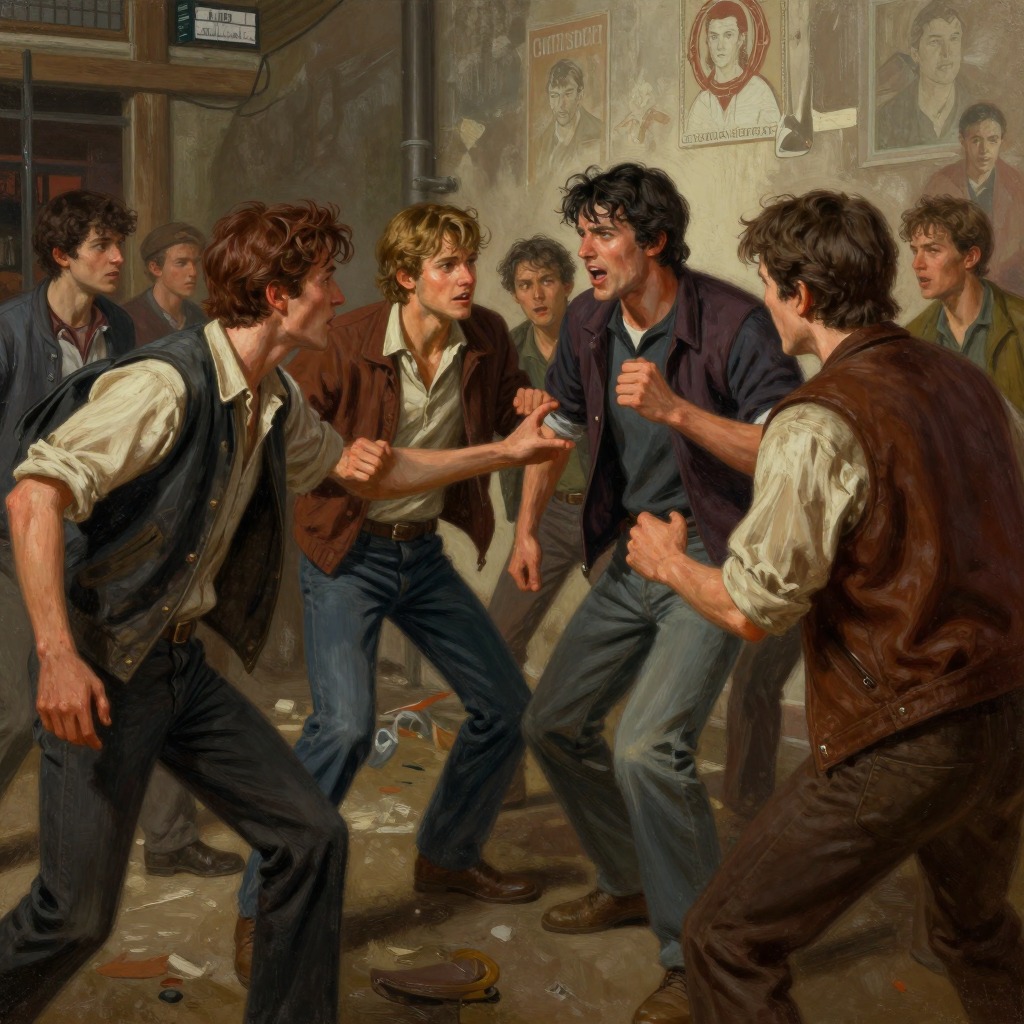
The West Side is the origin of nearly every violent confrontation in the novel. The Socs' attack on Ponyboy in Chapter 1 is carried out by five boys from the West Side, who drive a red Corvair and threaten to cut his hair . The brutal beating of Johnny Cade, which leaves him scarred and terrified, is perpetrated by Socs in a blue Mustang, a car that becomes a symbol of West Side menace . The final, fatal confrontation in the park, where Johnny kills Bob Sheldon, is also initiated by West Side Socs who have crossed into greaser territory . The West Side is not just a place; it is an active, aggressive force that invades the East Side, enforcing its dominance through violence. The greasers' own identity is forged in opposition to this threat, and their sense of solidarity is strengthened by the constant need to defend themselves against West Side incursions.
The West Side's Internal Complexity
Despite its monolithic portrayal as a world of privilege, the novel also reveals the West Side's internal fractures and hidden pains. Cherry Valance, a West Side cheerleader, becomes a key figure in complicating this picture. She tells Ponyboy that "things are rough all over" , and confesses that Socs have their own troubles, including a lack of genuine feeling and a constant, unsatisfied search for meaning . Randy Adderson, Bob Sheldon's best friend, further humanizes the West Side. He explains to Ponyboy that Bob's parents "spoiled him rotten" and never said "No" to him, which he believes contributed to Bob's reckless behavior and eventual death . Randy himself is sick of the fighting and the class war, recognizing that it "doesn't do any good" . These moments reveal that the West Side is not a monolith of happy, carefree rich kids, but a place where young people also struggle with parental neglect, emotional emptiness, and the pressure to conform to a cold, unfeeling social code. The West Side, like the East Side, produces its own casualties.
The West Side's Narrative Significance
The West Side functions as the novel's primary antagonist, but it is an antagonist that is ultimately revealed to be human. The greasers' journey is not just about winning a rumble, but about learning to see beyond the label of "Soc" to the individual. Ponyboy's growing understanding of Cherry and Randy allows him to conclude that "Socs were just guys after all" . The West Side, in this sense, is not just a location but a symbol of the social divisions that the novel seeks to critique. It represents the structural inequality that shapes the characters' lives, but also the possibility of empathy across class lines. The novel's final message—that "there's still lots of good in the world" —is a call to look past the geographical and social boundaries that the West Side and East Side represent, and to recognize the shared humanity that exists on both sides of the divide.