blue Mustang
The OutsidersThe blue Mustang is a potent symbol of the Socs' affluence and threat in S. E. Hinton's The Outsiders. More than a mere car, it is a recurring object that marks the presence of the West Side rich kids and their violent incursions into greaser territory, serving as a mobile emblem of the class divide that drives the novel's central conflict.
Appearance and Association with Violence
The blue Mustang first appears in the narrative as the vehicle from which Johnny Cade is attacked. Ponyboy Curtis recalls that a "blue Mustang full" of Socs pulled up beside the vacant lot, and four of them beat Johnny so severely that he carried a permanent scar and a deep psychological trauma. This event establishes the car as a harbinger of violence, a machine that delivers the Socs into greaser space to inflict harm. The Mustang's color and make become shorthand for danger: when Ponyboy later sees a blue Mustang trailing him, he knows he is about to be jumped. The car is not just transportation; it is a weapon of intimidation and a marker of the Socs' ability to strike anywhere, anytime.
The Night of Bob Sheldon's Murder
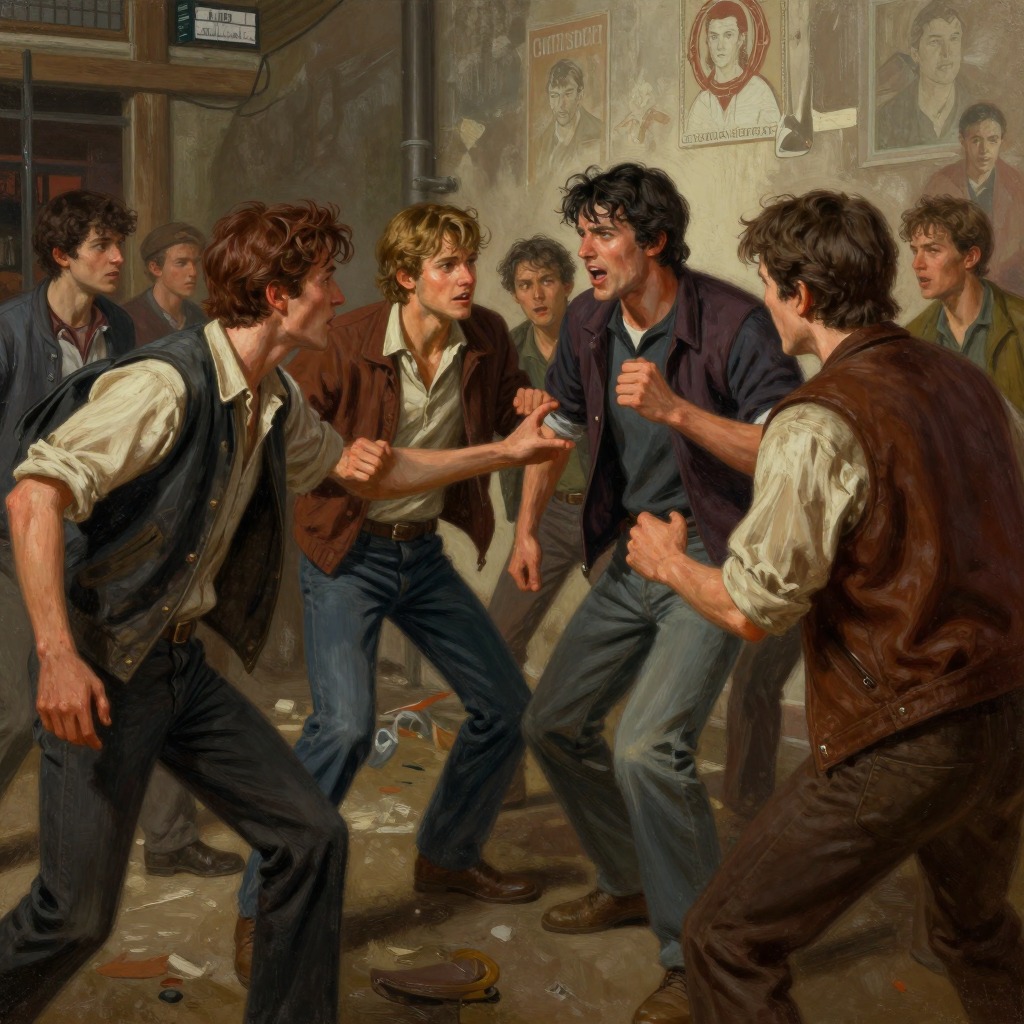
The blue Mustang plays a central role on the night Bob Sheldon is killed. After Ponyboy and Johnny have spent the evening with Cherry Valance and Marcia, the blue Mustang appears, driven by Bob and Randy Adderson. The car circles the park slowly, a predatory movement that signals the Socs' intent to confront the greasers. When the Socs get out, they are drunk and aggressive, and the confrontation escalates into the drowning of Ponyboy and the fatal stabbing of Bob by Johnny. The Mustang is thus the vehicle that brings the fatal encounter into being, its presence a direct cause of the murder that changes the lives of all involved.
Symbol of Class and Material Divide
The blue Mustang also functions as a symbol of the material gulf between the greasers and the Socs. Ponyboy notes that greasers cannot afford such cars; their pride is in their hair, not in vehicles like "Corvairs or madras shirts." The Mustang represents the wealth and privilege that the Socs take for granted, a tangible sign of the "breaks" they have that greasers do not. When Ponyboy later sees Socs arriving for the rumble in "four carloads" of similar cars, the Mustang is part of a fleet that underscores the economic disparity. Yet the car also becomes a site of cross-class connection: Cherry Valance drives a red Sting Ray, a car as "tuff" as any Mustang, and her willingness to help the greasers complicates the simple equation of car with enemy.
The Mustang as a Marker of Character
Beyond its symbolic weight, the blue Mustang is used to reveal character. Randy Adderson, Bob's friend, drives the Mustang and later seeks out Ponyboy to talk, expressing his weariness with the violence. The car that once carried the threat now carries a Soc who is "sick of all this," showing that the divide is not absolute. The Mustang, in Randy's hands, becomes a vehicle for dialogue rather than attack, though its history of violence cannot be erased. For Ponyboy, the sight of the Mustang still triggers fear, but his encounter with Randy inside it allows him to see a Soc as "just a guy."
Narrative Significance
The blue Mustang is one of the most consistently deployed objects in The Outsiders, appearing at key moments of violence, confrontation, and resolution. It is a material anchor for the class conflict, a recurring image that the reader learns to associate with danger and privilege. Its final appearance, in Randy's hands, offers a faint hope of understanding across the social divide, but the car's legacy of violence—the beating of Johnny, the murder of Bob—remains indelible. The Mustang is not just a car; it is a character in its own right, a steel-and-chrome embodiment of the forces that drive the story's tragedy.