
The Evolution of False Consciousness
The Ownership Wars: Who Owns YouThis flow traces false consciousness from religious obedience through capitalist desire to political self-deception.
increasing Bearing strength in each event
 decreasing
Bearing strength in each eventdecreasingSacred Obedience

Sacred Obedience
Authority in Heaven
The book begins with religion as an ancient technology of submission. Divine command establishes obedience as a virtue and disobedience as danger.
The believer’s inner life is organized around an invisible master.
Political Echo
This emotional structure can be reproduced by kings, owners, and leaders who claim superior authority.
Economic Obedience

Economic Obedience
The Owner Replaces the Priest
Capitalism becomes the modern system in which property owners command labor and shape social possibility. The language changes from salvation to efficiency, but dependence remains.
The worker is formally free yet materially compelled.
Naturalized Inequality
Market outcomes are presented as deserved, making hierarchy appear objective rather than political.
Consumer Desire

Consumer Desire
Wants as Commands
Advertising moves domination inward by teaching people to generate the desires that benefit owners. The consumer experiences market instruction as personal preference.
This is a more subtle form of obedience because it feels like self-expression.
The Manufactured Identity
People purchase objects to prove who they are, allowing the market to organize personality itself.
Political Self-Deception
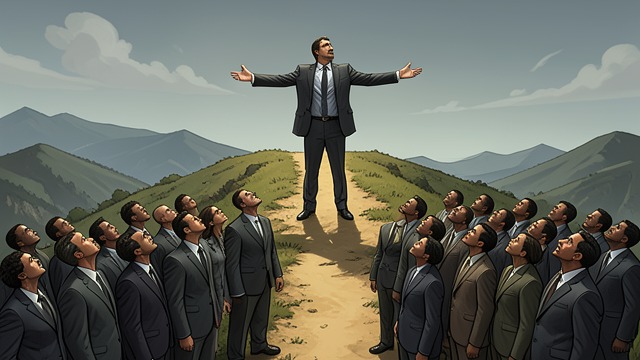
Political Self-Deception
The Owner as Liberator
The billionaire is accepted as a tribune of ordinary citizens. His wealth is reinterpreted as evidence that he can defeat the elite.
The victim adopts the owner’s perspective and defends the structure that disadvantages him.
Doublethink
The book identifies this as political doublethink: elite worship combined with anti-elite rhetoric.
Consciousness Reclaimed

Consciousness Reclaimed
Naming the Structure
False consciousness begins to weaken when people connect personal suffering to ownership, inheritance, and engineered desire. Private frustration becomes structural understanding.
The individual no longer mistakes market conditioning for freedom.
Collective Liberation
The final goal is a public consciousness capable of reorganizing society around common flourishing.
In the opening account of religion
In the transition to capitalism
In the analysis of advertising
During the Trump analysis
In the concluding call to awakening
