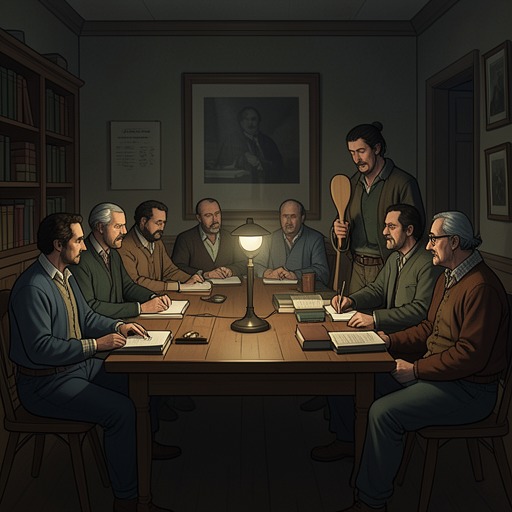
Übermensch
The Ownership Wars: Who Owns YouÜbermensch is the book’s name for a radical ideal of human transformation rather than a hereditary ruling class or a merely powerful individual. It denotes the possibility that humanity can surpass its existing forms through intelligence, creativity, discipline, and the deliberate revaluation of inherited values. Against the rule of billionaires and hereditary privilege, the concept supplies the book’s aspirational image of a humanity in which every person, not only the Ownership Class, is optimized.
Definition and Ideal
Supermen choose Meritocracy, while Last Men choose Capitalist Democracy. This opposition makes Übermensch a political and ethical choice as much as a philosophical one: the decisive question is whether society will preserve ordinary humanity under capitalist rule or attempt to cultivate higher capacities in everyone. The text rejects the idea that human life is exhausted by consumer preference, using the contrast between choosing blue or red iPhones and undergoing a transformation from “base metals” into “gold” to frame transcendence as the proper human task.
The ideal is therefore collective rather than a justification for the success of an already dominant minority. An optimized humanity is defined as one in which every human being is optimized, not one in which the top 1 percent and the Ownership Class alone are perfected. The book treats this as a zero-sum conflict under existing conditions: while the 1 percent succeeds, the rest of humanity fails, and the triumph of the many would end the Ownership Class’s rule.
New Hyperborea and HyperHumanity
The projected society of New Hyperborea gives the concept its most concrete political setting. New Hyperborea is described as free from mainstream religion, faith, prayer, meditation, racism, sexism, discrimination, monarchy, predatory economic systems, and worship of private elites and the super rich. Its admission principle is explicitly meritocratic rather than racial, sexual, national, or class-based: the finest minds may enter regardless of whether they are male or female, black, white, straight, gay, poor, or rich.
Wealthy applicants are subject to a further condition. People from rich backgrounds are acceptable only if they repudiate inheritance, privilege, cronyism, and nepotism, which the text identifies as the foundations of anti-meritocracy. The proposed community thus opposes both exclusionary identity hierarchies and inherited advantage, making intelligence the central criterion of human value as the book defines it.
Within New Hyperborea, HyperHumanity is expected to arise. HyperHumans are imagined as godlike in comparison with the apes of Old Humanity, and Old Humanity is treated as an obsolete form that cannot be allowed to hold the future back. The language is deliberately evolutionary and revolutionary: humanity must build itself anew, escape the beliefs of Old Humanity, and reject and destroy its inherited values through a comprehensive revaluation.
Nietzschean Distinction and Misuse
The book invokes Friedrich Nietzsche’s image of humanity as a passage between animal existence and the Superman. Humanity is described as a rope stretched between the animal and the Superman, with mankind remaining something to be overcome. This formulation presents Übermensch not as a biological caste but as a direction of development, a demand that human beings surpass their current limitations.
The text sharply separates this ideal from Nazi Germany’s interpretation of Nietzsche. Nazi Germany is characterized as a perversion of Nietzschean philosophy because it pursued an unsublimated Superman: a brutal, racist warrior and the imagined maker of a Teutonic war machine. By contrast, the book identifies the sublimated Superman with the genius, the artist, and the great soul. The preferred image is “Caesar with the soul of Christ,” transformed further into Caesars possessing the souls of Pythagoras, Leibniz, Goethe, or Nietzsche himself.
This distinction gives the concept an explicitly intellectual and artistic content. Strength without sublimation becomes militarism and racism; power joined to intelligence, spirit, will, art, and creativity becomes the form of excellence the book seeks. The ideal is consequently opposed to the authoritarian state that devotes every resource to war, even as the book imagines a state that could devote every resource to developing human intelligence and creative potential.
Conflict with the Ownership Class
Übermensch is defined against the plutocratic elite as much as against Old Humanity. The book insists that Donald Trump belongs to the 1 percent and the Ownership Class, despite presenting himself as an enemy of other elites. In this analysis, the supposed conflict between liberal and conservative elites conceals the single overarching power of the financial elite. The concept of higher humanity therefore cannot be reconciled with the preservation of billionaire rule or with the abolition of inheritance tax that would create a permanent hereditary caste of the super-rich.
The same opposition appears in the book’s treatment of conservative populism. Bernie Sanders is cited as explaining Donald Trump’s support through the anger of people who felt that economic and political elites had forgotten them, but the book argues that Trump’s political performance redirects that anger toward liberal, media, academic, and other non-ruling elites. The result is not an assault on the Ownership Class but its preservation through division and misrecognition.
The book accordingly contrasts the revolutionary ambition associated with Übermensch and meritocracy with the conservative “slave revolt,” which it describes as a revolt against lower-status groups rather than against masters. Trump’s supporters are said not to oppose the elite but to support and admire it, aspiring to share its hierarchy while maintaining racial and social distinctions below it. For the book, genuine meritocracy requires ending plutocratic rule altogether; it cannot emerge while inherited wealth determines social power.
Narrative and Thematic Significance
Übermensch gathers the book’s central contrasts into one emblem: transformation against stagnation, merit against inheritance, intelligence against anti-intellectualism, and universal human development against the optimization of the 1 percent. It also functions as a corrective to the book’s denunciation of Donald Trump. Trump is presented as an anti-Philosopher King and as a billionaire member of the elite, whereas the true higher human would embody intellectual and moral cultivation rather than inherited or accumulated wealth.
The concept’s force comes from its refusal to accept ordinary political choices as the limit of possibility. Capitalist Democracy represents the settled horizon of the Last Men; Meritocracy represents the wager that humanity can become something more. New Hyperborea, HyperHumanity, and the sublimated Superman are successive names for that wager, while the Ownership Class, hereditary privilege, racism, and the worship of wealth appear as the structures that must be overcome before it can be realized.