All truth passes through three stages
The Ownership Wars: Who Owns You“All truth passes through three stages” describes a recurring social pattern in which an original truth moves from mockery, through organized resistance, to eventual acceptance. The expression is used to frame intellectual history as a struggle between singular insight and institutions that protect an established paradigm.
The Three Stages
The formulation proceeds in a strict sequence. First, a new truth is ridiculed; second, it is violently opposed; third, it is accepted as self-evident. The movement is not merely chronological but rhetorical: ridicule dismisses the claim before it is seriously examined, opposition attempts to suppress it once dismissal fails, and later acceptance erases the appearance that the claim was ever genuinely difficult to recognize.
The sequence therefore presents resistance to truth as a temporary condition rather than a refutation. What begins as an object of contempt becomes a target of hostility and ends as something that appears obvious. The final stage reverses the status of the person who first advanced the idea: the once-isolated claimant is retrospectively confirmed, while the former opponents appear to have been resisting what should have been clear.
Use Against Scientific Groupthink
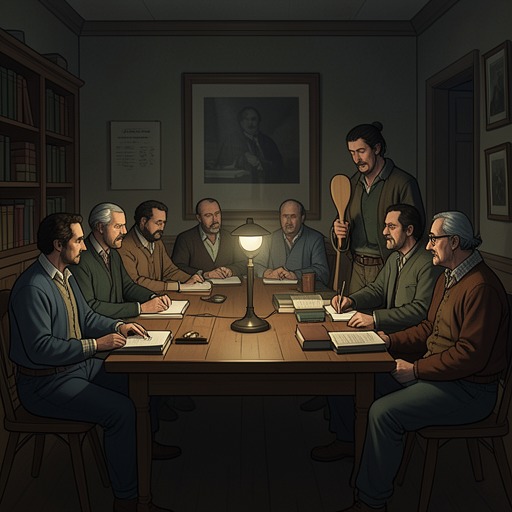
The book applies the expression directly to scientists, identifying them with the first stage because they ridicule truth when it is announced by a singular genius. Their mockery is described as extending beyond an idea itself to the genius's appearance, hair, eyes, mannerisms, way of speaking, profession, and every other visible or social irregularity. The response attributed to this community demands evidence and conformity with the prevailing scientific paradigm rather than openness to the unfamiliar claim.
This criticism makes ridicule a form of gatekeeping. The central issue is not simply whether a proposition can be tested, but whether its speaker complies with the community's rules, uniform, and paradigm. The expression thus exposes the personal attack as a displacement: instead of engaging a claim, the established group discredits the claimant's body, style, and social presentation.
The Genius and the Paradigm
The surrounding argument insists that the final answer to everything will not be formulated by a collection of groupthink scientists but by a single, extreme genius. Such a figure is expected to speak from outside the prevailing paradigm, which the scientific community is said to have been conditioned to worship. The genius's isolation is consequently treated as evidence of the paradigm's limits rather than as proof of the genius's error.
The book reinforces this position through a reference to Albert Einstein and the claim that even he became an object of derision in scientific circles because he opposed the empiricist idea that reality is grounded in ontological unreason and probability. The associated assertion, “God does not play dice,” links the expression to a larger commitment to intelligibility: God is identified with the Principle of Sufficient Reason, and everything is said to possess an exact explanation. Within this framework, opposition to a genius is not only sociological resistance but resistance to a rationally ordered reality.
Rhetorical Function and Significance
The expression is introduced through Arthur Schopenhauer's telling formulation, giving the argument the shape of a recognized historical law rather than a one-time complaint. Its compact triadic structure supplies the book with a ready-made drama: ridicule is the opening attack, violent opposition is the escalation, and self-evidence is the promised vindication. The progression also lends certainty to the speaker's forecast, since rejection can be reinterpreted as confirmation that the idea has entered the first stage.
The formula is finally extended beyond science. When the genius who explains everything arrives, the book predicts two opposing forms of resistance: worshipers of religion and worshipers of scientism. Each group is expected to hate, denounce, and oppose the figure. “All truth passes through three stages” therefore functions as both a theory of intellectual change and a shield against criticism, placing religious and scientific authority on opposite sides of the same structural conflict with unorthodox truth.