American right wing
The Ownership Wars: Who Owns YouThe American right wing is depicted as less an independent rebellion against power than a political formation that protects and desires domination by the Ownership Class. In the book's account, its defining contradiction is that it condemns government while venerating billionaires, resists collective power while accepting private hierarchy, and speaks of freedom while seeking leaders who will rule, punish, and rank society on its behalf.
Definition and Social Position
The book places the American right wing within a society ruled by the 1 percent, or Ownership Class. Its central accusation is that right wingers loathe ordinary people while worshipping elites, especially the plutocratic class whose wealth and power they help preserve. Rather than seeing the rich as opponents, they are said to regard them as allies and to defend arrangements that serve elite interests as though those arrangements served their own.
This relationship is explained through the master–slave dialectic associated with Georg Wilhelm Friedrich Hegel. The master is imagined as willing to risk life itself in the struggle for power, whereas the slave values survival more than domination and submits in order to preserve life. The book applies this model to the American right wing by arguing that the 99 percent accept subordination because they lack the will, ambition, or force to challenge the 1 percent. It further describes the elite as people who relish struggle and domination, while portraying their followers as people who want to be led, controlled, and given a place within an existing hierarchy.
Ideology and Political Allegiance
The American right wing is characterized as an agent of false consciousness. Capitalism, in this interpretation, survives by persuading the majority that elite interests are their own interests and that obedience is a form of self-advancement. The right wing therefore becomes not merely a constituency deceived by the Ownership Class but an active mechanism through which that class exercises power.
The book presents support for Donald Trump as the clearest example. Anyone who supports Donald Trump is described as a collaborator who strengthens the 1 percent, even when the supporter believes that the vote is directed against Washington, D.C., or Wall Street. The Trump insurgency is consequently interpreted as a return of far-right conservative rule based on racism, white supremacy, and ultra-plutocracy, and as a real-world version of Ayn Rand's Atlas Shrugged rather than a revolution against wealth.
The text also places the American right wing within a specifically American historical and religious tradition. It argues that the United States has never possessed a genuine left wing, because the country was founded by Protestant extremists and has retained their influence. In this account, America combines a negative-liberty state in economics and politics with a positive-liberty commitment to Christianity: the state refrains from challenging capitalism and religion while allowing Christian beliefs to shape families, education, and culture. Donald Trump is presented as an archetypal capitalist white Anglo-Saxon Protestant within that structure.
Hierarchy, Resentment, and Exclusion
The book treats resentment as a principal emotional force behind the right wing's political energy. Its supporters are said to resent cultural elites in government, universities, and coastal regions, but their resentment is redirected downward rather than upward. Because Donald Trump is himself portrayed as a billionaire plutocrat and senior member of the 1 percent, the book argues that his supporters' anger cannot be understood as hostility to the elite. It is instead directed at groups placed below them in a racial and social hierarchy.
This account emphasizes the desire to restore white supremacy and the social order associated with the Confederacy. The right wing is said to tolerate rule by a wealthy elite as long as that elite ensures that white conservatives remain above Black and Hispanic people. Donald Trump’s rhetoric about restricting supposedly undesirable immigrants, building a wall against Mexicans described as rapists, supporting the police, and making America great again is interpreted as a series of signals to voters who want non-white people, women, and gay people returned to subordinate positions. The right wing thus seeks not equality or liberation but recognition from its own masters and superiority over other subordinated groups.
The book connects this hierarchy to religious obedience as well. Many members of the 99 percent are described as Abrahamists who worship a dominant God who threatens eternal hell and demands absolute obedience. The willingness attributed to Abraham to murder his son at God's command becomes, in the book's polemic, an emblem of submission to an intimidating authority. The same pattern is then applied to Trump supporters, who are said to want the approval of a master who will choose them and place them above other slaves.
State, Capital, and the Confederate Analogy
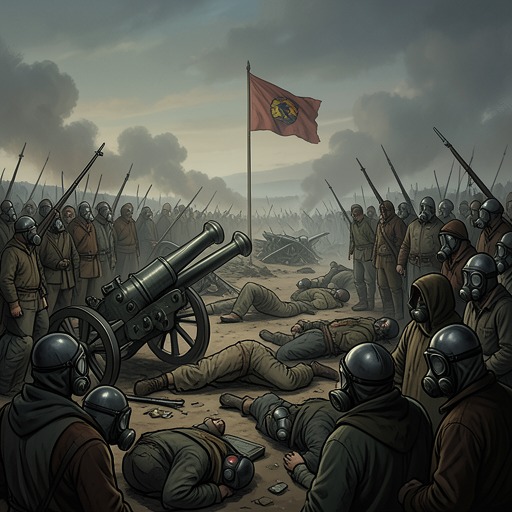
The American right wing is repeatedly identified with the Confederate tradition. The book argues that right wingers despise government because they want capitalists and families to remain free from state limits, including limits on exploitation. It treats the Civil War as fundamentally a conflict over the nature of capitalism and maintains that the Confederacy regarded slavery as an acceptable profit-maximizing institution. Contemporary conservatives and libertarians are presented as inheritors of that logic because they allegedly accept the reduction of human beings to property whenever private profit is at stake.
This analogy culminates in the claim that all right wingers are “Satanic Confederates” prepared to use arms and wage war against the government to prevent taxation or other interference with their money. The language is deliberately totalizing: it collapses different right-wing positions into a single opposition to morality, communitarianism, civil rights, and state authority. The book also calls the employee a capitalist euphemism for a slave, casting the employer as master, owner, and slaver.
The proposed answer is an expansion of positive state power. Abraham Lincoln is invoked as the figure who used the state to destroy the Confederacy as a physical entity, while a new Lincoln is demanded to destroy the Confederacy as a mental and ideological entity. Ending the right wing therefore means ending unrestrained predatory capitalism, not merely defeating a particular candidate or party. The American right wing is treated as a continuing cultural and economic system whose survival depends on weakening the state whenever the state might act on behalf of the General Will, the Commonwealth, or the Common Good.
Culture War and Narrative Significance
The book defines the culture war as a struggle between Confederate culture, associated with the right wing and negative liberty, and Union culture, associated with the left wing and positive liberty. The Union won the physical American Civil War, but the book insists that it has not yet won the mental Civil War. The modern Republican Party is described as the New Confederacy, and its continued existence as an unresolved national conflict.
The film They Live provides the book with a visual allegory for this conflict. John Carpenter's film is described as portraying a hidden elite that engineers economic collapse, ruins the working class, and brings it close to enslavement while broadcasting subliminal messages that create false consciousness. The book rejects right-wing conspiracy theories that identify the aliens with Jews or the Illuminati and instead emphasizes Carpenter's stated interpretation of them as yuppie followers of Ronald Reagan and embodiments of unrestrained capitalism.
Within this reading, the film's secret aliens become an image of Republicans: apparently ordinary people who are actually predatory enemies concealed within society. Its special sunglasses represent ideological critique because they reveal the message beneath propaganda, consumer spectacle, and apparent freedom. Yet the book finally argues that no special glasses are necessary. Reason alone should expose the right wing as the camouflaged enemy and reveal how negative liberty is used to sabotage positive liberty and preserve private elite power. The American right wing therefore serves as both political organization and interpretive symbol: it names the social force that, in the book's polemical architecture, converts popular resentment into obedience, racial exclusion, and the continued rule of the Ownership Class.