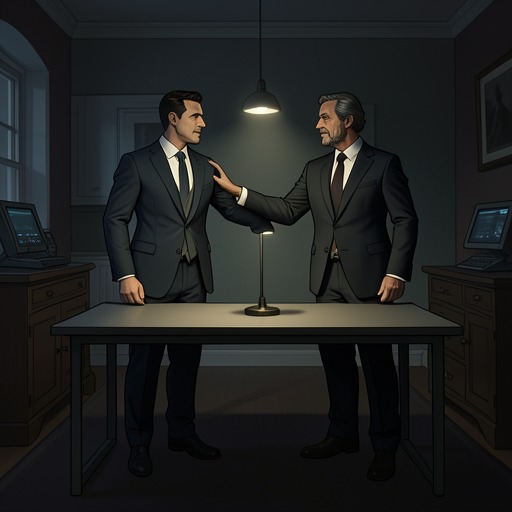
Donald Trump–Roy Cohn relationship
The Ownership Wars: Who Owns YouThe Donald Trump–Roy Cohn relationship is depicted as one of the decisive formative relationships in Donald Trump’s career. When Trump moved from the outer boroughs to Manhattan in the late 1970s, he found in Roy Cohn a mentor whose legal aggression, tabloid intelligence, and code of absolute loyalty helped shape the public style later associated with Trump. In the book’s interpretation, Cohn did not merely advise Trump; he helped produce the combative image of the Ownership Class showman who treats reputation, conflict, and media attention as instruments of power.
Formation in Manhattan
Trump came to Manhattan from the outer boroughs in the late 1970s and became associated with Cohn, who had been Senator Joseph McCarthy’s chief counsel during the McCarthy witch hunts and was also a go-to attorney for the Mafia. The connection is presented as a meeting of compatible interests rather than an accidental professional acquaintance. Trump, described as a leading member of the Ownership Class and as part of an elite likened to the ultimate mafia, turned to precisely the kind of intermediary who could operate through intimidation, connections, publicity, and legal pressure.
Cohn’s importance lay in the model of power he embodied. He was described as the most feared lawyer in New York City for a time, a ruthless practitioner of character assassination, gossip, innuendo, and legal intimidation. His clients were portrayed as people seeking extreme results, including killing a husband, torturing a business partner, or breaking the government’s legs. The image is not of a neutral counselor applying law dispassionately, but of a legal executioner whose value consisted in his willingness to use every available weapon for a client who paid for loyalty.
The lessons Cohn taught Trump
Cohn’s central instruction was that winning mattered more than principle. Alan Dershowitz’s account of the relationship emphasizes Cohn’s insistence on never apologizing, never backing down, never admitting error, and using every possible means to achieve an end. Cohn also advised Trump to sue aggressively, fight for everything, and never concede an inch. These instructions converted dispute into a permanent posture: retreat became weakness, admission became surrender, and factual correction became irrelevant if the fight could still be prolonged.
The relationship therefore joined personal loyalty to moral indifference. Dershowitz is cited as saying that for Cohn, loyalty was more important than principles or politics, and that this explained the closeness between the two men. Cohn’s loyalty was not presented as tenderness or mutual vulnerability. It was a transactional form of allegiance in which the mentor would brutalize opponents for the client and expect the client to remain inside the same code. Trump’s association with him is consequently interpreted as an education in power stripped of remorse.
Cohn’s own description of his method makes the lesson especially stark. He told Trump to “sue the bastards if you have deeper pockets … legally fight for everything … never concede an inch.” The advice makes financial resources part of the weapon itself: deeper pockets allow a conflict to continue until the opponent is exhausted. Legal action becomes not simply a means of resolving a dispute but a mechanism for domination, delay, and reputational destruction.
Media, language, and performance
Cohn also taught Trump how to understand the news cycle, especially the tabloid media. Roger Stone said that Trump learned tabloid media and media-cycle tactics from Cohn, and identified a series of expressions as Cohn’s verbal inheritances: “100 percent,” “Forget about it,” “A lot of people say,” “Believe me,” and “I tell you this.” Stone further observed that the two men’s speech patterns were similar. In this account, the connection between them survives not only in remembered advice but in recurring verbal habits that turn assertion into performance.
That media education fits the book’s broader portrayal of Trump as a showman. Trump is described as playing the part of President in the manner of an actor, and as having earlier sold an image of a flamboyant playboy lifestyle. His own formulation, “The show is Trump, and it’s sold-out performances everywhere,” makes self-presentation inseparable from identity. Cohn’s influence supplies the machinery behind that spectacle: attention is captured through provocation, opponents are kept under attack, and repetition creates the impression of authority even when no admission of error is possible.
The relationship thus connects legal aggression with theatrical publicity. Cohn understood that scandal, attack, and gossip could dominate the news cycle; Trump learned to inhabit that cycle as his natural arena. The public figure who emerges is simultaneously client, performer, and combatant, using the language of certainty and the threat of escalation to keep every dispute centered on himself.
Political and ideological significance
The book places the relationship inside a larger critique of plutocratic power. Trump is described as a billionaire member of the Ownership Class who nevertheless attracted supporters claiming that he stood outside the elite. Against that contradiction, Cohn becomes evidence of continuity: Trump’s rise is linked to established networks of wealth, coercive expertise, and elite influence rather than to a rebellion against the people who rule.
This interpretation also connects Trump’s politics to the book’s comparison between the Trump insurgency and a revived Confederacy, as well as to its description of right-wing rule as ultra-plutocratic. The relationship with Cohn matters because it makes the political persona intelligible as a product of methods already visible in New York: attack the opponent, refuse remorse, exploit unequal resources, and convert fear into loyalty. The later political spectacle is therefore not treated as a departure from Trump’s earlier world but as its enlargement.
The same pattern appears in the book’s account of predatory capitalism. Employers are called masters and employees slaves, while the Ownership Class is portrayed as using wealth and power to command those beneath it. Cohn’s counsel to use deeper pockets and perpetual legal combat becomes a miniature of that hierarchy. The person with greater resources can impose the terms of conflict, while the weaker party is forced to spend, defend, and endure. Cohn’s methods consequently function in the narrative as both personal instruction and social allegory.
Legacy and the monster image
Cohn died of AIDS, but the book presents his influence as continuing through Trump’s conduct and public style. It describes Trump as the monster created by Cohn, a formulation that turns mentorship into a genealogy of political behavior. The claim is not that Cohn’s presence alone explains every aspect of Trump, but that Cohn supplied a recognizable operating code: aggression as defense, loyalty as the substitute for principle, publicity as control, and refusal to concede as a permanent condition of power.
The relationship’s final significance lies in this transformation of private mentorship into public method. Cohn’s career in fearmongering, character assassination, and legal warfare becomes part of the explanation for Trump’s capacity to turn conflict into spectacle and spectacle into authority. The book closes this portrait with a moral demand not to excuse flamboyance or forget the violence concealed by performance. In that frame, the Donald Trump–Roy Cohn relationship is not an anecdote from a young developer’s past; it is the origin story of a style of power that later appeared on a national stage.